wayground logo

Free Printable Worksheets

NEW

Font size

S
M
L
XL
Worksheets

1.Quiz- Mixtures and Solutions

Total questions: 53

Worksheet time: 57mins

Name
Class
Date
1.

Amy combined marshmallows, peanuts, raisins, and cereal.

Why would Amy’s snack be considered a mixture?

a)

She used only nuts and cereal in the snack.

b)

Each item in the snack kept its physical properties.

c)

The look of each item changed when combined with the others.

d)

The taste of each item changed when combined with the others.

2.
In the above picture, a powder is about to be poured into the liquid. Which of the following should be done to make this powder dissolve faster?

a)
stir the powder in the liquid
b)
freeze the mixture
c)
add more powder to the liquid
d)
store the mixture in a dark place
3.
What is a substance that is dissolved in another substance? 
a)
solution
b)
solute
c)
solvent
d)
compound
4.
air is a 
a)
compound
b)
element
c)
heterogeneous mixture
d)
solution
5.
Another name for a homogeneous mixture is 
a)
an element.
b)
a solution.
c)
a compound.
6.

Which of the following actions will NOT

increase the rate of dissolution

(dissolving)?

a)

Stirring the solution

b)

Decreasing the temperature

c)

Increasing the surface area of the

solute

d)

Increasing the temperature

7.
How many grams of K2Cr2O7, are soluble in 100 g of water at 95 ºC?
a)
83 grams
b)
75 grams
c)
40 grams
d)
12 grams
8.

1. Which of these BEST describes the change in salt grains as they dissolve in water?

a)

The grains change their chemicals until they become water.

b)

The grains get higher in temperature until they melt into a liquid.

c)

The grains are washed clean until they are perfectly clear.

d)

The grains break apart until they can no longer be seen.

9.
How does a solution become supersaturated?
a)
dissolve lots of solvent in it.
b)
dissolve a little solute in it. 
c)
dissolve more solute than you should be able to. 
d)
dissolve a super amount of solvent in it. 
10.
When 20 grams of potassium chlorate, KClO3, is dissolved in 100 grams of water at 80 ºC, the solution can be correctly described as:
a)
supersaturated
b)
saturated
c)
unsaturated
11.
When 50 grams of KCl is dissolved in 100 grams of water at 50 ºC, the solution can be correctly described as:
a)
supersaturated
b)
unsaturated
c)
saturated
12.

You are given a small beaker of solution at room temp. You add a bit of solute to the solution and it dissolves. The solution was:

a)

saturated

b)

unsaturated

c)

concentrated

d)

warm

13.

How do you know when you have a saturated solution?

a)

You don't see anymore material in the solution. It has dissolved.

b)

The material dissolves and no more will dissolve because you see it collect at the bottom.

c)

The solution is bubbling and cloudy.

d)

The solution is clear and there is nothing at the bottom.

14.

The substance being dissolved is called the ________

a)

solvent

b)

solid

c)

solute

d)

solvate

15.

What does "like dissolves like" mean?

a)

polar solvents dissolve in polar solutes

b)

polar solutes dissolve in polar solvents

c)

non-polar solvents dissolve in polar solutes

d)

non-polar solutes dissolve in polar solvents

16.

When no more solute dissolves the solution is _________

a)

supersaturated

b)

unsaturated

c)

saturated

d)

supercalifragilisticexpialidocious

17.

Gases are more soluble at ______temps and _____pressures

a)

high, low

b)

low , high

c)

high, high

d)

low, low

18.
Which substance is SOLUBLE in water?
a)
sand
b)
oil
c)
salt (sodium chloride)
d)
sulfur
19.
What is it about the water molecule that makes it a great solvent?
a)
water demonstrates polarity; a partial charge on each side of the molecule
b)
due to its molecular formula
c)
it has a liner molecular shape
d)
due to it's non-polar molecular structure
20.
Solutions are composed of __________ .
a)
salts and solutes
b)
solvents and salts
c)
solutes and alloys
d)
solutes and solvents
21.
In a sample of salt water, NaCl would be considered the ______.
a)
Solution
b)
Solute
c)
Solvent
d)
Solvation
22.

If I want more sugar to dissolve in water, I should heat the water

a)

true

b)

false

23.

If I want more sugar to dissolve in water, I should stir the water

a)

true

b)

false

24.
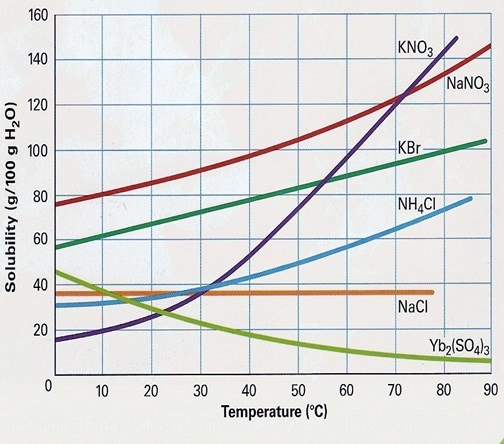
Students are asked to make statements about the solubility graph above. Which student does
the best job of communicating the general features of the graph?
a)
Most salts require 100 grams of water in order to dissolve completely.
b)
Table salt has the average solubility of all salts.
c)
The solubility of most salts increases with increasing temperature.
d)
Most curves show a decreasing slope as the temperature rises.
25.
90 grams of sodium nitrate (NaNO3) are put into 100 grams of water and stirred. The final
mixture has a temperature of 20°C. About how many grams of the sodium nitrate dissolved?
a)
23
b)
73
c)
80
d)
88
26.
Solvent is best defined as-
a)
a mixture in which the substances are spread out evenly between one another and cannot be told apart
b)
the ability of a substance to dissolve in another substance
c)
a substance that dissolves in another substance
d)
a substance into which another substance dissolves
27.
Which answer best defines solute?
a)
a substance into which another substance dissolves
b)
a substance that dissolves in another substance
c)
to form a solution with another substance
d)
the ability of a substance to dissolve in another substance
28.
What is unsaturated?
a)
A solution with more solute than solvent
b)
A solution with less than the maximum amount of solutes 
c)
A solution with the  perfect balance of solutes and solvents
d)
A solution with solids at the bottom
29.
Solubility refers to the ____ of solute that can dissolve in a certain volume or mass of solvent, at a certain temperature.
a)
Volume
b)
Proportion
c)
Mass
d)
Particles
30.
How does a solution become supersaturated?
a)
dissolve lots of solute in it.
b)
dissolve a little solute in it. 
c)
dissolve more solute than you should be able to. 
d)
dissolve a super amount of solvent in it. 
31.
When two liquids mix, they are said to be....
a)
insoluble
b)
miscible
c)
soluble
d)
immiscible
32.

Which solution is more concentrated?

Solution 1:

500 mL of water

100 g of salt


Solution 2:

500 mL of water

90 g of salt

a)

Solution 1

b)

Solution 2

c)

They have the same concentration

d)

I have no idea

33.

Concentration is

a)

the amount of solute in the solvent

b)

the amount of solvent in the solute

c)

density

d)

particle size

34.
When a solution is very concentrated, it has a high amount of _________ to _________.
a)
solute to solvent
b)
solvent to solute
c)
solvent to solution
d)
solution to solute
35.
What will allow more solute to be dissolved in a solvent.
a)
adding more solute
b)
stiring
c)
cooling solution
d)
heat
36.

Identify how many grams of KNO3 is required to make a saturated solution at 40'C.

a)

50 g

b)

45 g

c)

55 g

d)

33 g

37.
A solution of potassium chlorate, KClO3, has 20 grams of the salt dissolved in 100 grams of water at 70 ºC. Approximately how many more grams of the salt can be added to the solution before reaching the saturation point?
a)
10 grams
b)
30 grams
c)
80 grams
d)
60 grams 
38.
You can make a solution more concentrated by adding __________.
a)
solute
b)
solvent
c)
water
39.
Solution where more solute can still be dissolved at the given temperature. 
a)
Saturated
b)
Unsaturated
c)
Supersaturated
d)
Homogeneous solution
40.
If I dissolve carbon dioxide in water, what is my solvent?
a)
Carbon Dioxide
b)
There is no solvent
c)
Oxygen
d)
Water
41.
Separating mixtures based on boiling points.
a)
Desalination
b)
Distillation
c)
Decantation
d)
Condensation
42.
Distillation uses two changes of state. what are they?
a)
Evaporation and condensation
b)
Evaporation and freezing
c)
melting and boiling
d)
sublimation and condensation
43.

This diagram represents...

a)

An element

b)

A molecule

c)

A compound

d)

A mixture of elements and compounds

44.
a)
element
b)
compound
c)
mixture of elements
d)
mixture of compounds and elements
45.

Fractional distillation separates crude oil based on the different __________ of the molecules in the mixture

a)

melting point

b)

boiling point

c)

freezing point

d)

chemical reactivity

46.

Which tools are best for separating a mixtures of sand, iron filings, and water?

a)

Hot plate and filter

b)

Tweezers and filter

c)

Filter and magnet

d)

Magnet and hot plate

47.
What does it mean to dilute a solution?
a)
lower the concentration of solute per solvent
b)
increase the concentration of solute per solvent
48.
When a solvent contains as much of the solute as it can hold, the solution is said to be
a)
supersaturated
b)
diluted
c)
saturated
d)
unsaturated
49.
The amount of solute actually dissolved in a given amount of solvent.
a)
dilution
b)
concentration
c)
saturated solution
d)
supersaturated mixture
50.
__________ are made up of solutes and solvents.
a)
Solutions
b)
Suspensions
c)
Heterogeneous Mixtures
d)
Pure Substances
51.

The maximum amount of solute this beaker can hold is 3.0g, is this beaker unsaturated, saturated, or supersaturated?

a)

unsaturated

b)

saturated

c)

supersaturated

52.

When a small amount of additional solute is added to an unsaturated solution, what happens to the number of dissolved particles? Do they go up, down, or stay the same?

a)

goes up

b)

goes down

c)

stays the same

53.

When a small amount of additional solute is added to a saturated solution, what happens to the number of dissolved particles? Do they go up, down, or stay the same?

a)

goes up

b)

goes down

c)

stays the same