wayground logo

Free Printable Worksheets

Font size

S
M
L
XL
Worksheets

Physical Science Fall Final Review

Total questions: 25

Worksheet time: 39mins

Name
Class
Date
1.
True or false:  At the peak of the lift hill, a rollercoaster car has more potential energy than any other form of energy.
a)
True
b)
False
2.
According to Newton’s first law of motion, a moving object that is not acted on by an unbalanced force will
a)
remain in motion.
b)
eventually come to a stop.
c)
change its momentum.
d)
accelerate.
3.
The gravitational force of any object near Earth's surface is ____.
a)
unknown
b)
friction
c)
Newton's first law
d)
9.8 m/s2
4.
When the net force is zero, the forces on an object are balanced. True or false.
a)
true
b)
false
5.
For every action there is an equal and opposite reaction.
a)
Newton's 1st Law
b)
Newton's 2nd Law
c)
Newton's 3rd Law
d)
None of them
6.
Two students are in a baseball game. The first student hits a ball very hard and it has a greater acceleration than the second student who bunts the ball lightly.
a)
Newton's 1st Law
b)
Newton's 2nd Law
c)
Newton's 3rd Law
d)
None of them
7.
A ball rolling down the hill is an example of ___ energy.
a)
kinetic
b)
potential
8.
The fastest trains are magnetically levitated above the rails to avoid friction (and are therefore called
MagLev trains...cool, huh?). The fastest trains travel about 250 km in a half an hour. What is their
average speed in km/hour?
a)
250 km/hr
b)
500 km/hr
c)
125 km/hr
9.
An object is NOT accelerating if it is moving
a)
in a circle
b)
at constant velocity 
c)
at increasing speed
d)
only as influenced by gravity
10.
Energy that is stored in bonds between atoms is:
a)
Mechanical energy
b)
Chemical energy
c)
Kinetic energy
d)
Nuclear energy
11.

________________ is the rate at which work is done.

a)

Power

b)

Work

c)

Time

d)

Energy

12.

Which requires more power – a person walking up stairs or a person running up stairs?

a)

walking

b)

running

c)

they require equal power output

d)

no power is required at all

13.

A squirrel has a weight of 4.9 N. What is his Mass if he is running on the Ground?

a)

4.9 kg

b)

9.8 N/kg

c)

0.5 kg

d)

5.0 kg

14.

Which of the following are examples of Types of Friction?

a)

Static

b)

Balanced

c)

Sliding

d)

Unbalanced

e)

Rolling

15.

______ is the attractive force between any two objects that depends on the objects mass and distance to each other.

a)

Weight

b)

Gravity

c)

Net Force

d)

Rolling Friction

16.

What is never allowed in the lab?

a)

Eye safety

b)

Chemicals

c)

Food or Drink

d)

Music

17.
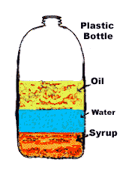
Which liquid is the least dense?
a)
oil
b)
water
c)
syrup 
d)
plastic bottle
18.
What is the formula for density?
a)
density = mass x volume
b)
density = mass / volume
c)
density = mass + volume
d)
density = mass - volume
19.
Jack has a rock. The rock has a mass of 14g and a volume of 2cm3. What is the density of the rock?
a)
7 mL
b)
7 g/cm3
c)
28 g/cm3
d)
1/7 g/cm3
20.
15.6 L = ___________ mL
a)
15,600
b)
156,000
c)
1,560,000
d)
15,600,000
21.
7,000 g = ____ kg
(1 kg = 1000 g
a)
70
b)
7000
c)
7
d)
0.07
22.
energy of position
a)
potential energy
b)
kinetic energy
23.
A ball rolling down the hill is an example of ___ energy.
a)
kinetic
b)
potential
24.
How much work is produced when 350 N is used to move a car 5 m (W=Fd)?
a)
70 J
b)
1750 J
c)
355 J
d)
175 J
25.

The Ratio of the output force to the input force is the _____ of a machine.

a)

Power

b)

Elastic Potential

c)

Mechanical Advantage

d)

Gravitational Potential