
 Worksheets
Economics test
Total questions: 137
Worksheet time: 2hrs 17mins
When producers offer more of a good as its price increases and less as its price falls, this defines the
law of demand
law of supply
change in demand
change in supply
The willingness and ability of a producer to make a product is referred to as
quantity supplied
quantity demanded
supply
demand
Movement along a supply curve demonstrates
a change in quantity supplied
a change in quantity demanded
a change in supply
a change in demand
A shift in a supply curve demonstrates
a change in quantity supplied
a change in quantity demanded
a change in supply
a change in demand
Which of these demonstrates an example of a supply curve? (More than one answer)


Which of the following supply curves demonstrates a decrease in the quantity supplied?
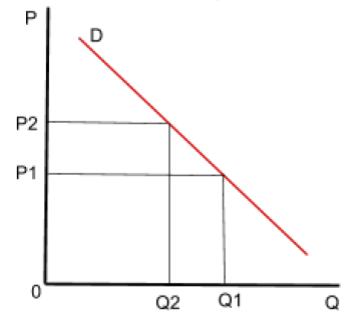


A decrease in supply is demonstrated by which of the following?


A hurricane wipes out an orange crop in Florida, sharply affecting the supply of oranges. Which chart demonstrates this concept?


The prices for houses steadily increase, causing more people to want to sell their homes. Which of these demonstrates this concept?


A popular musical act announces a concert at a 10,000 seat venue. Prices for tickets skyrocket so the venue announces that there will be 500 standing room only tickets offered. What concept does this demonstrate?
elastic supply
inelastic supply
change in supply
change in quantity supplied
shortage

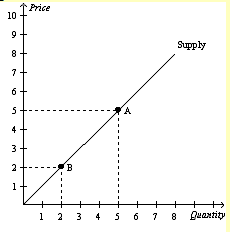


Price of Autos increase
increase in supply
increase in quantity supplied
decrease in supply
decrease in quantity supplied
the main factor that causes a change in supply
price
style
taxes
regulations
besides price, supply can shift due to factors that are known as --
price of resources
determinants of supply
demand
competition
When the gov't pays money to businesses, usually to encourage them to produce a certain product..
taxes
regulations
competition
subsidies
Businesses pay the gov't, which helps pay for gov't services- but can lead to higher prices for their products
subsidies
cost of production
regulations
taxes
The gov't sets rules on how businesses must be run, which can also affect the cost of production.
taxes
regulations
competition
subsidies
If determinants of supply lead to an increased level of production, the supply curve will shift
downward
to the right
to the left
directly upward
The cost of production includes the price of resources. If resources become more expensive, what will happen to supply levels?
increase
decrease
remain the same
come to a complete stop
Which government tool can cause changes in supply levels and force the supply curve to shift?
taxes
subsidies
regulations
all of these
If a slight price increase leads to an increase of production, then that supply is considered __
inelastic
elastic
The motivation for ALL companies to be successful..
save the world
feed the children
social justice
profit
Once a business has paid all of its costs, the money left over is ___
revenue
profit
supply
tax
When prices rise, supply levels will also increase. If prices drop, supply will also fall.
law of supply
law of demand
determinant of supply
cost of production
Which of these would be figured in to the cost of production? (choose all that apply)
wages
natural resources
utilities
insurance
Which of these is considered a non-price determinant?
changes in income
equilibrium
changes in demographics
price of related goods
Which of these is NOT a non-price determinant?
changes in population size
advertising
surplus
consumer taste
If I expect the price of a bicycle to drop next week, I wait until next week to buy it. This is an example of...
law of supply
surplus
income
consumer expectations
Law of supply states that producers will offer ______________ of a product as its price increases.
none
some
more
less
Law of supply states that producers will offer ______________ of a product as its price decreases.
less
more
none
some
If I make Jordans for $50 and sell them for $100. I will make $50. This is an example of...
quantity supplied
demand
supply
profit
A rise in price of a good will most likely cause producers to...
increase production
start manufacturing a different good
decrease production
shut down
When quantity supplied and quantity demanded are stable, this results in...
a party
equilibrium
economic decline
recession
Salazar's Sweets sells popsicles; because it is so hot (in October!), more people buy these popscicles. Salazar's now sells their sweets at a higher price.
This is supply and demand.
This is the law of demand.
This is the law of supply.
This is crazy.
According to the law of supply, if the price of a good increases, the producer will...
make more of a good
do nothing
make a demand schedule
make less of a good
Examples of a producer would be...
farmers
Amazon
dogs
Wal-Mart
An example of consumers would be
your friend
you
Target
Blackman High School
Price elasticity of supply is the responsiveness of
demand to a change in price.
price to a change in supply.
quantity supplied to a change in price.
price to a change in supply.
If the supply curve of a product is vertical, PES is equal to
0.
1.
-1.
infinity.
The supply of agricultural goods is
relatively inelastic while the supply of manufactured goods is relatively elastic.
relatively elastic while the supply of manufactured goods is relatively inelastic.
If storage of a good is cheap and readily available, supply is likely to be
relatively elastic.
relatively inelastic.
perfectly inelastic.
perfectly elastic.
The mining boom in created a shortage of labour in the hospitality industry in WA. This made the supply of restaurant meals in WA
perfectly inelastic.
more elastic.
perfectly elastic.
less elastic.
Factory owner Susan has calculated that her PES is 3. This number means that,
if price were to rise by 2% Susan would supply 6% more products.
If price were to rise by 2% Susan would supply 3% more products.
the percentage change in price is three times the percentage change in quantity.
in the PES formula, the top number is smaller than the bottom number.
The PES for wheat in a given country
is less elastic the longer the time period in question.
is more elastic the more substitutes there are for wheat.
is greater the more wheat there is in storage.
will be higher if there are restrictions on wheat imports.
If the price of a product doubled and in response the quantity supplied also doubled then the PES is equal to
1
-1
2
o
If the firm have more spare capacity, then it will be possible for the firm to increase supply. This means supply is
Elastic
Inelastic
Unitary elasticity
During recession price elasticity of supply will be
Elastic
Inelastic
Unitary elasticity
During recession there more spare capacity, meaning there will be more resources unused due to less demand from the consumers
True
False
None of the above
When the price is more and the firms are able to produce more to take the benefit of this increase in price, then supply is said to be....
Elastic
Inelastic
Unitary elasticity
None of the above
Firms producing perishable items with less warehousing facility will be able to respond to increase in price and and they can supply more to meet the increase in demand. Is the statement true or false
False
True
In agriculture farming, it takes time to increase the supply of fruits and vegetables as the harvesting needs time. Hence supply will be less responsive to increase in price,nad supply will be ...
Inelastic
Elastic
Unitary Elasticity
None of the above
If there are more firms producing more luxury items then supply of luxury items will increase. In such case, if there is any increase in price, the firms can supply more to make use of this rise in price.Supply will be....
Elastic
Inelastic
Unitary Elasticity
None of the above
If there are more firms producing more luxury items then supply of luxury items will increase. In such case, if there is any increase in price, the firms can supply more to make use of this rise in price.
True
False
Products like pencils, books, and other school stationaries are easy to store in a warehouse. If a firm producing such goods and has a good warehousing facilities and can supply more when prices are rising, then supply will be
Inelastic
Unitary elasticity
Elastic
None of the above
Supply is more price elastic if more time is available as the firms can adjust the supply and increase the supply when price are increasing.
True
False
A product is likely to have a price elasticity of demand that exceeds 1 when:
Its price falls
It is a necessity
It has close substitutes
Consumers are not very responsive to changes in price

If the income elasticity of demand for good X is negative and the cross-price elasticity of demand between good X and good Y is negative, which of the following must be true of good X?
X is an inferior good and is a complement to Y.
X is an inferior good and is a substitute for Y.
X is a normal good and is a complement to Y.
X is a normal good and is a substitute for Y.
Assume the income elasticity of demand for good Z equals −5.0. Which of the following is true?
An increase in income will lead to a decrease in demand.
Good Z is a normal good.
An increase in income will lead to an increase in demand.
Good Z must have an inelastic demand.

A
B
C
D
E

A
B
C
D
E

A
B
C
D
E

A
B
C
D
E

A
B
C
D
E

A
B
C
D
E

A
B
C
D
E

On the basis of the data table above, what is the marginal cost of the third unit of output.
40
50
60
90
130
_____________ is a function of inputs.
Raw Materials
Output
Production Function
Labour
When the amount of a factor increases the total output
Decreases
is maximum
Increases
becomes zero
________ an addition to the total production by the employment of an extra unit of a factor.
Average Product
Total Product
Marginal Product
Output
Output is the _________ variable
Independent
Dependent
_____________ is a function of inputs.
Raw Materials
Output
Production Function
Labour
________ an addition to the total production by the employment of an extra unit of a factor.
Average Product
Total Product
Marginal Product
Output
Output is the _________ variable
Independent
Dependent
When more units of a factor are employed for producing a commodity , the average product first ______ then _______.
falls,rises
rises,falls
Which of the following represent 'per labour unit of output'?
TPP
Average Physical Product
Physical Product
Marginal Product
The law of variable proportions is said to exist when
there are only two variable factoras
there is a fixed factor and a variable factor
all factors are variable
The law of variable proportion examines the production function
is a long run production function
with one fixed factor
keeping all factors variable
with one factor variable, while keeping the other factors fixed
As the slope of the total product curve gets flatter, the curve
becomes convex
does not change
becomes concave
becomes vertical
When MP is zero
TP is maixmum
TP starts falling
AP becomes negative
TP is zero
The marginal physical product of labour is given by
ᐃL/ ᐃQ
ᐃP/ ᐃL
ᐃQ/ ᐃL
Q/L
Which stage represents the range of rational production decision?
Stage III
Stage I
Stage II
At the point of inflexion the marginal product is at its
maximum
Zero
Negative
is equal to total product
Law of variable proportion is the new name of the famous
Production Function
Law of Diminishing Returns
Law of Demand
Returns to Scale
the period of time in which plant capacity can be varied is known as:
short run
long run
identify the phase in which TP increases at an increasing rate and MP also increases.
increasing returns to a factor.
decreasing returns to a factor
negative returns to a factor.
what is the behaviour of TP, when MP becomes negative?
TP increases at an increasing rate
TP increases at diminishing rate
TP is at its maximum point
TP decreases
At the point of inflexion the marginal product is at its
maximum
Zero
Negative
is equal to total product
According to the law of diminishing returns:
the total product of an input will eventually be negative.
the marginal product of an input will eventually be negative.
the marginal product of an input will eventually decline.
the total product of an input will eventually decline.
none of the above
When Average Product (AP) is maximum, the Marginal Product (MP) is:
Equal to AP
Less than AP
More than AP
None of the above
When AP increases, MP is:
Less than AP
Equal to AP
More than AP
None of these
When MP is negative
TP is maixmum
TP starts falling
AP becomes negative
TP is zero
Which of the following is not a phase in the law of variable proportions
Increasing returns
Constant returns
Diminishing returns
Negative returns
Average product can have
Positive values only
Negative values only
Both positive as well as negative values
Neither positive nor negative
If TP of employing one unit of variable factor is 12 units and that of 2 units of variable factor is 16 units, the marginal product of 2 units of VF is
3
4
8
16
The total output generated by the first four units of variable input is 200 units, 350 units, 450 units and 500 units. The marginal product of the third unit of input is
50
100
150
200
Both AP and MP curves are generally
U shaped
Inversely U shaped
Rising
Falling
The law of variable proportion examines the production function
is a long run production function
with one fixed factor
keeping all factors variable
with one factor variable, while keeping the other factors fixed
Which stage represents the range of rational production decision?
Stage III
Stage I
Stage II
identify the phase in which TP increases at an increasing rate and MP also increases.
increasing returns to a factor.
decreasing returns to a factor
negative returns to a factor.
what is the behaviour of TP, when MP becomes negative?
TP increases at an increasing rate
TP increases at diminishing rate
TP is at its maximum point
TP decreases
Writing total output as Q, change in output as △Q, total labor employment as L, and change in labor employment as △L, the marginal product of labor can be written algebraically as
ΔQ ∙ L.
Q / L.
ΔQ / ΔL.
ΔL / ΔQ.
both b and d
A time period when at least one factor of production is held constant is called
Market period
Very short period
Short run
Long run
Which of the following is an example of a variable factor?
Permanent labour which remains employed at all levels of output
Land on which the factory is located
Machinery which does not change easily
None of the above
Which of the following inputs are variable in the long run?
Labour
Capital and equipment
Plant size
all of above
The production function means relationship between
cost of input
Physical input to physical output
cost of output
wages for production
Which of the following is not a reason for operation of increasing returns to a factor
Better utilisation of fixed factor
Limitation of fixed factor
Increase in efficiency of variable factor
Indivisibility of fixed factor
The average product curve in the input-output plane, will be_________________
an 'S' shaped curve
an inverse 'S' shaped curve
a 'U' shaped curve
an inverse 'U' shaped curve
The marginal product curve in the input-output plane, looks like__________________
a 'U' shaped curve
an inverse 'U' shaped curve
an inverse 'S' shaped curve
an 'S' shaped curve
When Average Product (AP) is maximum, the Marginal Product (MP) is:
Equal to AP
Less than AP
More than AP
None of the above
__________________measures the productivity of a factor input.
Total product
Average product
Marginal product
Returns to a factor
____________, at any particular level of employment of an input, is the average of all marginal products upto that level.
Total product
Average product
Marginal product
Returns to a factor
____________________ refers to change in output when only one input is changed, other inputs remaining unchanged.
Total product
Average product
Marginal product
Returns to a factor
______________ shows the pattern of change in total product when only one input is increased, other inputs remaining unchanged.
Marginal product
Average product
Law of variable proportions
Returns to a factor
What is the behaviour of AP when TP increases at decreasing rate?
AP increases
AP decreases
AP may increase or decrease
AP is constant
Which of the following statements accurately describe the relationship between AP and MP?
AP rises when MP is above it and falls when MP is below it.
MP intersects AP at its minimum point.
AP and MP are always parallel to each other.
AP is always rising when MP is falling and vice-versa.
When AP increases, MP is:
Less than AP
Equal to AP
More than AP
None of these
What is the behaviour of TP, when MP becomes negative?
TP increases at an increasing rate
TP increases at diminishing rate
TP is maximum
TP decreases
If AP of one unit of a variable factor is 12 units and that of 2 units of the variable factor is 16 units, the the MP of 2nd unit of the variable factor is__________________
28 units
20 units
4 units
44 units

