
 Worksheets
Review for Earth and Moon Test
Total questions: 25
Worksheet time: 18mins
A student is creating a model of the Earth and the Sun to explain why the length of day and night change throughout the year. What would be the most important feature to add to the model and why?
The Earth should make a perfect circle around the Sun so the Sun’s light hits all surfaces equally.
The Earth should make an elliptical orbit around the Sun so that the Sun is at different distances throughout the year.
The Earth should be tilted on its axis as it goes around the Sun so that the amount of light hitting the Earth varies depending on the tilt.
The Earth should be placed upright on its axis as it goes around the Sun so that it shows the Earth slowing its rotation.

The model shows Earth during part of its orbit around the Sun. Why don’t all parts of the Earth have day and night at the same time?
Earth revolves around the Sun on an axis, and it is day only.
The Sun revolves around Earth, and it can only shine on half of Earth at one time.
Earth rotates on its axis, and only the part of Earth facing the Sun experiences day.
The moon revolves around Earth and blocks the Sun from certain parts of Earth at different times.
What is the term for the changing shapes of the Moon as viewed from Earth?
orbits
phases
Sun
revolve
When the Moon is waxing, the lit part appears to be ____________.
Increasing in size
Almost invisible
Decreasing in size
Completely visible
What unit of time is determined by Earth’s revolution?
year
day
month
hour
Which of the following is the best explanation of the difference between rotation and revolution?
Revolution is Earth spinning on its axis; rotation is Earth traveling around the Sun.
Revolution is Earth spinning on its axis; rotation is the Sun traveling around Earth.
Rotation is Earth spinning on its axis; revolution is Earth traveling around the Sun.
Rotation is Earth spinning on its axis; revolution is the Sun traveling around Earth.
Which of the following does Earth do?
Earth orbits on its axis daily and revolves around the Sun.
Earth rotates on its axis daily and revolves around the Sun.
Earth orbits on its axis daily and orbits around the Sun.
Earth rotates on its axis daily and rotates around the Sun.
What causes day and night on Earth?
the revolution of the Sun
the revolution of Earth around the Sun
the rotation of the Moon around Earth
the rotation of Earth on its axis
How many rotations does Earth make on its axis in a single day?
one
two
three
four
Which of the following shows the Moon in a waxing gibbous phase?


Approximately how often does the Moon orbit Earth?
once a day
once a week
once a month
once a year
1What do the terms "new", "full", "gibbous", "quarter", and "crescent" describe?
The Moon’s orbit
The Moon’s rotation
Phases of the Moon
Seasons of the year
During which phase does the Moon appear to be invisible?
Full moon
First quarter moon
Third quarter moon
New moon
How long does a lunar cycle last?
12 hours
24 hours
29.5 days
365 days
What causes winter in the northern hemisphere?
The distance of Earth from the Sun
The tilt of Earth’s axis
The power of the Sun’s rays
The degree of the Sun’s rays hitting the equator

What should the student do with the chart to correctly show the phases of the moon?
Students should reorder the information by starting at the full moon for the beginning of the month and ending at the new moon at the end of the month.
Students should reorganize the information to show the phases in a circular flow chart to show that the patterns continue.
Students should include the Sun as step 9 on the chart to show that the Sun has an impact on the phases of the moon.
Students should reorganize the information to show the phases in chronological order from top to bottom.
As the moon's shape appears to get smaller, we say that the moon is __________________.
swelling
waxing
waning
disappearing
A student wonders why it is colder in the winter than in the summer. Which of the following explanations BEST explains these temperature differences.
There are less daylight hours and there are less direct rays from the sun.
There are less daylight hours and there are more direct rays from the sun.
There are more daylight hours and there are less direct rays from the sun.
There are more daylight hours and there are more direct rays from the sun.
How does the Moon get its light?
It reflects the Earth's light.
It reflects the other stars' light.
It reflects the Sun's light.
It makes its own light.
What term is associated with the moons that are increasing in size (more light on them) each day?
Waxing moons
Waning moons
Crescent moons
Gibbous moons
Which of the following shows the Moon in a waxing crescent phase?
Which of the following shows the Moon in a first quarter phase?
Which of the following shows the Moon in a full moon phase?
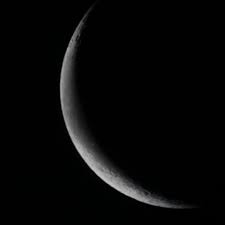

What phase of the moon is shown?
waning gibbous
1st quarter
waxing crescent
Waxing gibbous

