
 Worksheets
8.5 Winter Weather Test 22-23
Total questions: 20
Worksheet time: 20mins
Ingredients for Lake effect are a long unfrozen lake and .....
Strong winds above 40 mph
A lake/land temperature difference of at least 23 °F (13 °C).
No winds
A lake/land temperature difference of at least 5 °F (-15 °C).
Which condition is NOT favorable for lake effect to form?
cold air moving over a ‘warm’ unfrozen lake
convergence of wind with land
warm dry air

Will lake effect snow likely develop if the lake is frozen?
no
yes

During which time period did the lake-effect snow storm most likely occur as it moved across to Pulaski?
1
2
3
4

Best evidence from the data table for lake effect is
Wind blowing any distance over any water into will create lake effect snow.
Wind blowing east over 50 degree water into 25 degree air is required for lake effect.
Wind blowing west over 50 degree water into 25 degree air is required for lake effect.

A front is defined as
The height of land above sea level
A boundary between two air masses
the pressure caused by the weight of a column of air pushing down on an area
a high-speed high-altitude airstream blowing from west to east near the top of the troposphere

Air pressure is defined as
The height of land above sea level
A boundary between two air masses
the pressure caused by the weight of a column of air pushing down on an area
a high-speed high-altitude airstream blowing from west to east near the top of the troposphere


What are two main parts of an air masse?
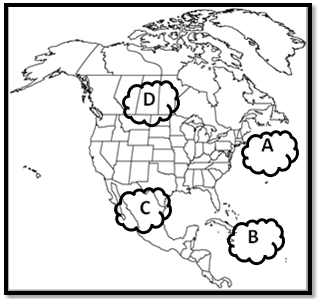
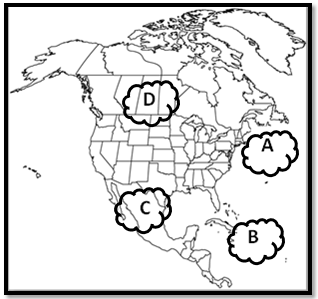
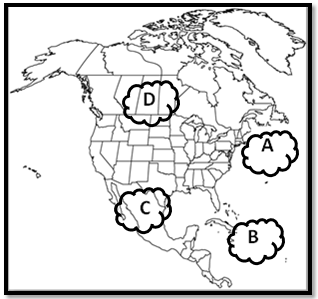
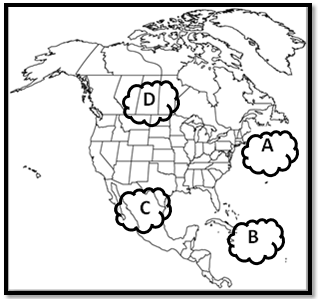


How do clouds stay in the air?
Lows generally flow up, which holds up clouds and highs flow down which makes it sunny.
Lows generally flow up, which makes it cold and highs flow down which makes it hot.
Lows generally flow down, which holds up clouds and highs flow up which makes it sunny.

