wayground logo

Free Printable Worksheets

NEW

Font size

S
M
L
XL
Worksheets

Ocean Unit Review

Total questions: 41

Worksheet time: 1hrs 8mins

Name
Class
Date
1.

As depth increases..........

a)

Things become shallow

b)

temperature decreases, pressure increases, and light decreases

c)

It is more salty

d)

An Ocean Current

2.

Flat, deep, and smooth part of the ocean floor. Cold temperatures are found here.

a)

Continental Shelf

b)

Abyssal Plain

c)

Continental Slope

d)

Seamounts

3.

Amount of salt found in water

a)

Photic Zone

b)

Gulf Stream

c)

Photosynthesis

d)

Salinity

4.

The amount of mass per unit of volume

a)

Density

b)

Metric Units

c)

Mass

d)

Volume

5.

A cold current that moves around the world?

a)

Ecosystem

b)

Organism

c)

Deep Ocean Current

d)

Photic Zone

6.

Warm water surface current located on the coast (Gulf of Mexico)

a)

Gulf Stream

b)

Ecosystem

c)

Organism

d)

Density

7.

All living things are an.....

a)

Mammal

b)

Human

c)

Organism

d)

Reptile

8.

when living and nonliving things interact in an environment

a)

Human Body

b)

Phytoplankton

c)

Ecosystem

d)

Organism

9.

the constant movement of ocean water that is caused by the patterns of wind and water density

a)

Ocean Current

b)

Continental Drift

c)

Land Before Time

d)

Zooplankton

10.
If you are walking into the ocean you would be on the continental...
a)
shelf
b)
slope
c)
rise
11.

an underwater mountain chain where new ocean floor is formed

a)

mid-ocean ridge

b)

seamount

c)

guyot

d)

abyssal plain

12.

How many major oceans are there in the world?

a)

7

b)

6

c)

5

d)

4

13.
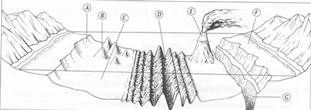
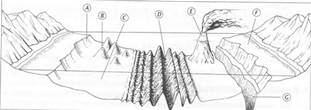
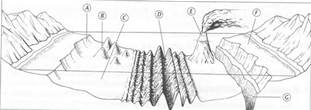
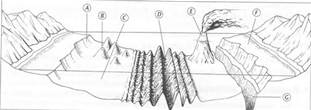
What is letter C?
a)
Mid-Ocean Ridge
b)
Cont. Shelf
c)
Cont. Slope
d)
Abyssal Plain
14.
What is letter D?
a)
Cont. Shelf
b)
Mid-Ocean Ridge
c)
Volcanic Island
d)
Seamount
15.
What is letter A?
a)
Cont. Shelf
b)
Cont. Slope
c)
Seamount
d)
Abyssal Plain
16.
What is letter G?
a)
Mid-Ocean Ridge
b)
Rift
c)
Trench
d)
Cont. Shelf
17.
What letter is B?
a)
Cont. Shelf
b)
Cont. Slope
c)
Mid-Ocean Ridge
d)
Seamount
18.
The gradually sloping part of a continent that extends under the ocean is the...
a)
continental slope
b)
continental shelf
c)
abyssal plain
d)
trench
19.

A ____________________ shows how energy is passed from one living thing to another...

a)

ecosystem

b)

food chain

c)

habitat

20.

Is this a food chain or a food web?

a)

Food chain

b)

Food web

21.
What are the organisms that break down dead stuff?
a)
Producers
b)
Consumers
c)
Decomposers
d)
Organisms
22.

A ____________________ shows the competition in food chains

a)

Environment

b)

Food Web

c)

Ecosystems

23.

As oceans become deeper, the water temperature ___________________.

a)

increases

b)

decreases

c)

stays the same

24.

The water deeper in the ocean is _________________

a)

saltier

b)

less salty

25.
A combination of 2 or more ingredients where each keep their own physical properties and can be easily separated.
a)
solution
b)
dissolve
c)
mixture
d)
saltwater
26.
A mixture of one substance evenly dissolved in another.
a)
mixture
b)
property
c)
density
d)
solution
27.
Which example below describes a simple mixture where the ingredients maintain their physical properties?
a)
bucket of saltwater and sand
b)
peanuts, raisins, and chocolate pieces
c)
sugar and water
d)
all of the above
28.
You have the following solids in a lab: salt, sand, lemonade powder, and pepper.  Which solids will dissolve in water to create a solution?
a)
pepper, sand, and salt
b)
salt, lemonade powder, and sand
c)
salt and lemonade powder
d)
pepper and sand
29.
Which part of an atom is POSITIVELY charged?
a)
protons
b)
neutrons
c)
electrons
d)
atoms
30.
What part of an atom is NEGATIVELY charged?
a)
protons
b)
neutrons
c)
electrons
d)
atoms
31.
What is the term for combining 2 or more atoms together?
a)
atoms
b)
elements
c)
molecules
d)
compounds
32.

All matter is made of what

a)

energy

b)

atoms

c)

electrons

d)

compounds

33.
Particles in an atom that are neutral and have no charge are 
a)
negatrons 
b)
electrons 
c)
neutrons 
d)
protons 
34.

When you cool matter, what happens to the atoms and molecules?

a)

they move faster

b)

they move slower

c)

they stop moving

d)

they stay the same

35.
In a solid, the molecules are - 
a)
close together
b)
moving around
c)
moving fast
36.
When you heat matter, what happens to the atoms and molecules?
a)
they move faster 
b)
they move slower
c)
they stop moving
d)
they stay the same
37.

Which glass contains water with high turbidity?

a)

Glass 1

b)

Glass 2

38.

Which glass has the highest salinity?

a)

The left one

b)

The middle one

c)

The right one

39.

Which Zone is from 0-200 meter below sea level?

a)

Twilight Zone

b)

Sunlight Zone

c)

Midnight Zone

40.

The Twilight Zone is ______ meters below sea level.

a)

0-200

b)

200-1,000

c)

1,000-4,000

41.

The ___ Zone is 1,000-4,000 meters below sea level.

a)

Sunlight

b)

Twilight

c)

Midnight