wayground logo

Free Printable Worksheets

NEW

Font size

S
M
L
XL
Worksheets

Apes Unit 4 Earth Systems

Total questions: 49

Worksheet time: 1hrs 19mins

Name
Class
Date
1.
Which is the correct order of the convection cells starting from the equator?
a)
polar, ferrell, hadley
b)
ferrell, hadley, polar
c)
polar, hadley, ferrell
d)
hadley, ferrell, polar
2.
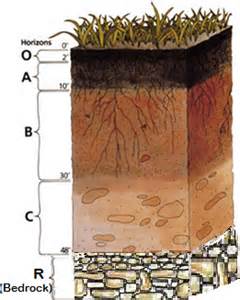
Which horizon is made up of partially weathered rocks?
a)
Horizon A
b)
Horizon B
c)
Horizon C
d)
Horizon D or R
3.
_______ is the type of soil used most often with plants. It is a mixture of clay, sand, and silt.
a)
loam
b)
humus
c)
mud
d)
dirt
4.
Soil sample that is 60% clay, 30% silt, and 10% sand has which texture? 
a)
clay
b)
clay loam
c)
sandy loam
d)
silt 
5.
Which is the correct order of soil horizons starting at the surface?
a)
A, B, E,C, O
b)
O, A, B, C, E
c)
O, E, A, B, C
d)
O, A, E, B, C
6.

The rate at which water flows through the soil is called soil percolation or ______.

a)

Groundwater

b)

Permeability

c)

Soil Pores

d)

Porosity

7.
What is "upwelling"?
a)
when wind near a shore pushes surface water away, nutrient rich cold water rises from the depths
b)
water rises from springs at the bottom of lakes
c)
it is when cold water sinks in the Norwegian Sea
d)
It is when the Coriolis effect makes currents go around in a circle
8.
Which soil component has the least capacity for holding water?
a)
silt
b)
clay
c)
sand
d)
humus
9.
You dig a small hole in the soil and the next day it rains. The hole fills with water, but does not empty even after several days of dry weather. What is the soil mostly made of?
a)
clay
b)
sand
c)
humus
d)
silt
10.
The Coriolis Effect is caused by
a)
Earth rotating around the sun
b)
Earth rotating on its axis
c)
The tides
d)
Gravity
11.
This is the side of the mountain that is often drier and warmer.
a)
Leeward Side
b)
Wet Lapse Rate
c)
Windward Side
d)
Wild Side
12.

What are the proportions of sand, silt, and clay for the soil at point X ?

a)

5% Sand, 95% Silt, 5% Clay

b)

5% Sand, 20% Silt, 5% Clay

c)

65% Sand, 30% Silt, 10% Clay

d)

60% Sand, 30% Silt, 10% Clay

13.

What is the correct sequence of layers of the earth's atmosphere from earth's surface to space?

a)

troposphere, stratosphere, mesosphere, thermosphere.

b)

mesosphere, stratosphere, thermosphere, troposphere.

c)

troposphere, mesosphere, stratosphere, thermosphere.

d)

stratosphere, troposphere, mesosphere, thermosphere.

14.

Which two factors allow earth to experience four distinct seasons?

a)

latitude & solar intensity

b)

tilt of axis & rotation of axis

c)

tilt of axis & rotation around sun

d)

distance from sun & place in orbit around sun

15.

Which is a direct result of the Coriolis Effect?

a)

Upwellings

b)

tides

c)

ocean conveyor belt

d)

Tsunami

e)

Ocean gyres

16.

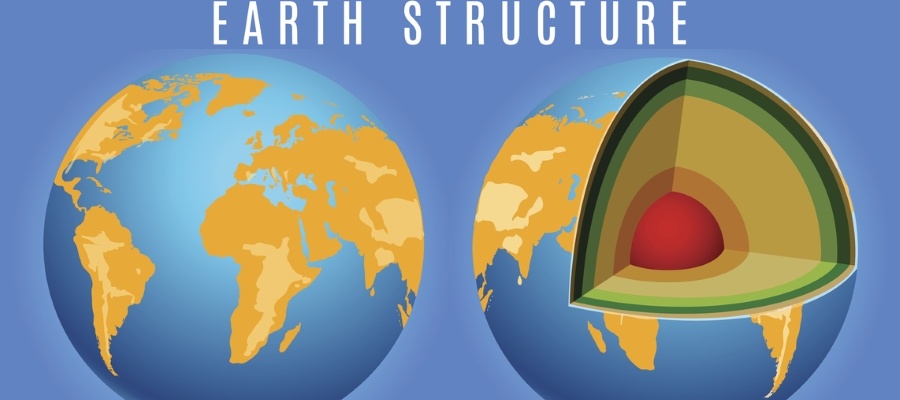
The surface of the earth, otherwise known as the ______, is broken into seven major pieces and sits atop a liquid layer called the _______

a)

lithosphere, asthenosphere

b)

astenosphere, mantle

c)

crust, litosphere

d)

asthenosphere, lithosphere

17.
One consequence of El Nino is _______ and increased rainfall in South America..
a)
flooding
b)
stronger Tradewinds
c)
strong winter storms
d)
drought
18.
All of the land that drains into a particular body of water is called a(n):
a)
watershed
b)
bedrock
c)
island
d)
aquifer
19.
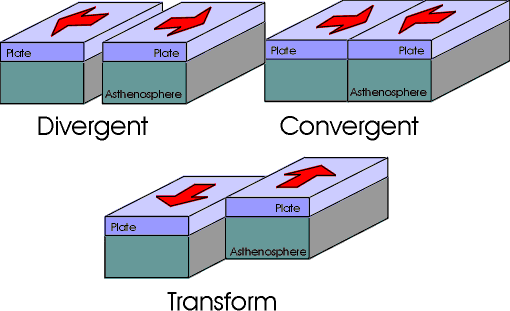
The San Andrea's Fault in California is which type of boundary?
a)
Convergent
b)
Divergent
c)
Subductive Zone
d)
Transform
20.
The two main agents of erosion are...
a)
wind and flowing water
b)
gravity and frost wedging
c)
oxygen and water
d)
carbon dioxiede and wind
21.
During __________ upwelling occurs off the coast of Peru.
a)
Normal Conditions
b)
El Nino
22.
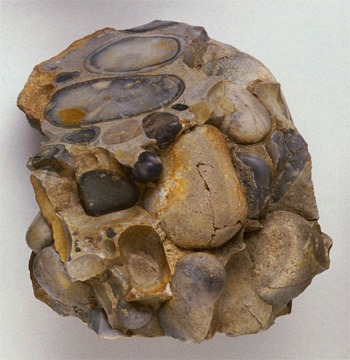
This rock was formed by smaller pieces of rock that settled at the bottom of a lake millions of years ago. What type of rock is this?
a)
Sedimentary
b)
Igneous
c)
Metamorphic
23.
The layer of soil which the topsoil is found.
a)
Horizon A
b)
Horizon B
c)
Horizon C
d)
Horizon D or R
24.
Which of the following contributes to the unequal warming of earth?
I. variation in the angle of sunlight that reaches Earth
II. variation in the amount of surface area over which the Sun's rays are distributed
III. variation in the amount of sunlight reflected from clouds
a)
I only
b)
I and II only
c)
II and III only
d)
III only
25.
The Coriolis effect is responsible for
a)
the convergence of two ascending Hadley cells
b)
the location of atmospheric currents caused by the unequal heating of Earth
c)
the cooling effect of air as it rises and expands
d)
the deflection of atmospheric currents
26.
The process when rocks break into smaller pieces due to exposure to natural elements is called
a)
erosion
b)
weathering
c)
sediments
27.
Which of the following is the correct order of soil particles in order of increasing particle size?
a)
clay-sand-silt
b)
sand-clay-silt
c)
silt-clay-sand
d)
clay-silt-sand
28.

Define the following:


Parent Material

a)

​​A layer parallel to the soil surface whose physical, chemical and biological characteristics differ from the layers above and beneath.

b)

A distinct layer of soil.

c)

The underlying geological material in which soil horizons form.
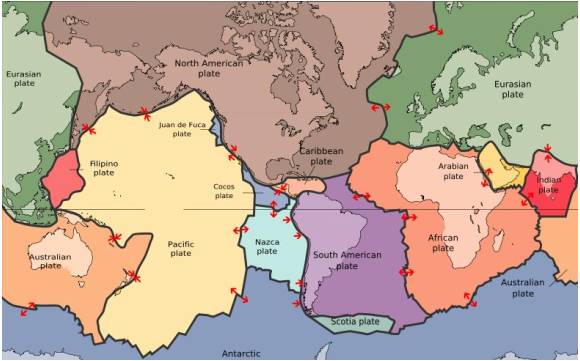
29.

The map in the picture shows tectonic plate boundaries. This map would be useful in predicting the location of future

a)

droughts

b)

hurricanes

c)

earthquakes

d)

tornadoes

30.
The sun's rays are least direct
a)
near the poles
b)
near the equator
c)
at high altitudes
d)
far from the ocean
31.

In which layer of the atmosphere does ozone help block UV radiation from striking the Earth?

a)

troposphere

b)

mesosphere

c)

stratosphere

d)

thermosphere

32.

In which layer of the atmosphere does ozone help block UV radiation from striking the Earth?

a)

troposphere

b)

mesosphere

c)

stratosphere

d)

thermosphere

33.

In which layer of the atmosphere do all the pressure, wind, and precipitation changes occur?

a)

Outer space

b)

stratosphere

c)

troposphere

d)

mesosphere

34.

Define the following:


Rainshadow

a)

A region having little rainfall because it is sheltered from prevailing rain-bearing winds by a range of hills.

b)

Are the low-latitude overturning circulations that have air rising at the equator and air sinking at roughly 30° latitude.

c)

An irregular periodic variation in winds and sea surface temperatures over the tropical eastern Pacific Ocean, affecting the climate of much of the tropics and subtropics.

35.

Which letter refers to a transform plate boundary?

a)

A

b)

B

c)

C

d)

D

36.

What are the proportions of sand, silt, and clay for the soil at point V ?

a)

5% Sand, 95% Silt, 5% Clay

b)

40% Sand, 40% Silt, 20% Clay

c)

65% Sand, 30% Silt, 10% Clay

d)

50% Sand, 30% Silt, 20% Clay

37.

ability for water and air to flow through soil

a)

Porosity

b)

Permeability

c)

Texture

d)

Salinity

38.

Which letter refers to a divergent plate boundary?

a)

A

b)

B

c)

C

d)

D

39.

Nutrient needed for photosynthesis in plants

a)

P

b)

K

c)

N

d)

U

40.

zone of leaching

a)

O

b)

A

c)

C

d)

E

41.

What are a circular system of currents in the Earth's major oceans?

a)

ocean current

b)

gyre

c)

upwelling

d)

conveyor belt

42.

These global winds blow from 30 degree latitude to the equator.

a)

Polar Easterlies

b)

Westerlies

c)

Tradewinds

d)

Doldrums

43.

subsoil horizon

a)

O

b)

B

c)

C

d)

E

44.

These global winds blow from the poles to about 60 degree latitude.

a)

Polar Easterlies

b)

Westerlies

c)

Tradewinds

d)

Doldrums

45.

Air always wants to move from areas of ______________ pressure to _______________ pressure.

a)

low to high

b)

high to low

c)

doesn't matter

d)

huh?

46.

The highest pressure on Earth is found here due to the amount of cold sinking air.

a)

poles

b)

30 degree latitude

c)

60 degree latitude

d)

equator

47.
How is wind named?
a)
From the direction which they blow to.
b)
From the direction which they come from.
c)
From the Department of Atmospheric Affairs 
d)
By the amount of air pressure. 
48.
In the Northern Hemisphere, hurricane winds blow
a)
harder than in the Southern Hemisphere
b)
counterclockwise
c)
clockwise
d)
less than in the Southern Hemisphere
49.
GWhich way to the global winds blow in each hemisphere?
a)
east to west in Northern Hemisphere and west to east in the Southern Hemisphere
b)
west to east in Northern Hemisphere and east to west in Southern Hemisphere
c)
North to south in the Northern Hemisphere and south to north in Southern Hemisphere
d)
south to north in the Northern Hemisphere and north to south in the Southern Hemisphere