
 Worksheets
Gas Exchange, Transport and Circulation
Total questions: 10
Worksheet time: 5mins
Name
Class
Date
1.
All cells need nutrients and _____ to survive.
a)
gills
b)
capillaries
c)
lungs
d)
oxygen
2.
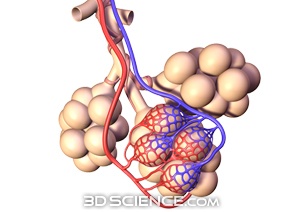
When you breathe, your lungs take in ___ and remove ___.
a)
air/oxygen
b)
oxygen/carbon dioxide
c)
carbon dioxide/waste
d)
waste/air
3.
Through which vessel does gas exchange happen?
a)
artery
b)
vein
c)
capillaries
d)
liver
4.
The movement of a gas or liquid from regions of higher concentration to regions of lower concentration
a)
active transport
b)
endocytosis
c)
exocytosis
d)
diffusion
5.
Small blood vessels called _____ surround organs and transport oxygen to cells.
a)
gills
b)
capillaries
c)
lungs
d)
oxygen
6.
Which types of organisms would have an OPEN circulatory system
a)
Vertebrates
b)
Fish
c)
Arthropods (have exoskeletons)
d)
Frogs
7.
Arrange the following statements in the correct order to show how oxygen gas is produced in the leaf and then enters the atmosphere.
(1) Oxygen passes through the stomata.
(2) Oxygen diffuses from the mesophyll cells to the water film.
(3) Oxygen diffuses from the water film to the air space
(4) Oxygen is released from the mesophyll cells.
a)
(3) -> (1) -> (4) -> (2)
b)
(4) -> (2) -> (3) -> (1)
c)
(3) -> (4) -> (1) -> (2)
d)
(4) -> (3) -> (1) -> (2)
8.
What causes the stoma to open?
a)
Leaves placed in dark areas.
b)
Water moving into the guard cells.
c)
Leaves that are suffering in a drought.
d)
Water moving out of the guard cells.
9.
Most stomata are usually found in underside of leaves. Why?
a)
conserve water
b)
get more CO2
c)
prevent infection
d)
none
10.
The leaf has a shiny, waxy cuticle around it to
a)
increase the rate of photosynthesis
b)
attract more light
c)
control water loss
d)
stop carbon dioxide and oxygen gases escaping
100 %

