Wayground logo

Free Printable Worksheets

Font size

S
M
L
XL
Worksheets

ECO120 QUIZ

Total questions: 51

Worksheet time: 49mins

Name
Class
Date
1.
Total Costs / Quantity = _____
a)
Marginal Cost
b)
Average Total Cost
c)
Implicit Cost
d)
Explicit Cost
2.
Variable Cost/Quantity = _______
a)
Marginal Variable Cost
b)
Average Fixed Cost
c)
Average Variable Cost
d)
Marginal Total Cost
3.
Change in Total Revenue/Change in Quantity
ΔTR/ΔQ = _____
a)
Marginal cost
b)
Marginal Revenue
c)
Profit
d)
Marginal Profit
4.
 Total Revenue - Total Cost = _____
a)
Profit
b)
Revenue
c)
Marginal Revenue
d)
Variable Revenue
5.
Costs that do not change when the quanity of output produced changes?
a)
Fixed Costs
b)
Variable Costs
c)
Explicit Costs
d)
Implicit Costs
6.

Which of these are costs?

a)

fixed

b)

variable

c)

operating

d)

revenue

7.

How much profit was made?

Buy a toy for RF 100. Sell it for 400.

a)

RF 200

b)

RF 300

c)

RF 400

d)

RF 500

8.

A cost that is included in economic profit

a)

Implicit Cost

b)

Marginal Cost

c)

Average Cost

d)

Economic Cost

9.

In the long-run all costs are:

a)

Variable Costs

b)

Fixed Costs

c)

Total Cost

d)

Marginal Cost

10.

Identity curve number 3

a)

Fixed cost

b)

Variable cost

c)

Total cost

d)

Marginal cost

11.

1.How many approaches in calculating national income?

a)

4

b)

3

c)

2

d)

1

12.

In a circular flow of income in a closed economy with government intervention, leakage consists of _________________.

a)

Investment and savings

b)

Savings only

c)

Savings and taxes

d)

Savings, taxes and imports

13.

6.When a nation's exports exceed its imports and is calculated as exports - imports

a)

trade surplus

b)

trade deficit

c)

inventory

d)

gross domestic product

14.
To focus on producing one thing to improve productivity is known as:
a)
Specialization
b)
International trade
c)
Absolute Advantage
d)
Supply and Demand
15.
When determining comparative advantage one must determine 
a)
Opportunity cost
b)
Specialization
c)
Absolute Advantage
d)
Embargos 
16.
If I am better at all types of production, I have the ______ in all forms of production.
a)
Comparative advantage
b)
Specialization
c)
Absolute advantage
d)
developed nation
17.
This trade barrier limits the number of products that can be brought into a country.
a)
Tariff
b)
Quota
c)
Embargo
d)
Subsidy
18.
Infant industries can be helped in the world market by giving those industries a 
a)
subsidy
b)
quota
c)
embargo
d)
tariff
19.
Tariffs and Quotas can benefit nations imposing them by...
a)
Raising revenue
b)
increasing variety of goods
c)
lowering prices
d)
increasing consumption 
20.

Balance of payment is measured as

a)

Difference between visible items of exports and imports

b)

Difference between invisible items of exports and imports

c)

Difference between external and internal flow of gold

d)

Difference between all receipts of foreign exchange and payment of foreign exchange

21.

Balance of trade is measure as

a)

Difference between import and export of goods

b)

Difference between import and export of services

c)

Difference between import and export of capital

d)

Difference between all exports and all imports

22.

Current account records transactions relating to

a)

Export and import of goods

b)

Non factor and factor income

c)

Current transfers

d)

All of these

23.

Balance of trade is a part of

a)

Current account BOP

b)

Capital account BOP

c)

Official reserves account

d)

None of these

24.

A labor force of 20 million people has 18.5 million people employed. Find the unemployment rate.

a)

10%

b)

8.5%

c)

7.5%

d)

6%

25.

Cyclical unemployment

a)

Describes recent college graduates

b)

Lasts longer than 6 months

c)

Describes employees moving from one job to another

d)

Increases inflation Increases inflation

26.

The unemployment rate is the ratio of

a)

unemployed to labor force

b)

employed to labor force

c)

seeking employment to labor force

d)

dissatisfied to labor force

27.

Farm helpers are unemployed when the cropping season is over.

a)

frictional

b)

cyclical

c)

structural

d)

seasonal

28.

__________ refers to a decrease in price level.

a)

Hyperinflation

b)

Disinflaation

c)

Deflation

d)

Stagflation

29.

Which of the following causes of inflation is often described as “too much money chasing too few goods”?

a)

Demand-pull inflation

b)

Cost-push inflation

c)

Demand-push inflation

d)

Cost-pull inflation

30.
When inflation is high the _______________of the dollar decreases
a)
cost value
b)
purchasing power
c)
importance
d)
validity
31.
What is inflation?
a)
rise in all prices
b)
rise in most prices
c)
rise in some prices
d)
rise in general prices
32.
An index that measures the prices of a market basket of goods that typical consumers purchase.
a)
Consumer Price Index
b)
Federal Reserve
c)
Bank
d)
Deflation
33.
What 2 types of inflation are there?
a)
demand pull and cost push
b)
demand pull and supply glut
c)
supply glut and demand side
d)
supply inflation and demand inflation
34.
GDP that is adjusted for inflation
a)
real GDP
b)
nominal GDP
c)
price level
d)
net national product
35.
Fiscal policy is
a)
decisions the government makes to fight inflation
b)
actions the the Federal Reservice takes to control money supply
c)
does not help with inflation
36.
What causes cost push inflation
a)
An increase in demand for goods and services
b)
An increase in supply
c)
A rise in production costs passed on to consumers
d)
A fall in the price of imports
37.
Taxing & spending to help the economy grow is referred to as
a)
expansionary policy
b)
monetary policy
c)
contractionary policy
d)
budget deficit
38.
The federal government's overall approach to spending and taxes is called
a)
Physical Policy
b)
Fiscal Policy
c)
Money
d)
Monetary Policy
39.
An example of expansionary fiscal policy would be
a)
cutting taxes.
b)
cutting government spending.
c)
cutting production of consumer goods.
d)
cutting prices of consumer goods.
40.
Selling bonds
a)
increases money supply
b)
decreases money supply
41.
High reserve requirements 
a)
lower the money supply
b)
increase the money supply
42.
Which of these is NOT a monetary policy tool?
a)
Discount rate
b)
Balance Accounts
c)
Open Market Operation
d)
Reserved Requirements
43.
What action would the Federal Reserve take to control inflation?
a)
Buy government securities
b)
Decrease the required reserve ratio
c)
Increase taxes
d)
Increase the discount rate
44.
During a contraction what would you do to stimulate the economy?
a)
Lower the RRR, Lower the DR, Buy Bonds
b)
Raise the RRR, Raise the DR, Sell Bonds
45.

What is the goal of a firm?

a)

to make profits

b)

to maximize profits

c)

to maximize revenue

d)

none of the above

46.

Check all that apply: Which of the following are characteristics of a perfectly competitive market?

a)

Many buyers/sellers

b)

Identical Products

c)

Price Makers

d)

Low barriers of entry

47.

The image above shows a firm making

a)

Economic Profit

b)

Economic loss

c)

Breaking even

d)

Shutting down

48.

A barrier to entry is

a)

an economic term for economies of scale

b)

illegal in most markets

c)

anything that prevents new firms from entering the market

d)

a factor that increases competition

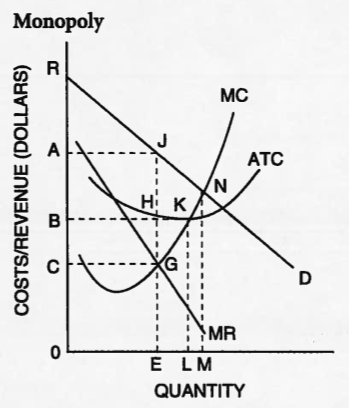
49.
This monopoly will maximize profits at what price?
a)
A
b)
B
c)
C
d)
R
50.
Economic profits for this monopoly are represented by area:
a)
0CGE
b)
0AJE
c)
AJHB
d)
BAJN
51.

The above figure shows a perfectly competitive firm. If the market price is $15, the firm

a)

is incurring an economic loss.

b)

is making an economic profit.

c)

is making zero economic profit.

d)

will immediately shut down.

e)

might shut down but more information is needed about the AVC.