
 Worksheets
AP Macro Unit 1 Review
Total questions: 23
Worksheet time: 22mins
Name
Class
Date
1.
__________study of how people (including companies/countries) make choices on buying, selling, using, and distributing goods/services.
a)
Economics
b)
Consumer Science
c)
Opportunity Costs
2.
____________ The actual thing you gave up to have something else. Everything has a cost
a)
Opportunity Cost
b)
Tradeoff
c)
Incentive
3.
Individuals who come up with a new idea for a good or service, then they make it a reality
a)
resource
b)
human resources
c)
consumer
d)
entrepreneur
4.
Something we use from nature
a)
natural resource
b)
human resource
c)
capital resource
d)
entrepreneur
5.
The idea that resources are limited; we don't have an unlimited supply of what we want
a)
scarcity
b)
supply
c)
demand
d)
inflation
6.
Human-made materials used to produce goods and services.
a)
capital
b)
land
c)
labor
d)
entrepreneur
7.
An economy where the government controls the factors of production resources.
a)
command
b)
market
c)
capitalism
d)
mixed
8.

Which factor of production would you consider a lawn mower?
a)
Land
b)
Labor
c)
Capital
d)
Entrepreneur
9.

Point D on the graph is a period of:
a)
contraction
b)
expansion
c)
recession
d)
decline
10.
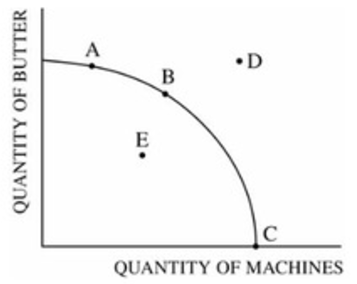
The diagram shows the production possibilities curve for Country Y. Which of the following statements is true?
a)
If Country Y is producing at point C, it is using all its resources efficiently
b)
The opportunity cost of producing more machines is constant
c)
Country Y cannot produce at point E
d)
The most efficient point of production is point D
11.

The simplified production possibilities curves for country A and B are shown. Which one of the following statements is correct?
a)
Country A has the comparative advantage in both goods
b)
Country A has the comparative advantage in chairs & Country B has the comparative advantage in shirts
c)
Country B has the absolute advantage in shirts only
d)
Country A has the comparative advantage in shirts & Country B has the comparative advantage in chairs
12.
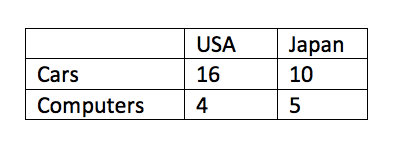
Based on the table provided, which one of the following statements is correct?
a)
Japan has the absolute advantage in producing cars
b)
Japan has the comparative advantage in producing cars
c)
The United States has the absolute advantage in producing both cars and computers
d)
The opportunity cost of producing a car in Japan is 1/2 a computer
13.
If nations specialize according to their comparative advantage and engage in trade with each other, each nation can:
a)
Consume outside its production possibilities curve
b)
Produce outside its production possibilities curve
c)
Shift its production possibilities curve to the right
d)
Produce more of all goods
14.
If a price is above equilibrium price, it creates a...
a)
shortage
b)
surplus
c)
market price
d)
demand
15.
If a price is below the equilibrium price it creates a...
a)
shortage
b)
surplus
c)
market price
d)
supply
16.
For the law of demand, as price rises, what happens to quantity demanded?
a)
it goes up
b)
it goes down
c)
it stays the same
d)
it is not effected
17.
Goods that are bought and used together are
a)
complementary goods
b)
substitute goods
c)
income goods
d)
unrelated goods
18.
Thousands of people leave a small town due to a factory closing down. Sales at the local grocery store become slow. What causes this change?
a)
Prices or availability of substitutes
b)
Prices or availability of complementary goods
c)
Change in the weather or season
d)
Change in the number of buyers
19.
Which statement expresses a central idea of how the laws of supply and demand work?
a)
The government sets the prices for goods and services.
b)
Prices are determined by the interaction of producers and consumers.
c)
Consumers alone determine the prices for goods and services.
d)
Technology dictates the prices charged for goods and services.
20.
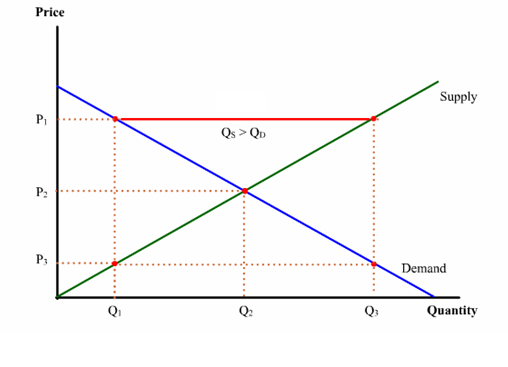
What does this graph show?
a)
Shortage
b)
Surplus
c)
Supply Table
d)
Equilibrium
21.
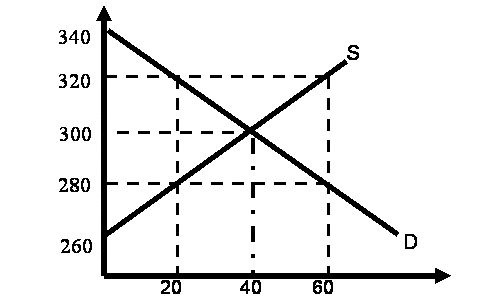
If a price floor was set at 320, what quantity would be purchased?
a)
20
b)
40
c)
60
d)
80
22.
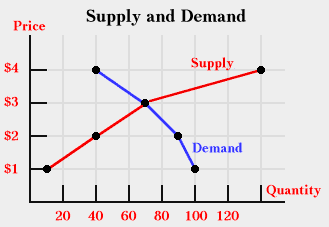
What is the Equilibrium Price?
a)
1
b)
2
c)
3
d)
4
23.
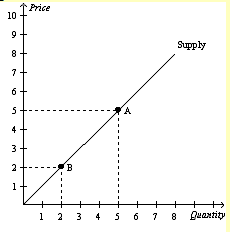
The movement from Point A to Point B represents a(n)
a)
increase in the price.
b)
decrease in the quantity supplied.
c)
shift in the supply curve.
d)
Both Orange and Blue are correct.
100 %

