
 Worksheets
Industrial Revolution Day 5
Total questions: 13
Worksheet time: 15mins
Match the following
Freedom from cruel or unusual punishment
8th Amendment
Washington warned against having permanent foreign alliances and creating political parties
Farewell Address
Indian Removal Act forced Natives off lands; Cherokee sued to keep land; Court favored Natives; Jackson ignored the Court
Worcester v. Georgia
Process for admitting new states to U.S.; territories govern themselves
Northwest Ordinance
Process for admitting new states to U.S.; territories govern themselves
Provided a direct water route to the Midwest
canals
Transmitted information quickly over long distances
telegraph
Allowed people to travel upstream to new markets
steamboats

What is being described in this excerpt?
Spinning jenny and the textile industry
Interchangeable parts and mass production
Cotton gin and plantation system
Steam engine and railroad commerce

Which of these best completes the diagram above?
The demand for slaves increases in the South.
More textile factories are established in the South.
The number of European immigrants arriving at southern port cities increases.
More tobacco and food crops are cultivated on southern plantations.
New York City became one the largest cities in America after the completion of the (a) . (b) made moving goods faster and more efficient, which resulted in decreased prices of goods for consumers. Interchangeable parts led to the idea of (c) , where goods could be produced at a faster rate and sold at a cheaper price point. (d) creates competition, resulting in better products for consumers.
(a) had an increase in voting turnout and favored the common man, not the wealthy. Federal rule over interstate trade was established with the (b) ruling. The fast way to ship goods and people across the country was by (c) . A more powerful (d) was created by Robert Fulton which powered ships to move upstream.
Rivers typically run North and South. To make a water way flow West and East, engineers built (a) , man-made rivers. The (b) system was a process that factory owners used to do more than one step of manufacturing under one roof. The Founding Fathers believed in the principle of (c) which divides government power between the Federal and State governments.
Unalienable rights are rights that people are born with, like life, liberty, and property, and cannot be taken away from you without (a) . To convince people to ratify the Constitution, Alexander Hamilton, James Madison, and John Jay wrote the (b) . The power of the Judicial Branch to overlook the Legislative and Executive Branch to ensure they are abiding by the Constitution is called (c) .
How did the railway system affect America’s economy?
It slowed industrial growth and production
It boosted trade and commerce
It benefited the agriculture economy only
It limited trade between regions
How did Eli Whitney’s invention of the cotton gin impact the South’s economy during the mid-1800s?
It led to increased cotton production and profits.
It reduced the need for enslaved labor in cotton production.
It caused Southern farmers to stop growing cotton and switch to other crops.
It decreased the demand for Southern cotton in world markets.
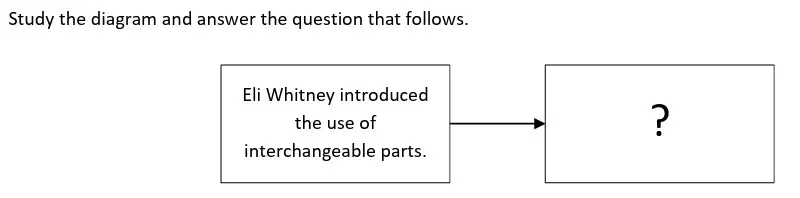
Which statement correctly replaces the question mark in this cause-and-effect diagram?
Manufacturing became slower and more expensive.
Products were produced faster and parts could be easily replaced.
Only skilled artisans could make replacement parts.
Factories stopped producing goods in large quantities.
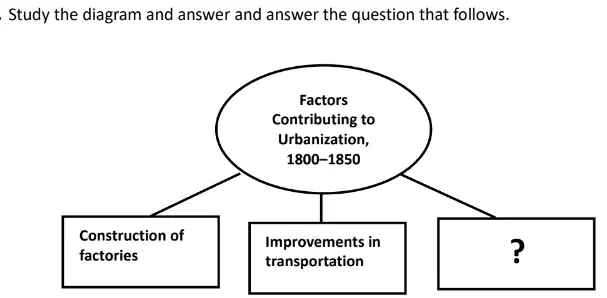
Which factor correctly replaces the question mark on this diagram?
Nullification of federal labor laws
Increases in immigration
Invention of electric generators
Increased support for abolitionism
This table lists the historical reasons behind the migration of different groups of people to the
United States.
Which statement BEST describes reasons behind various historical migrations?
Sought economic opportunities in the North
Looked for religious freedom mainly in the North and East
Forcibly brought to the South and West as enslaved labor
Sought economic opportunities in the West despite discrimination

