wayground logo

Free Printable Worksheets

Font size

S
M
L
XL
Worksheets

Ancient Greece Test 2022

Total questions: 148

Worksheet time: 4hrs 52mins

Name
Class
Date
1.

The Minoans lived mainly on the island of

a)

Crete

b)

Cyprus

c)

Alexandria

d)

Ellis

2.

Frescoes are

a)

painting on wet clay

b)

small clay amulets

c)

open courtyard areas

d)

fresh foods

3.

What was the name of the war between the Mycenaean and Troy

a)

The Peloponnesian War

b)

The Persian War

c)

The Ionian War

d)

The Trojan War

4.

What is the name of the blind poet who wrote the Iliad and the Odyssey?

a)

Pythagoras

b)

Homer

c)

Aeneid

d)

Socrates

5.

What was the name of the largest city on the island of Crete?

a)

Knossos

b)

Athens

c)

Sparta

d)

Carthage

6.

What was the legacy of Minoan Civilization?

a)

Masters of the sea and ship building

b)

Metal working and Jewelry

c)

agriculture and the Olympics

d)

writing and sculpting

7.

Which civilization drove the Mycenaean Civilization out of Greece?

a)

the Minoan

b)

the Akkadians

c)

the Assyrians

d)

The Dorians

8.

Because Crete was so centrally located in the Mediterranean Sea ....

a)

It's inhabitants became really good sailors.

b)

The people of Crete became wealthy because of trade.

c)

Both

d)

Neither

9.

This was the palace of __________________. This is what Sir Arthur Evans discovered in the 1800's and named the Minoan civilization after this king.

a)

King Arthur

b)

King Midas

c)

King Minos

d)

King Pepto

10.

How did the Minoans get their wealth?

a)

With the help of aliens

b)

With the help of Ancient Egyptians

c)

Through Trade

d)

Through warfare

11.

What was the Mycenaean capital?

a)

Athens

b)

Sparta

c)

Mycenae

d)

Crete

12.

Crete was the first great _____?

a)

Trading center

b)

Palace for Zeus

c)

Civilization

d)

Warboat

13.

What land form would best describe the majority of Ancient Greece?

a)

Fjord

b)

Plateau

c)

Peninsula

d)

Butte

14.

Why was sea trade & travel so important to the development of Greek civilization?

a)

Greece had numerous natural resources to trade with others.

b)

Sea travel was what linked most parts of Greece.

c)

Greece needed to compete with other sea traveling countries.

d)

None of the other choices are correct.

15.

Approximately how much of Ancient Greece was covered in mountains?

a)

Approximately 25%

b)

Approximately 40%

c)

Approximately 50%

d)

Approximately 75%

16.

What effect did the mountains have on the development of Greek civilization?

a)

Independent communities developed in Greece.

b)

The mountains unified Greece.

c)

Greeks became adept in mountain travel.

d)

They raised a lot of mountain goats.

17.

Which group of Indo-Europeans settled on mainland Greece?

a)

Minoans

b)

Mycenaeans

c)

Trojans

d)

Hittites

18.

According to the textbook, who is said to be responsible for the decline of the Mycenaeans?

a)

The Romans

b)

The Hittites

c)

The Dorians

d)

The Minoans

19.
Pg. 115: Frescoes are?
a)
Watercolor paintings done on wet plaster
b)
Name of the people that lived in Crete
c)
Traditional food served for royals
d)
Name of the people that lived at Knossos
20.
Pg. 115: How did the Minoan civilazation end?
a)
Fire blazzed the entire civilization
b)
Archaeologists are still not sure
c)
New ruler came into power
d)
Mycenae took over during the Aegean War
21.
Pg. 116: Odyssey tells the story of?
a)
Struggles of the ancient Greek hero Odysseus
b)
Egyptian mythology
c)
Trade secrets of the Minoans
d)
Early tales of Christianity
22.

The civilizations of early Greece settled _____________________.

a)

in the mountains

b)

in a river valley

c)

along the coast

d)

in the desert

23.
What word best describes the land of the Greek peninsula?
a)
rocky and mountainous
b)
flat
c)
desert
d)
rolling plains
24.
Why was communication difficult between communities in Ancient Greece?
a)
They did not have telephones
b)
Mountains and Water
c)
communication was easy
d)
most people had horses
25.
What does the word "Democracy" mean?
a)
"rule by the government"
b)
"rule by the many"
c)
"rule by the wealthy"
d)
"rule by the people"
26.
Greek has many _________that are like mini countries.
a)
counties
b)
city-states
c)
provinces
d)
parishes
27.
If you were someone who thought deeply about life's questions, you would be known as a _____________
a)
Archaeologist 
b)
Historian
c)
Philosopher
d)
Dorian
28.

Part of Greece is a peninsula meaning that…

a)

It has a tropical climate

b)

It is uninhabitable

c)

It is not part of mainland Greece

d)

It is surrounded by water on three sides

29.
What is another name for a Greek city-state?
a)
Polling Place
b)
Acropolis
c)
Polis
d)
Oligarchy
30.
what is a hilltop in a Greek city state called? 

(It housed a fort and a temple to the city-state's local god or goddess)
a)
Agriculture
b)
Thermopylae
c)
Acropolis
d)
Ephor
31.
What are the names of the Major bodies of water around Greece?
a)
Adriatic Sea and Sea of Cortes
b)
Mediterranean Sea and Aegean Sea
c)
Atlantic and Pacific Oceans
d)
LAke Michiganand Superior
32.
Because Greece is covered by mountains, they ______________.
a)
have little farmland
b)
invented skiing and other alpine sports
c)
were able to visit surrounding towns often
d)
travel was easy
33.

What were the two sides fighting in the Trojan War?

a)

Greeks and Romans

b)

Greeks and the people of Troy

c)

Romans and Inca

d)

Spartans and Athans

34.

Which of the following events marked the Dark Ages of Ancient Greek culture

a)

The loss of the ability to read and write

b)

The development of advanced medicine

c)

The development of advanced fighting techniques

d)

The end to Inter city state fighting

35.

People captured by the Spartans and forced to work as serfs.

a)

debtors

b)

the others

c)

helots

d)

dementors

36.

Heavily armed foot soldiers

a)

bowmen

b)

axe men

c)

ninjas

d)

hoplites

37.

Elected members of Sparta’s oligarchy

a)

spirits

b)

unknowns

c)

ephors

d)

untouchables

38.

The reforms of Cleisthenes

a)

supported tyranny.

b)

allowed women to rule.

c)

laid the foundations of democracy.

d)

freed all the slaves in Athens.

39.

The tyrants of ancient Greece were

a)

all oppressive and wicked.

b)

supporters of aristocrats.

c)

rulers who seized power by force.

d)

wanted to establish a democratic government.

40.
Of or influenced by the Greek Empire. A type of culture typically referred to after the conquests of Alexander the Great.
a)
Hellenistic 
b)
Hellenic 
c)
Greekish 
d)
Greco 
41.
Greek Historian, considered the father of History. Wrote the "Histories" about the Persian War. 
a)
Herodotus 
b)
Thucydides 
c)
Myron 
d)
Zeus 
42.
The search for wisdom and the right way to live is called________? 
a)
philosophy 
b)
peninsula 
c)
oligarchy 
d)
Hellenism 
43.
What is one Greek idea or tradition that is still practiced today? 
a)
democracy 
b)
oligarchy 
c)
worshipping zeus 
d)
placing olive branches on the winners of the olypics 
44.
Which is true of a direct democracy? 
a)
The people elect representatives who make decisions
b)
Juries are selected by the defendants
c)
Citizens vote on all laws themselves
d)
Governmental officials are chosen by a council of elders
45.

n a comparison of the ancient cities of Athens and Sparta, Sparta placed more emphasis on

a)

education

b)

military service

c)

family order

d)

human right

46.

Which statement most likely represents the view of a citizen of ancient Athens visiting Sparta?

a)

“The government and society in Sparta are so strict. The people have little voice in government.”

b)

“I feel as though I have never left home. Everything here is the same as it is in Athens.”

c)

“This society allows for more freedom of expression than I have ever experienced in Athens.”

d)

“I have never heard of a society like Sparta that believes in only one God.”

47.

Why did the ancient city-states of Athens and Sparta develop different political systems?

a)

The Byzantine Empire dictated government policies.

b)

Foreign travelers introduced new philosophies.

c)

For over three centuries, civil wars raged in these city-states.

d)

The mountainous topography resulted in the isolation of these city-states.

48.

How was Sparta an oligarchy?

a)

They had a king

b)

They had a president

c)

They had a council of elders

d)

They had a prime minister

49.

Which of the following sides fought in the Peloponnesian War?

a)

Athens versus Sparta

b)

Athens versus the rest of Greece

c)

Sparta versus the rest of Greece

d)

Greece versus Persia

50.
Who fought in the Persian War?
a)
Greece and Sparta
b)
Greece and Athens
c)
Greece and Persia
d)
Greece and Macedonia
51.
Which leader sent his ships to Marathon to fight to punish the Greek mainland for meddling in his empire?
a)
Darius I
b)
Xerxes
c)
Cyrus the Great
d)
Pericles
52.
Who ultimately won the Persian War?
a)
Greeks
b)
Spartans
c)
Persians
d)
Athens
53.
Why did the first Persian War start?
a)
Persia wanted to punish Athens for interfering in the Ionian Revolt.
b)
Sparta and Athens were competing to be the best city-state .
c)
Persia wanted revenge for their defeat at Marathon.
d)
Sparta and Athens both wanted to defeat Persia.
54.
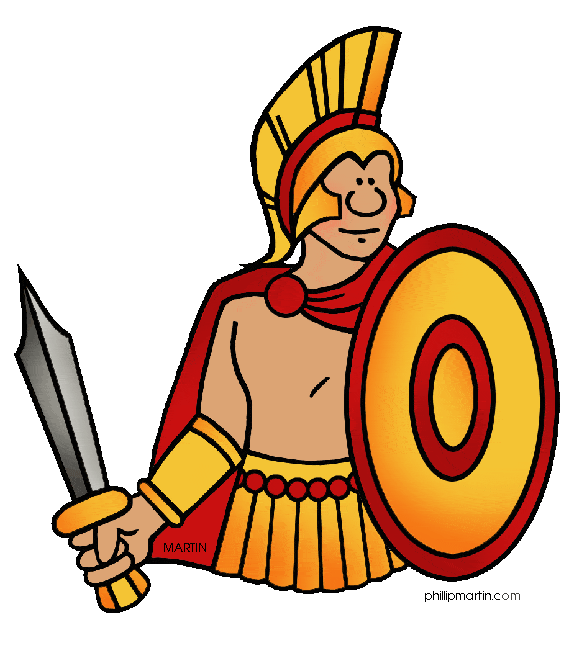
Ten years after the first battle in the Persian Wars, Darius' son Xerxes tried to conquer Greece once more.
Which Greek city-state helped Athens?
a)
Mycenae 
b)
Crete
c)
Sparta
d)
Troy
55.
Which popular sporting activity resulted from the first battle of the Persian Wars?
a)
The Marathon
b)
The Triathlon
c)
The Olympics
d)
The Pentathlon
56.
At the Battle of Marathon, ________________.
a)
Persian Empire was defeated by Alexander the Great.
b)
Athens was defeated by Persian Empire.
c)
Sparta was defeated by Athens. 
d)
Persian Empire was defeated by Athens.
57.
During the 2nd Persian War a Spartan force of 300 held off the Persian army for 2 days at a place called __________.
a)
Marathon
b)
Salamis
c)
Thermopylae
d)
Ionia
58.
In the Battle of Salamis, how was the Athenian navy able to defeat the Persians?
a)
the Athenians tricked the Persians ships into following them into a narrow channel, then attacked and rammed the Persian ships until they sank
b)
with special sounds, they were able to communicate with, and control the whales in the sea, to swim and collide with the Persian ships and sink them
c)
they fired cannonballs at the Persian ships and sunk them
d)
the Athenian archers were able to shoot their arrows twice as far as the Persian archers
59.
Which of the following statements is true concerning the Persian Wars?
a)
The Persians defeated the Greek city-states
b)
Athens started its decline after the end of the war
c)
Sparta and Athens were united against the Persians
d)
Persian ideas were adopted by the Athenians
60.
A marathon is a foot race that covers ____ miles.
a)
10
b)
26
c)
150
d)
18
61.
The Golden Age of Athens occurred under the leadership of--
a)
Alexander the Great
b)
Darius
c)
Pericles
d)
Socrates
62.
Which issue led to the Peloponnesian War?
a)
Competition for control of Greece
b)
Religious differences
c)
A long standing trade dispute
d)
Revenge for past military defeats
63.

The battle of Salamis was the first great what?

a)

Naval battle

b)

Territorial battle

c)

Land battle

d)

Mountain Battle

64.

The following information describes which battle of the Persian War: The final battle of the Persian War where Athens easily beat the army of the Persians (on land).

a)

Thermopylae

b)

Salamis

c)

Plataea

d)

Marathon

65.

The following information describes which of the Persian Wars: Greeks led Persians into a narrow strait of water and then easily sank many Persian ships (because of their large size) causing the Persians to retreat.

a)

Thermopylae

b)

Salamis

c)

Plataea

d)

Marathon

66.
1. From what does the Peloponnesian War get its name?
a)
a. From the language spoken by the people fighting
b)
b. From the river where the largest battle was fought
c)
c. From the city-state that was conquered by Sparta
d)
d. From the general who started the war
e)
e. From a peninsula where many Greek city-states are located
67.
3. What happened that weakened Athens during the First Peloponnesian War?
a)
a. Many of their ships were sunk in a huge storm
b)
b. They were attacked by the Persians
c)
c. There was a plague in the city that killed many people including their leader
d)
d. Much of the wall protecting the city collapsed due to poor construction
e)
e. Many of their soldiers deserted to go to the Olympic Games
68.
6. Which of the following best describes the war strategy of Athens?
a)
a. To meet the Spartans head on and destroy them in a ground battle
b)
b. To remain inside the walls of their city and use their superior ships to win the war
c)
c. To lay siege to Sparta and eventually starve them out of their city
d)
d. All of the above
e)
e. None of the above
69.
7. What former enemy did Sparta turn to for help during the Second Peloponnesian War?
a)
a. Rome
b)
b. Athens
c)
c. Carthage
d)
d. Egypt
e)
e. Persia
70.
8. Who was Pericles?
a)
a. A great general and leader of Athens
b)
b. The king of Sparta
c)
c. A Greek philosopher who was against all war
d)
d. A famous warrior from Corinth
e)
e. The patron god of the Spartans
71.

Who is Thucydides?

a)

An influential politician in Athens

b)

A former Athenian general and leading historian of the war

c)

A Spartan general

d)

An Athenian diplomat

72.

What feature or view was highly valued in Athens?

a)

Physical aggression and toughness

b)

Education and the arts

c)

Equality for all people

d)

Learning from other cultures was useless

73.

Sparta was located on which peninsula?

a)

Attica

b)

Italian

c)

Peloponnesus

d)

Baja

74.

What was the eastern edge of Alexander the Great's Empire?

a)

Macedonia

b)

Athens

c)

India

d)

Egypt

75.
______________ controlled and dominated the Delian League.
a)
Athens
b)
a peace keeping Sparta
c)
Persia
d)
Macedonia
76.
_____________ controlled and dominated the Peloponnesian League
a)
Athens
b)
Sparta
c)
Ionia
d)
Troy
77.
How do we know so much about the Peloponnesian War?
a)
Socrates explained it to his students in great detail.
b)
Alexander the Great demanded a book to be written to preserve the war.
c)
The Greeks painted the events of the war on pottery.
d)
Thucydides, the father of history, wrote a detailed unbiased account of the war.
78.

What was the result of the Peloponnesian War?

a)

Greece prospered more than ever

b)

Greece began to decline

c)

Athens conquered new lands

d)

The Greeks began to rebuild the Parthenon

79.

In Athenian democracy...

a)

All men and women voted

b)

Only landowners could participate in government

c)

Citizens elected representatives to make laws for them

d)

All citizens participated and passed laws

80.

Who were Herodotus and Thucydides?

a)

Playwrights

b)

Historians

c)

Philosophers

d)

Scientists

81.

Which accomplishment is associated with Alexander the Great?

a)

The spread of Greek culture throughout the empire

b)

The introduction of Christianity to the Near East

c)

The defeat of the Chinese army in Asia

d)

The destruction of the Athenian navy in battle

82.

What is the correct order of governments in Athens?

a)

Monarchy --> Aristocracy --> Tyranny --> Democracy

b)

Democracy --> Oligarchy --> Monarchy --> Autocracy

c)

Autocracy --> Monarchy --> Theocracy --> Democracy

d)

Tyranny --> Democracy --> Theocracy --> Aristocracy

83.

Which statement best describes the influence Solon and Draco had on Athenian society?

a)

Solon and Draco created reforms to ensure greater fairness and justice to many Athenians

b)

Solon and Draco created a government in which a small group of aristocrats held all power.

c)

Solon and Draco denied citizenship to foreigners and enforced immigration laws

d)

Solon and Draco ensured all citizens had equal opportunities to hold government positions.

84.

Which one of these is NOT one of Pericles' Three Goals for Athens?

a)

Strengthen Democracy

b)

Glorify Athens

c)

Strengthen Oligarchies

d)

Build Athenian Empire

85.

How did Pericles' strengthen democracy in Athens?

a)

Taking away stipends for the poor

b)

Reforms try to balance power between the rich & the poor so everyone can participate in government

c)

Reforms try to shift the balance of power so the poor cannot participate in government

86.

This column is plain and simple

a)

Doric

b)

Ionic

c)

Corinthian

87.

This column is decorated with scrolls on either side of the capital

a)

doric

b)

ionic

c)

corinthian

88.

This column is the most decorative using scrolls and leaves

a)

doric

b)

ionic

c)

corinthian

89.
People who try to explain knowledge, reality, and existence.
a)
archaeologists
b)
anthropologists
c)
philosophers
d)
paleontologists
90.
Questioned people to get them to question themselves. Knew that he knew nothing.
a)
Aristotle
b)
Plato
c)
Socrates
d)
Aesop
91.
Student of Plato. Taught Alexander the Great.
a)
Aristotle
b)
Socrates
c)
Aesop
d)
Archimedes
92.
Student of Socrates. Taught about knowledge and justice.
a)
Aristotle
b)
Archimedes
c)
Plato
d)
Aesop
93.

The Delian League was an alliance that was created by Athens to ____________.

a)

go to war with Sparta

b)

protect its members from attack by the Persians

c)

to form a peace with Persia

d)

to form a peace with Sparta

94.

The Greeks excelled in philosophy, art, architecture, and ___________________.

a)

theater

b)

map making

c)

electronics

d)

transportation

95.

The Greeks excelled in drama and theater. They invented ________________ or very serious plays with unhappy endings.

a)

comedies

b)

satires

c)

suspenseful

d)

tragedies

96.

The Greeks also created ______________ or plays with humorous themes and happy endings.

a)

comedies

b)

satires

c)

tragedies

d)

documentaries

97.

Ancient Greek culture continues to influence modern

a)

weaponry and warfare.

b)

music and dance.

c)

architecture, literature, and theatre.

d)

computer technology.

98.

What was the time that art, philosophy, and literature flourished in Greece?

a)

The Golden Age of Greece

b)

Greece Government

c)

Ancient Greece

d)

None of the above

99.

What does the word "Philosophy" mean?

a)

Love of Greece

b)

Love of ancient history

c)

Love of wisdom

d)

Love of Philosophy

100.
The most important consequence of the Peloponnesian War was that
a)
Athens emerged as the undisputed leader of Greece.
b)
the war left Greece exhausted and vulnerable to attack.
c)
Persia was able to take advantage of Greek divisions to complete its conquest.
d)
Sparta's victory propelled it to lasting domination of Greece.
101.

Who is this Greek Philosopher!: He Started the Academy!

a)

Socrates

b)

Plato

c)

Aristotle

102.

Who is this Greek Philosopher!: He was put on trial and sentenced to death

a)

Socrates

b)

Plato

c)

Aristotle

103.

Who is this Greek Philosopher!: He was the Teacher of Alexander The Great

a)

Socrates

b)

Plato

c)

Aristotle

104.

Who is this Greek Philosopher!: He was the Teacher of Plato:

a)

Socrates

b)

Plato

c)

Aristotle

105.

Plato had the idea of "Philosopher King Theory." What was this theory?

a)

All people were good in the world and contributed to society.

b)

People that need to be the one's seeking the answer.

c)

Socrates was the king of philosophy

d)

Plato was the king of philosophy.

106.

Most Greek oligarchs were rich men or _____________________ who inherited land from their families.

a)

samurai

b)

aristocrats

c)

senators

d)

philosophers

107.
One person inherits power
a)
monarchy
b)
aristocracy
c)
oligrachy
d)
Democracy
108.
Athenian leader who is credited for the first Greek written code of laws   and is remembered for his “harsh laws.”
a)
Pisistratus
b)
Draco
c)
Cleisthenes
d)
Solon
109.

He extended citizens to men who did not own land.

a)

Solon

b)

Draco

c)

Pisistratus

d)

Cleisthenes

110.

He introduced ostracism, whereby a citizen could expel an undesirable person from the city for 10 years.

a)

Cleisthenes

b)

Draco

c)

Pisistratus

d)

Solon

111.

What is the correct order of the battles?

a)

Thermopylae, Salamis, Plataea, Marathon

b)

Marathon, Salamis, Thermopylae, Plataea

c)

Plataea, Salamis, Thermopylae, Marathon

d)

Marathon, Thermopylae, Salamis, Plataea

112.

Why was this time period considered a "Golden Age?"

a)

Greek art, architecture, science, and philosophy were excellent

b)

The Greeks found a huge gold mine and became very rich

c)

The Persians conquered the Greeks and demanded that all of their gold be given as a tax to the Persians

d)

Pericles loved shiny things

113.
Alexander the Great is from 
a)
Greece
b)
Macedonia
c)
Sparta
d)
Persia
114.

When Alexander and his men conquered Egypt, the location was renamed?

a)

Egypt

b)

Greece

c)

Alexandria

d)

Rome

115.

What happened to Alex's empire after his death?

a)

His Persian wife became regent.

b)

His son took over but quickly lost control

c)

The empire was split among his major generals

d)

The Persian king, Darius III, reclaimed most of the territory.

116.
the astronomer who concluded that Earth is round
a)
Eratosthenes
b)
Stoicism
c)
plane geometry
d)
circumference
117.
Happiness comes from doing your duty and following reason, not emotion.
a)
Stoicism
b)
plane geometry
c)
circumference
d)
Epicureanism
118.
Happiness is the freedom from fear and pain
a)
Epicureanism
b)
Eratosthenes
c)
Stoicism
d)
plane geometry
119.
Alexandria was the Greek capital of Egypt and was most famous among
scholars for its
a)
vast library
b)
famous theaters.
c)
exciting architecture.
d)
grand art museums.
120.
The Greek scientist who stated that the sun is the center of the solar system and that the Earth revolves around it was
a)
Aristarchus.
b)
Euclid.
c)
Hypatia.
d)
Epicurus.
121.
Who was the Hellenistic scientist and inventor who famously boasted, "Give me a lever long enough and I will move the world."?
a)
Euclid
b)
Eratosthenes
c)
Aristarchus
d)
Archimedes 
122.
Why was Socrates sentenced to death?
a)
He tried to overthrow the government.
b)
He was corrupting the minds of the youth of Athens.
c)
He stole silver from the treasury.
d)
He protested democracy.
123.
What was the name of Aristotle's school?
a)
The Academy
b)
The Lyceum
c)
The School of Rock
d)
The Parthenon
124.
How did Socrates die?
a)
By drinking poison (hemlock juice).
b)
By hanging.
c)
By exile.
d)
He died in prison.
125.
Scientist who made advances in public health and formed a code of behavior for doctors
a)
Socrates
b)
Hippocrates
c)
Hypocrites
d)
Plato
126.

What was one of the effects of Alexander the Great's conquests?

a)

expansion of Hellenistic culture

b)

formation of the Christian church

c)

decreased importance of the Silk Road

d)

increased support of the Mayan leaders

127.

What is called Hellenistic Culture?

a)

Greek Civilization

b)

Greek blends with other cultures

c)

Alexander's Empire

d)

Alexandria Civilization

128.

Who is considered the father of Geometry?

a)

Pythagoras

b)

Thales

c)

Euclid

d)

Archimedes

129.
Why did they call Alexander "Alexander the Great?"
a)
He was very handsome like Mr. Coffman
b)
He wore expensive clothes and had beautiful castles.
c)
He was king of Macedonia
d)
He controlled and conquered large areas of land
130.

How old was Alexander when he died?

a)

30

b)

53

c)

65

d)

33

131.

What was the Socratic method?

a)

A variable and solution technique

b)

A question and answer technique

c)

A experiment and solution technique

d)

A test and and question technique

132.
What was most important to Spartans when it came to education?
a)
reading and writing
b)
a strong mind and body
c)
boys and girls receiving military training
d)
boys and girls learning to cook and clean
133.
Spartan women had more rights than other Greek women.  What proves this?
a)
Spartan women could own their own  property.
b)
Spartan women learned how to care for their households.
c)
Spartan women could become members of the Council.
d)
Spartan women served in the military.
134.
What did the Assembly in Ancient Athens do?
a)
They suggested new laws and allowed the Council to vote on them. 
b)
They debated and approved new laws, but the Council could overrule them.
c)
They debated and approved new laws after the Council suggested them.
d)
They approved new laws after the kings suggested them.
135.
The location of Sparta affected its people's attitudes and actions.  How so?
a)
They relied on trading to get their necessary goods.
b)
They became a democratic society.
c)
They were suspicious of outsiders.
d)
They changed the way they lived often.
136.
Who was the archeologist who discovered Minos and the Minoan civilization?
a)
Sir Arthur Evans
b)
Henry Schliemann
c)
Homer
d)
James Potter
137.
________________ may have led to the end of the Minoan Civilization.
a)
The minotaur
b)
The Trojan War
c)
An earthquake
d)
A volcanic eruption
138.
What crops can be grown in Greece?
a)
olives, grapes
b)
wheat, barley
c)
corn, oats, potatoes
d)
olives, grapes, wheat and barley
139.
The Greek scientist Aristarchus claimed which of the following?
a)
The earth is flat
b)
The earth is the center of the universe
c)
The sun is the center of the universe
d)
the sun is smaller than the earth
140.

Which of the following states how Greece was affected by the Persian War?

a)

Their loss led to a time of disorder and chaos.

b)

Their victory gave them power over the Persians.

c)

Their victory united them as a nation for the first time.

d)

Their loss caused them to be controlled by the Persians for a time longer.

141.

The Parthenon is considered the finest example of ancient Greek architecture because of its

a)

strange and imaginative proportions.

b)

colored marbles.

c)

enormous size.

d)

balance and harmony of parts.

142.
Early Greek philosophers were important. What were they the first to do?
a)
Ignore their fellow man's responsibility
b)
study and analyze the world around them using logic and reason.
c)
describe why the Greek gods were to be worshipped
d)
help the Greek people make good decisions in daily life
143.

Alexander the Great's conquest of Greece, Asia Minor, Egypt, and Persia led to what?

a)

Spread of Hellenic culture

b)

Adoption of a feudal system

c)

Establishment of representative democracy

d)

Spread of Islamic culture throughout Europe

144.

The Parthenon is an example of Greek..

a)

Theater

b)

Temples

c)

Houses

d)

Government Buildings

145.
Says that doctors should do their best to help the patient, and protect their privacy. Doctors still pledge to follow this today.
a)
Hippocratic Oath
b)
Hellentistic Era 
c)
Archimedes
d)
Aristotle 
146.

The Parthenon is considered the finest example of ancient Greek architecture because of its

a)

strange and imaginative proportions.

b)

colored marbles.

c)

enormous size.

d)

balance and harmony of parts.

147.
The Greek scientist Aristarchus claimed which of the following?
a)
The earth is flat
b)
The earth is the center of the universe
c)
The sun is the center of the universe
d)
the sun is smaller than the earth
148.

What do famous Greek thinkers Pythagoras and Archimedes have in common?

a)

Both develop political theories

b)

Both move to the city Rome

c)

Both developed mathematical theories.

d)

Both traveled with Alexander the Great.