

wayground logo

Free Printable Worksheets

NEW

Font size

S
M
L
XL
Worksheets

The Water Cycle

Total questions: 28

Worksheet time: 15mins

Name
Class
Date
1.
Which of these is an example of precipitation?
a)
snow
b)
air
c)
clouds
d)
vapor
2.
Which is the opposite of condensation?
a)
runoff
b)
evaporation
c)
precipitation
d)
transpiration
3.
What is it called when plants give off water vapor as a waste product?
a)
condensation
b)
evaporation
c)
sublimation
d)
transpiration
4.
When water _________, dew forms.
a)
Melts
b)
Evaporates
c)
Condenses
d)
Precipitates
5.
What is the energy source for the water cycle?
a)
the sun
b)
the earth
c)
water
d)
the moon
6.
When water condenses, the water vapor in the air gets ___________ and changes back into liquid.
a)
cold
b)
hot
c)
warm
d)
solid
7.
Rain soaks into the ground
a)
Infiltration
b)
Condensation
c)
Throughflow
d)
Surface runoff
8.
Water flows along the surface. This happens if the ground is very hard or wet which makes it impermeable i.e. water cannot pass through. 
a)
Throughflow
b)
Infiltration
c)
Surface runoff
d)
Groundwater
9.
_________________ is precipitation that did not evaporate or get absorbed into soil.
a)
Inflitration
b)
Condensation
c)
Sublimation
d)
Runoff
10.
Water that is beneath earth's surface 
a)
groundwater 
b)
infiltration
c)
runoff
d)
transpiration 
11.

The movement of water between the atmosphere and Earth’s surface.

a)

rock cycle

b)

continental drift

c)

water cycle

d)

humidty

12.

Any form of water that falls from clouds and reaches Earth’s surface.

a)

accumulation

b)

precipitation

c)

condensation

d)

surface runoff

13.

A measure of the amount of water vapor in the air.

a)

humidity

b)

precipitation

c)

evaporation

d)

transpiration

14.

What is the correct order of the water cycle?

a)

precipitation, evaporation. run off, condensation

b)

evaporation, run off, precipitation, condensation

c)

evaporation, condensation, precipitation, run off

d)

run off, condensation, evaporation, precipitation
15.
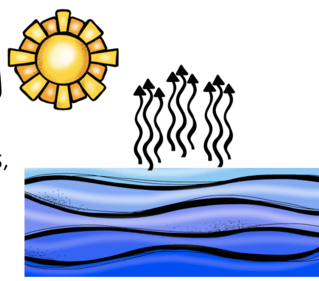
Evaporation happens when the sun ___________ water and turns it into vapor.
a)
cools
b)
heats up
c)
freezes
d)
lights up
16.
Why is the sun important to the water cycle?
a)
The sun provides electricity for the water to flow to earth. 
b)
The sun provides Earth with light and heat energy to make the cycle work. 
c)
The plays no role in the water cycle. 
d)
The sun creates runoff for the water cycle to begin. 
17.

How much of our planet is estimated to be covered with water?

a)

10%

b)

25%

c)

50%

d)

75%

18.

Evaporation is __________________.

a)

when water changes from a solid to a liquid

b)

when water changes from a liquid to a gas

c)

when water changes from a gas to a liquid

d)

none of the above

19.

What changes water from one state to another?

a)

clouds

b)

the ocean

c)

a change in temperature

d)

none of the above

20.

The passage of water vapor from a plant to the atmosphere is called ____________.

a)

transpiration

b)

evaporation

c)

hydrosphere

d)

condensation

21.

When is the best time for water to evaporate?

a)

cold and snowy

b)

wet and raining

c)

hot and dry

d)

all the time

22.

When warm water vapor is blown over land in the water cycle, what happens?

a)

evaporation

b)

the sun's rays heat up the ocean

c)

hot water vapor rises

d)

cooler air gets heavy with precipitation over the land

23.
Which best explains why runoff is important?
a)
It returns water to other locations on Earth
b)
It increases the chance of flooding
c)
It makes evaporation occur faster
d)
It increases condensation
24.
After the rain falls down onto Earth's surface, what most likely happens? What is it called?
a)
1. The remains of the water is soaked into the ground.
2.Groundwater
b)
1. Groundwater
2. The remains of the water is soaked into the ground.
c)
1. Groundwater
2. Transpiration happens to the plants.
d)
1. The liquid turns into an gas or an water vapor
2. Evaporation
25.
Which stage does #3 show in the diagram?
a)
condensation
b)
evaporation
c)
precipitation
d)
run off
26.
 What is a huge, slow-moving mass of ice and snow called?
a)
well
b)
glacier
c)
river system
d)
geyser
27.

What is the name given to water in the gaseous state?

a)

water

b)

water vapour

c)

ice cube

d)

snow

28.

What is the name of the process whereby water vapour turns to water?

a)

condensation

b)

evaporation

c)

boiling

d)

freezing
