Wayground logo

Free Printable Worksheets

Font size

S
M
L
XL
Worksheets

ASp2324 SolvQuad 1-53 ExpFunc 54-76 ExpAppl 77-101 Geom 102-123

Total questions: 123

Worksheet time: 21hrs 34mins

Name
Class
Date
1.

[BEGIN U4P2: Solving Quadratic Functions (1-53)] Solve by factoring: x2 = 7x + 18

a)

-7 and -18

b)

9 and 2

c)

9 and -2

d)

2 and 7

2.
What is this formula?
a)
This is the speed of light formula.
b)
This is the quadratic formula.
c)
This is the zero product property.
d)
This is scary.
3.
What is the first step to solving THIS equation by completing the square?
a2 + 10a + 21 = 0
a)
Set the equation equal to zero
b)
Divide 10 by 2 and add the result to both sides
c)
Add a2 and 10a together
d)
Subtract the 21
4.
Find the missing value "c" to create a perfect square trinomial:
x2 – 8x  + ___ 
a)
-4
b)
16
c)
4
d)
8
5.
Complete the square for
x2 + 12x + ____
a)
x2 + 12x + 144
b)
x2 + 12x + 36
c)
x2 + 12x - 36
d)
x2 + +12x - 144
6.
Complete the square.
x2 + 14x + ____
a)
x2 + 14x - 196
b)
x2 + 14x + 49
c)
x2 + 14x - 49
d)
x2 + 14x + 196
7.
When factoring
x2 - 4x + 4 = 20,
what goes in the blank?
(x - __ )2 = 20
a)
4
b)
2
c)
8
d)
20
8.
Solve by completing the square.
x2 + 4x= 12
a)
x = 2 and -2
b)
x = -6 and 2
c)
x = 6 and -2
d)
x = 1 and -1
9.
Determine the values of
a, b, and c for
the quadratic equation: 
4x2 – 8x = 3
a)
a = 4, b = -8, c = 3
b)
a = 4, b =-8, c =-3
c)
a = 4, b = 8, c = 3
d)
a = 4, b = 8, c = -3
10.
Factor x2-11x+24
a)
(x-3)(x-8)
b)
(x-2)(x-12)
c)
(x+3)(x+8)
d)
(x+2)(x+12)
11.
Solve for the values of x:
(x + 2)(x - 3) = 0
a)
{ 2, 3 }
b)
{ -2, -3 }
c)
{ 2, 3 }
d)
{ -2, 3 }
12.

Solve by factoring

a)

-4, 2

b)

-2, 4

c)

-16

d)

-4

13.

Solve by factoring. (HINT: Factor GCF 1st)

a)

x = 3, x = -6

b)

x = 0, x = 2

c)

x = 2, x = 3

d)

x = -2, x = 1

14.
Factor Completely: 
x4-9x2
a)
x2(x+3)(x-3)
b)
(x2+3x)(x2-3x)
c)
(x2+9)(x-3)(x+3)
d)
x2(x2-9)
15.
Solve
x2 + 13x + 12 = 0
a)
x = -12, -1
b)
x = 12, 1
c)
x = 13, 1
d)
x = -13, -1
16.
Factor x2-6x-40
a)
(x-10)(x+4)
b)
(x+10)(x-4)
c)
(x-8)(x+5)
d)
(x+8)(x-5)
17.
The quadratic equation can be used to solve quadratic equations that cannot be factored.
a)
True
b)
False
18.
Solve the equation: 
5x2 - 35x + 60 = 0
a)
x = 3,  -4
b)
x = -3,  4
c)
x = 3,  4
d)
x = -3,  -4
19.

Solve for the values of x:

(x + 2)(x - 3) = 0

a)

{ 2, 3 }

b)

{ -2, -3 }

c)

{ 2, 3 }

d)

{ -2, 3 }

20.

Solve by factoring:

n² - 2n = 0

a)

n = 2 and 0

b)

n = -2 and 0

c)

n = 2

d)

n = 0

21.

Solve: x2=36x^2=36  

a)

±6\pm6  

b)

±18\pm18  

c)

±12\pm12  

d)

66  

22.

What are the factors of
x2−16x^2-16  

a)

(x−4)2\left(x-4\right)^2  

b)

(x+4)2\left(x+4\right)^2  

c)

(x−4)(x+4)\left(x-4\right)\left(x+4\right)  

d)

(x)2−(4)2\left(x\right)^2-\left(4\right)^2  

23.

How many roots can a quadratic function have?

(select all that are true)

a)

0

b)

1

c)

2

d)

Infinite

24.

What is the discriminant of the Quadratic Formula?

a)

−b2a\frac{-b}{2a}

b)

b2−4ac\sqrt{b^2-4ac}

c)

b2−4acb^2-4ac

d)

−b±b2−4ac2a\frac{-b\pm\sqrt{b^2-4ac}}{2a}

25.
Factor:  x2 - 2x - 24
a)
(x + 6)(x - 4)
b)
(x + 4)(x - 6)
c)
(x - 4)(x - 6))
d)
(x - 3)(x + 8)
26.
Factor:  x2 + 13x + 30
a)
(x + 3)(x + 10)
b)
(x + 5)(x + 6)
c)
(x + 2)(x + 15)
d)
(x + 1)(x + 30)
27.
Factor:  x2 - 16x + 24
a)
(x + 2)(x - 14)
b)
(x - 2)(x - 14)
c)
(x + 14)(x - 2)
d)
(x - 4)(x - 6)
28.

Determine the values of

a, b, and c for

the quadratic equation:

4x2 – 8x - 3 = 0

a)

a = 4, b = -8, c = 3

b)

a = 4, b =-8, c =-3

c)

a = 4, b = 8, c = 3

d)

a = 4, b = 8, c = -3

29.
Factor:  2x2 - 5x + 2
a)
(2x - 1)(x - 2)
b)
(2x + 1)(x - 2)
c)
(2x - 2)(x - 1)
d)
(2x + 2)(x - 1)
30.
Factor:  3x2 - 5x - 2
a)
(3x + 1)(x - 2)
b)
(3x + 2)(x - 1)
c)
(3x - 1)(x + 2)
d)
(3x - 2)(x + 1)
31.
The solutions of the quadratic equation 
x2+12x+35=0 are
a)
x = -5 or x = -7
b)
x = 5 or x = 7
c)
x = -35 or x = -1
d)
x = -9 or x = -4
32.
The solutions of the quadratic equation 
x2+2x-15=0 are
a)
x = 3 or x = 5
b)
x = 5 or x = -3
c)
x = -5 or x = 3
d)
x = -3 or x = -5
33.
The solutions of the quadratic equation 
x2+x+3=0 are
a)
x = 1 or x = 3
b)
x = -1 or x = -3
c)
x = -3 or x = 1
d)
No solutions
34.
What are the solutions to this equation? (x-3)(x+2)=0
a)
x=3,-2
b)
x=-3,2
c)
x=2,3
d)
x=3,2
35.

What technique was used to "discover" the quadratic formula?

a)

taking the square root

b)

completing the square

c)

factoring using the area model

d)

factoring by trial and error

36.
What should you do first in solving this equation?
x2 + 6x - 13 = 3
a)
Get factored form
b)
Write down: a=1, b=6, c=-13
c)
Make it equal 0 by subtracting 3 on each side
d)
Type it all in a calculator.
37.
In the equation
y = x2 +5x +7, match each leading coefficient with its correct letter 
a)
a=0, b=5, c=7
b)
a=1, b=5, c=7
c)
a=7, b=5, c=1
38.
Solve Using the Quadratic Formula 
2x2 + 7x - 15 = 0
a)
-1.5 or 5
b)
No Solution
c)
-5 or 1.5
d)
0.7 or 5
39.
Identify the 'c' value: y = 16x2 -8x -24
a)
16
b)
-8
c)
24
d)
-24
40.
Use the quadratic formula to find the solutions for
y = 3x3 + 8x - 1
a)
0.1167 and -2.7833
b)
.7 and -16.7
c)
.35 and -8.35
d)
0.2358 and -1.236
41.
Use the quadratic formula to find the solutions for
y = -x2 - 5x + 12
a)
-4.9 and -0.1
b)
-8.54 and 8.54
c)
-0.45 and 3.55
d)
-6.77 and 1.77
42.
Name "c" for the equation
4x2 - 5x + 7 = 10
a)
7
b)
17
c)
-5
d)
-3
43.
Use the graph to determine the solutions.
a)
-1 and -3
b)
1 and -3
c)
1 and 3
d)
-1 and 3
44.
Solve Using the Quadratic Formula
 x2 + 4x - 40 = -8
a)
-10 & -4
b)
-4 & 10
c)
-8 & 4
d)
8 & -4
45.
Use the quadratic formula to solve 2x2 + 2x - 12?
a)
-2, 3
b)
2, 3
c)
2, -3
d)
-2, -3
46.
How many solutions does the equation 4x2 + 4x + 1 = 0 have?
a)
0
b)
1
c)
2
d)
More than 2
47.
find x for
2x2-8x-24=0
a)
x= 6, -2
b)
x= 2, -6
c)
x= 4, 2
d)
x= 2, 6
48.

b2−4acb^2-4ac  is called the . . .

a)

Square root

b)

Quadratic formula

c)

X-intercepts

d)

Discriminant 

49.

If there are no real solutions, the discriminant is

a)

zero

b)

a postive number

c)

a negative number

d)

a perfect square

50.

x2+4x+3=0x^2+4x+3=0  

a)

x = 1 and -3

b)

x = -1 and -3

c)

x = -1 and 3

d)

x = 1 and 3

51.

x2+2x−1=2x^2+2x-1=2  

a)

x = -1 and -3

b)

x = 1 and 3

c)

x = 1 and -3

d)

x = -1 and 3

52.

2x2−2x+3=02x^2-2x+3=0  

a)

x = -1 and 3

b)

x = 1 and -3

c)

No real solution

d)

x = 1

53.

2x2−36=x2x^2-36=x   [END U4P2: Solving Quadratic Functions (1-53)]

a)

x=−92and 4x=\frac{-9}{2}and\ 4  

b)

x=92 and −4x=\frac{9}{2}\ and\ -4  

c)

x=4 and −4x=4\ and\ -4  

d)

No real solution

54.

[BEGIN HW U3L3 Exponential Function Characteristics (54-76)] What is the equation that represents the BLUE curve?

a)

y=(12)xy=\left(\frac{1}{2}\right)^x  

b)

y=4(12)xy=4\left(\frac{1}{2}\right)^x  

c)

y=2(12)xy=2\left(\frac{1}{2}\right)^x  

d)

I do not know

55.
Whats the horizontal asymptote?
a)
y=1
b)
y=0
c)
(0,-1)
d)
y=-1
56.
Is the pictured graph growth, decay, or linear or none?  
a)
Exponential Growth
b)
Exponential Decay
c)
Linear
d)
None
57.
Write each product using an exponent. 
7 x 7 x 7 x 7 x 7 x 7 x 7 x 7 
a)
77
b)
78
c)
87
d)
79
58.
Which of the following could correctly represent a horizontal asymptote? 
a)
(0,3)
b)
y=3
c)
3
d)
(3,0)
59.
What is the initial value of the function y=⅓ × 4x
a)
⅓
b)
3
c)
4
d)
¼
60.
Whats the horizontal asymptote?
a)
y=3
b)
y=-2
c)
y=-3
d)
(0,-3)
61.
What is the domain of the function shown below?
a)
-2 < x < 5
b)
0 < x < 12
c)
y > 0
d)
All Real Numbers
62.
What is the range of this graph?
a)
y = 6
b)
(0, -4)
c)
y > -6
d)
y < -6
63.
What is the range of the function shown below?
a)
0 < y < 12
b)
-2 < y < 5
c)
y > 0
d)
All Real Numbers 
64.
Is the pictured graph growth, decay, or linear or quadratic?  
a)
Growth
b)
Decay
c)
Linear
d)
Quadratic
65.

Which represents exponential decay?

a)

A

b)

B

c)

C

d)

D

66.
In an exponential function, what does the 'a' represent? 
a)
SLOPE
b)
RATE OF CHANGE
c)
Y-INTERCEPT
d)
COMMON RATIO
67.

What is the domain and range of the exponential function shown?

a)

Domain all real numbers and range y > 1.

b)

Domain all real numbers and range y > 2.

c)

Domain all real numbers and range y < 2.

d)

Domain x > 2 and range y > 2.

68.

What is the asymptote of the exponential function shown?

a)

y = 6

b)

y = 5

c)

y = 10

d)

y = -5

69.

Describe the transformations of the exponential function shown.

a)

Stretch by a factor of 7, shift left 4, and shift down 7.

b)

Stretch by a factor of 7, shift right 4, and shift down 7.

c)

Shrink by a factor of 7, shift left 4, and shift down 7.

d)

Stretch by a factor of 7, shift left 4, and shift up 7.

70.

Describe the transformations of the exponential function shown.

a)

Reflection over the x-axis, shift right 5 and shift down 2.

b)

Shift right 5 and shift down 2.

c)

Reflection over the x-axis, shift left 5 and shift down 2.

d)

Shift right 5 and shift up 2.

71.

Describe the transformations of the exponential function shown.

a)

Shrink by a factor of 2/3 and shift right 10.

b)

Shrink by a factor of 2/3 and shift left 10.

c)

Stretch by a factor of 5 and shift left 10.

d)

Stretch by a factor of 5 and shift right 10.

72.

What is the x-intercept and the y-intercept of the exponential function shown?

a)

( 1, 0 ) and ( 0, -2 )

b)

( 0, 1 ) and ( -2, 0 )

c)

( 1, 0 ) and ( -2, 0 )

d)

( 0, 1 ) and ( 0, -2 )

73.

Which graph represents the function shown?

a)
b)
c)
d)
74.

Which graph represents the function shown?

a)
b)
c)
d)
75.

Which exponential equation represents the graph shown?

a)
b)
c)
d)
76.

[END HW U3L3 Exponential Function Characteristics (54-76)] Which exponential equation represents the graph shown?

a)

b)

c)

d)

77.

[BEGIN HW U3L6 Exponential Applications (Rule of 72) (77-101)] How long will it take an investment of $7,120.73 at 13% interest to double?

a)
5
b)
6.6
c)
5.5
d)
6.1
78.

How long will it take an investment of $6,573.45 at 17% interest to double?

a)
4.7
b)
4.2
c)
3.8
d)
5.1
79.
How long will it take an investment of $44,148.50 at 11% interest to double?
a)
7.2
b)
5.9
c)
6.5
d)
7.9
80.
How long will it take an investment of $37,215.04 at 15% interest to double?
a)
5.8
b)
4.8
c)
5.3
d)
4.3
81.
How long will it take an investment of $23,140.40 at 17% interest to double?
a)
4.7
b)
4.2
c)
3.8
d)
5.1
82.
How long will it take an investment of $46,889.32 at 3% interest to double?
a)
26.4
b)
28.8
c)
21.6
d)
24
83.
How long will it take an investment of $46,637.27 at 13% interest to double?
a)
5
b)
6.1
c)
6.6
d)
5.5
84.
How long will it take an investment of $29,545.20 at 6% interest to double?
a)
14.4
b)
13.2
c)
10.8
d)
12
85.
How long will it take an investment of $45,119.11 at 12% interest to double?
a)
6
b)
5.4
c)
7.2
d)
6.6
86.
How long will it take an investment of $27,871.86 at 36% interest to double?
a)
2
b)
1.8
c)
2.4
d)
2.2
87.
How long will it take an investment of $17,261.38 at 19% interest to double?
a)
3.8
b)
4.2
c)
3.4
d)
4.5
88.
How long will it take an investment of $38,105.19 at 50% interest to double?
a)
1.7
b)
1.4
c)
1.6
d)
1.3
89.
How long will it take an investment of $25,529.01 at 11% interest to double?
a)
6.5
b)
7.2
c)
5.9
d)
7.9
90.
How long will it take an investment of $31,684.90 at 7% interest to double?
a)
10.3
b)
9.3
c)
12.3
d)
11.3
91.
How long will it take an investment of $32,545.86 at 24% interest to double?
a)
3
b)
2.7
c)
3.3
d)
3.6
92.
How long will it take an investment of $41,607.60 at 5% interest to double?
a)
15.8
b)
14.4
c)
17.3
d)
13
93.
How long will it take an investment of $19,325.65 at 36% interest to double?
a)
2.2
b)
2.4
c)
2
d)
1.8
94.
How long will it take an investment of $18,542.70 at 36% interest to double?
a)
2.4
b)
2
c)
2.2
d)
1.8
95.
How long will it take an investment of $11,883.99 at 48% interest to double?
a)
1.7
b)
1.8
c)
1.5
d)
1.4
96.
How long will it take an investment of $14,049.44 at 18% interest to double?
a)
4.8
b)
3.6
c)
4
d)
4.4
97.
How long will it take an investment of $828.17 at 13% interest to double?
a)
5.5
b)
5
c)
6.1
d)
6.6
98.
How long will it take an investment of $22,920.78 at 18% interest to double?
a)
3.6
b)
4.8
c)
4
d)
4.4
99.
How long will it take an investment of $22,535.93 at 6% interest to double?
a)
12
b)
13.2
c)
14.4
d)
10.8
100.
How long will it take an investment of $4,210.33 at 8% interest to double?
a)
8.1
b)
9.9
c)
9
d)
10.8
101.

[HW U3L6 Exponential Applications (Rule of 72) (77-101)] How long will it take an investment of $25,254.27 at 11% interest to double?
a)
7.2
b)
5.9
c)
6.5
d)
7.9
102.

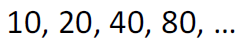
[BEGIN HW U3L8 Geometric Sequences (102-123)] Find the common ratio for the geometric sequence.

a)
10
b)
1/2
c)
2
d)
4
103.
Is the sequence -432, 72, -12, 2,...geometric?
a)
yes
b)
no
104.

What are the next 3 terms in the following geometric sequence:

512, 256, 128, ___, ___, ___, ...

a)

1024, 2048, 4096

b)

32, 8, 2

c)

64, 32, 16

d)

92, 66, 38

105.
Write the explicit formula for the geometric sequence.
a)
an = 4(3)n-1
b)
an = 3(4)n-1
c)
an = -4(3)n-1
d)
an = 3(-4)n-1
106.
Find the first four terms of the sequence given the rule:
an = 4(5)n-1
a)
20, 100, 500, 2500
b)
5, 20, 80, 320
c)
4, 20, 100, 500
d)
4, 9, 14, 19
107.
What is the 14th term of the geometric sequence?
a)
14,348,907
b)
4,782,969
c)
1,594,323
d)
45
108.

Given the sequence:

125, 25, 5, ....

Write the rule an using the geometric sequence formula:

a)

an = (125)(1/5)(n-1)

b)

an = 625(1/5)(n-1)

c)

an = 625(5)(n-1)

d)

an = 125 + 5n

109.
Find a12 in the sequence -1, -3, -9, -27, ...
a)
-177,147
b)
-19,683
c)
-59,049
d)
118,098
110.

A geometric sequence has a common ration(r) of 3 and the 8th term (a8) is 13,122. What is the first term of the sequence (a1)?

a)

3

b)

6

c)

18

d)

2

111.

What is the 9th term in a geometric sequence with a common ratio of 2 and a first term of 3?

a)

384

b)

768

c)

1,536

d)

27

112.

Daisy received $2 on her first birthday. Each year, the amount of money she received tripled. How much money will she receive on her 5th birthday?

a)

$10

b)

$300

c)

$162

d)

$416

113.
The population of Winnemucca, Nevada, can be modeled by P=6191(1.04)t where t is the number of years since 1990. What was the population in 1990? 
a)
0 people
b)
It doesn't say
c)
I don't know
d)
6191
114.
The population of Winnemucca, Nevada, can be modeled by P=6191(1.04)t where t is the number of years since 1990. What percent did the population increase each year?
a)
4%
b)
It doesn't say
c)
I don't know
d)
400%
115.
Which of the following functions shows an initial amount of $15 and an increase of 35% each year?
a)
y = 15(35)x
b)
y = 15(1.35)x
c)
y = 15(0.35)x
d)
y = 35(1.15)x
116.
What is the decay rate in the following model?
A=1200(.85)6
a)
-1200
b)
-.15
c)
6
d)
-6
117.
The value of a car is $15,000 and depreciates at a rate of 8% per year. What is the decay factor?
a)
.08
b)
1.08
c)
.92
d)
8
118.
The number of mosquitoes at the beginning of the summer was 4,000. The population of mosquitoes is expected to grow at a rate of 25% a month. How many mosquitoes will there be after 4 months?
a)
9766
b)
9006
c)
9765
d)
5433
119.
Suppose a culture of bacteria begins with 5000 cells and dies by 30% each year. Write an equation that represents this situation.
a)
y=5000(0.7)x
b)
y=30(5000)x
c)
y=5000(1.3)x
d)
y=5000xx
120.

The population of the United States was 248,718,301 in 1990 and was projected to grow at a rate of about 8% per decade. Predict the population, to the nearest hundred thousand, for the years 2018.

a)

978617180000 people

b)

248757647 people

c)

993883180 people

d)

55448350 people

121.
A population of fish starts at 8,000 and decreases by 6% per year. What is the population of fish after 10 years?
a)
14327
b)
4309
c)
839
d)
7680
122.
Daniel’s Print Shop purchased a new printer for $35,000. Each year it depreciates at a rate of 5%. How much will the printer be worth in 8 years?
a)
$23,219.72
b)
$136.72
c)
$51,710.94
d)
$16,710.94
123.

[END HW U3L8 Geometric Sequences (102-123)] The attendance at the art museum at the New Year’s opening was 250 people. The attendance has been increasing at a rate of 3% each month. How many people will attend by the end of a year?

a)
356
b)
265
c)
5825
d)
1329