
 Worksheets
09. THEORY OF EVOLUTION JEDI TRAINING
Total questions: 11
Worksheet time: 23mins
There are several theories that scientist use to explain how evolution occurs. Some of these theories are no longer accepted by scientists.
Evolutionary theory that claims that individual organisms could alter the size or shape of particular organs by using their bodies in new ways and pass these changes to their offspring by heredity.
Transformational theory
Theory that explains that individuals that are better adapted to their environment survive and reproduce more successfully than less well adapted individuals do.
Theory of natural selection
Proposes that species are stable most of the time, but every now and then there is a disruptive event that prompt rapid change.
Theory of punctuated equilibrium
Theory that suggests that evolution occurs at a slow.
Theory of gradualism
Evolution toward different traits in related species.
This occurs when related species adapt to different environment.

Convergent evolution

Divergent evolution

Coevolution
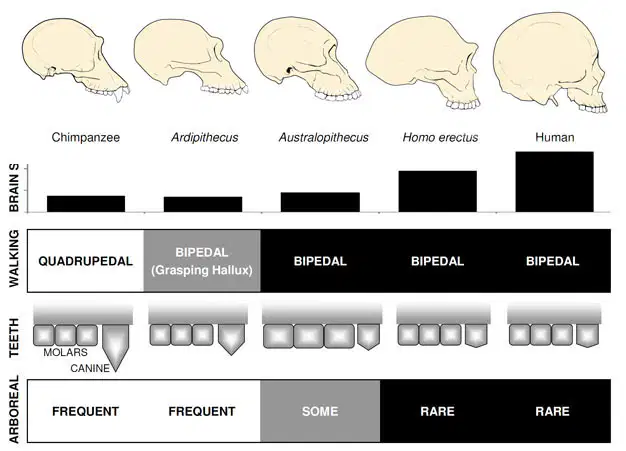
Hominid evolution, or the evolution of bipedal primates has been characterized by various trends over the last 7 million years. Place the trends in their correct column.
forehead size
teeth size
jaw size
use of language
cranial capacity
brain size
tool making ability
browridge size
Reorder the following hominid fossils from from most primitive (old) to modern (new)


Reorder the following hominid fossils from from most primitive (old) to modern (new)


Reorder the following hominid fossils from from most primitive (old) to modern (new)


Reorder the following trends in hominid evolution
bipedalism
increased in cranial capacity
ability to use language and tools
A human arm and a whale fin have similar bone structure but the whale fin is used for swimming and the arm is used for reaching and grabbing. What type of structures are these? (a) s?
A bat wing and a butterfly wing are both used for flying but they are made differently. What type of structure is this? (b)
When comparing the DNA of two different organisms, the more differences in the DNA base pairs the more (c) they are.
A (d) has apparent function and appear to be residual parts from a past ancestor. Examples include the human appendix, the pelvic bone of a snake, and the wings of flightless birds.
Similarities in homologous structures and embryonic development can be used to infer
Evolution is the process by which species changes over time. There are several ideas proposed to explain how such changes occur.
Evolution toward similar traits in unrelated species.
This occurs when unrelated species adapt to similar environment.
Convergent evolution
Evolution toward different traits in related species.
This occurs when related species adapt to different environment.
Divergent evolution
Evolution where two or more species change in close association with each other.
Coevolution
Analogous Structure
Same function but different structure (wings of a buttrfly and a bird)
Homologous Structure
Same structure different function (a whale fin and a human arm)
Comparative Embryology
Comparing embryological development of different species
Molecular biology
Comparing DNA and amino acid sequences of different species
Vestigial Structures
Structures remaining in the body of an organism that no longer have a function (whale hip)
Evolution is the process by which species changes over time. There are several ideas proposed to explain how such changes occur.
A shark is a fish, a dolphin is a mammal, they have a very distant common ancestor. However, they have evolved very similar body types to swim in the ocean.
Convergent evolution
All species of Galapagos finches descended from a recent common ancestor. As they colonized different islands, they developed different physical traits.
Divergent evolution
The shape of the of the flower and the beak of the Hawaiian honeycreeper fit precisely.
The bird can draw nectar more efficiently than the other bird species. During nectar feeding most honeycreepers provide pollination service.
Coevolution

