
 Worksheets
Matter Part 2 Review
Total questions: 28
Worksheet time: 21mins
What makes mass and weight different?
Mass is the amount of matter meanwhile weight is expressed in kg, lbs. and g.
Mass and weight are expressed in g, kg and lbs.
Mass is the amount of matter meanwhile weight is the force of gravity on an object's mass.
none of the choices
Vaporization/ evaporation is the change of physical state from _______ to _______.
gas to liquid
liquid to gas
solid to gas
gas to solid
Dry ice on the kitchen counter has disappeared without a trace. Dry ice skips the liquid phase. It never "melts" instead turns directly into a gas. This is an example of what change of physical state?
Sublimation
Melting
Condensation
Deposition
It is formed by heating and ionizing a gas. Occurs only in lightning discharges and artificial devices.
Bose-Einstein Condensate
Plasma
Plsama
Plamas
Which of the following is an example of chemical property?
Electrolysis
Corrosive
Combustibility
all of the choices
Why does your drink get cold when you put ice on them?
because the ice takes up energy from your drink causing them to get colder
because the ice takes up energy from the surrounding air causing your ice to melt
because the ice needs energy to melt causing it to release energy to your drink
none of the choices


Element
Compound
Homogeneous Mixture
Heterogeneous MIxture

What is it?
Pure Substance
Mixture
When there is 2 or more atoms combined together
Element
Compound
Homogeneous Mixture
Heterogeneous Mixture
A positively charged particle found in the nucleus of an atom is
a quark.
an electron.
a proton.
a neutron.
A negatively charged particle located outside the atom's nucleus is
a neutron.
a proton.
an electron.
a quark.
A subatomic particle that has no charge and that is found in the nucleus of an atom is
a quark.
a proton.
a neutron.
an electron.
An area around an the center of the atom where electrons are located
is deep space.
is a quark.
is a nucleus.
is an electron cloud.

How many protons does Nitrogen have?
7
8
14
14.01

Which of the labeled structures is a neutron?
a
b
c

What is the mass number of this element?
7
8
14
14.01
If an element has an atomic number of 11 and a mass number of 23, how many neutrons does it have?
11
12
23
34

What is the chemical symbol of this element?
79
Au
AU
gold
a unique number for each element that equals the number of protons in an atom of that element
element name
element symbol
atomic number
atomic mass
a grouping of elements based on similar properties, arranged by columns in the periodic table; also known as a group
family
period
row
isotope
a row on the Periodic Table of Elements
family
period
row
isotope
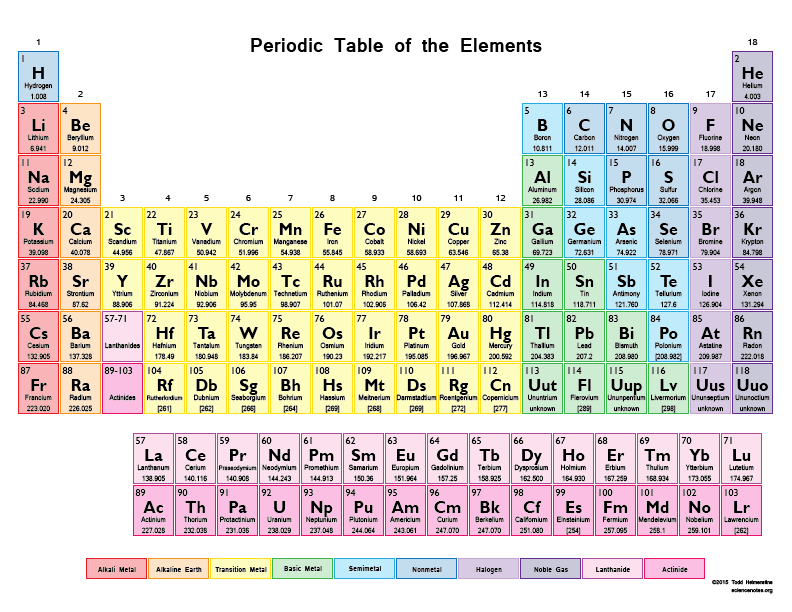
What is the atomic number of Barium, Ba? (enlarge the periodic table)
20
38
56
88
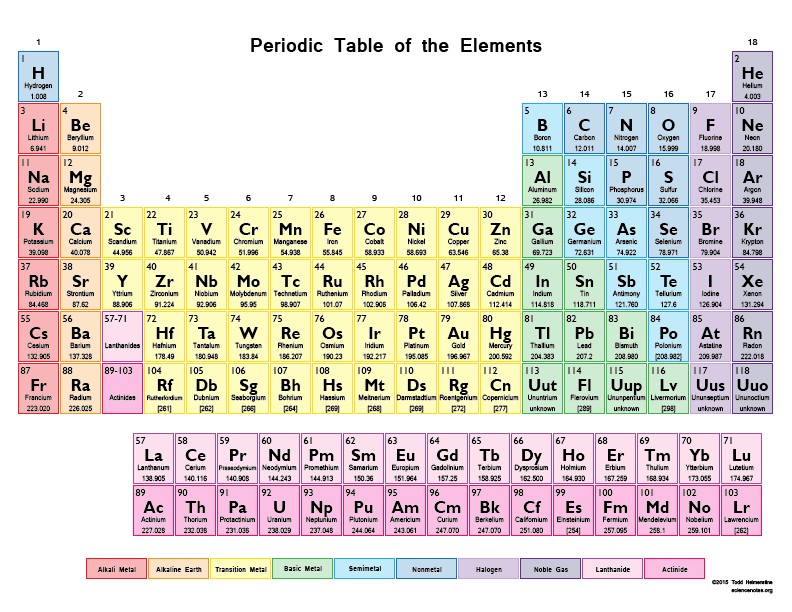
How many protons are in a sodium atom, Na? (tap to enlarge the periodic table)
Sodium has 1 proton.
Sodium has 3 protons.
Sodium has 11 protons
Which two elements on the periodic table are in the same group?
Na and He
O and C
Li and Ne
He and Ar

