
 Worksheets
5.1 Distribution and Abundance
Total questions: 14
Worksheet time: 10mins

Which of the following describes a population?
The total number of people, animals, and plants in New York City
The total number of apartments in New York City
The total number of people living in New York City
The amount of water in the Hudson River
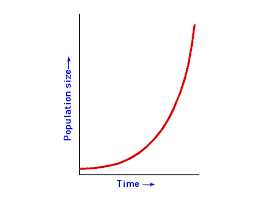
What type of growth is shown in the diagram?
exponential growth
logistic growth
predator-prey cycle
boom-bust curve
Largest number of individuals of a population that the environment can support...
carrying capacity
population
biome
mutualism

Will competition increase or decrease the population of a species of animals?
Decrease
Increase

When a population grows past the ecosystem's carrying capacity, what most likley happens to the population?
Continues to grow
The population starts to die off to return to carrying capcity
The population will go completely extinct due to lack of resources
Limiting factors are sometimes helpful because they can keep the population from getting to large.
True
False
Which limiting factor is density independent?
water
food
natural disasters
Which limiting factor would increase due to the number of individuals in a population?
Unusual weather
Natural disaster
Disease
An environmental factor such as amount of space, disease, and availability of mates that depends on the number of members in a population is called
density- dependent factor
density- independent factor

If a disease destroying wheat plants in a field swept through an ecosystem, what would happen to the bird population that feed off of the wheat in the the field ?
The bird population would stay the same
The bird population would increase
The bird population would decrease
Food, water, sunlight, shelter, and space are resources that are called
limiting factors
species
biotic
none of the above
Which of the following is a density dependent factor?
volcanic eruption
earthquake
disease
hurricane

