wayground logo

Free Printable Worksheets

NEW

Font size

S
M
L
XL
Worksheets

Genetics Benchmark Review 21-22

Total questions: 37

Worksheet time: 54mins

Name
Class
Date
1.

If an organism is said to have a genotype of "aa", which of the following then best describes it?

a)

Homozygous recessive

b)

Homozygous dominant

c)

Heterozygous dominant

d)

Heterozygous recessive

2.

If round seeds (R) are dominant to wrinkled seeds, which best describes a seed that's heterozygous?

a)

rr

b)

RR

c)

Rr

d)

Wrinkled

3.

Yellow flowers (Y) are dominant to white flowers. Which best describes a genotype of "Yy"?

a)

yellow

b)

Homozygous dominant

c)

Heterozygous recessive

d)

yy

4.

Based on the Punnett Square shown, what should fill in the missing box?

a)

GG

b)

Gg

c)

gg

d)

gG

5.

Based on the Punnett Square shown, what should go in the missing boxes?

a)

BB

b)

Bb

c)

bb

d)

white flower

6.

Based on the Punnett Square shown, what best describes the alleles of missing boxes?

a)

tt

b)

Tt

c)

Homozygous dominant

d)

Heterozygous

7.
Heterozygous is when...
a)
the alleles are the same
b)
the alleles are different
c)
the alleles are absent
d)
the alleles are present
8.
In a heterozygous genotype, the ___________ allele takes over in the phenotype.
a)
recessive
b)
dominant
c)
lower case letter
d)
both 
9.
Which of the following alleles is homozygous (purebred) recessive?
a)
Tt
b)
tt
c)
TT
d)
t
10.
What you see, or the physical appearance.
a)
Genotype
b)
Phenotype
c)
Homozygous
d)
Heterozygous
11.
Genotype refers to the ...
a)
physical expression of the genes
b)
the possible combination of alleles in a gene
c)
whether an allele is dominant or recessive
d)
how an organism will appear
12.
the theory that all species are descended from common ancestors who have changed over time by means of natural selection 
a)
Adaptations 
b)
 Mutation
c)
Theory of Evolution
d)
Speciation
13.
inherited trait that increases an organism’s chance of surviving in a environment long enough to pass on its genes   
a)
Adaptations 
b)
 Mutation
c)
Theory of Evolution
d)
Speciation
14.
random change in an organism’s DNA; can have positive, negative, or neutral effects on the organism 
a)
Adaptations 
b)
 Mutation
c)
Theory of Evolution
d)
Speciation
15.
the process of one species developing into two or more species that can no longer mate 
a)
Adaptations 
b)
 Mutation
c)
Theory of Evolution
d)
Speciation
16.
process by which the individuals best adapted to their environment tend to survive and pass their traits to subsequent generations   
a)
Adaptation
b)
 Mutation
c)
Natural Selection
d)
Speciation
17.
the basic unit of heredity carried by the chromosomes; codes for proteins which determine the traits of an organism 
a)
Heredity
b)
Variation
c)
Gene
d)
Speciation
18.
the range of expression of a trait within a population 
a)
varitation
b)
gene
c)
chromosome
d)
speciation
19.
Populations need variation in traits in order for natural selection to happen
a)
true
b)
false
20.
The environments an organism lives in determines which adaptation is best.
a)
true
b)
false
21.
Finches flew to a different island because their beak was better adapted to food there. 
a)
true
b)
false
22.
If the environment changes, finches with beaks that are better adapted have a better chance of surviving to reproduce. 
a)
true
b)
false
23.
Speciation occurred when populations of finches became isolated from each other and after a long time could no longer mate. 
a)
true
b)
false
24.
Why are advantageous traits more likely to be passed onto offspring?
a)
Because they are more likely to survive and reproduce.
b)
Because they come from dominant alleles.
c)
Because they come from recessive alleles.
d)
Because the trait is an acquired phenotype.
25.
Which of the following means "genetic change over time"
a)
natural selection
b)
speciation
c)
evolution
d)
fitness
26.
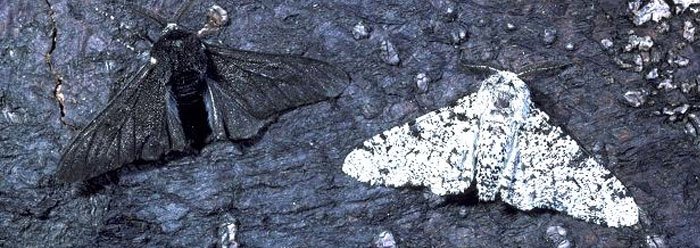
The trees these moths used to live on were white, but have been covered in soot from coal factories. Which moth will be more successful in this environment?
a)
Dark moth
b)
Light moth
c)
Both will be equally successful
d)
Neither will be successful
27.
Since the 1800s humans have stopped burning coal, and the trees have returned to their original color. Which moth will be more successful in this environment?
a)
Dark moth
b)
Light moth
c)
Both will be equally successful
d)
Neither will be successful
28.
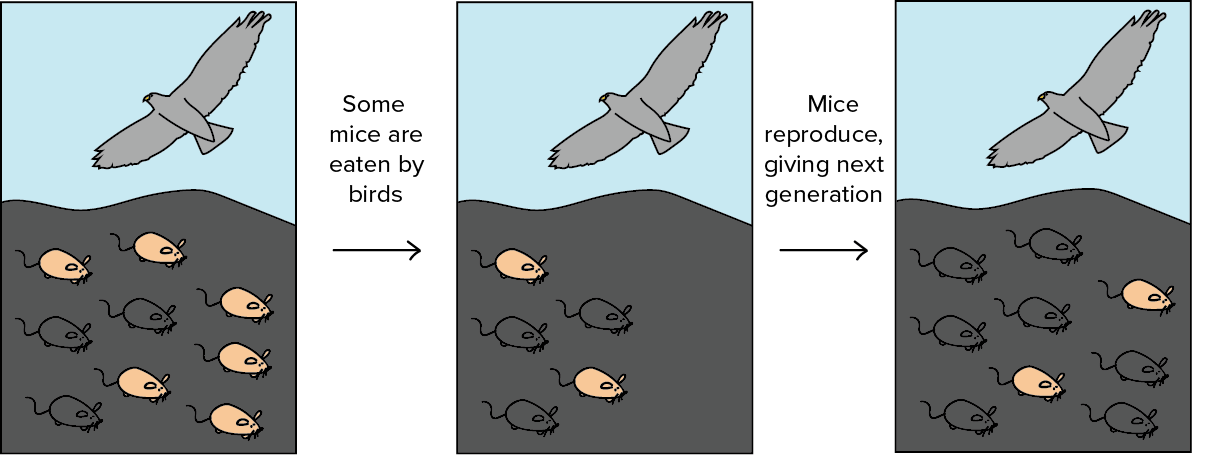
What process is being shown in this image?
a)
Variation
b)
Natural Selection
c)
Selective Breeding
d)
Homeostasis
29.
Why is the mouse population changing over time?
a)
The light mice can reproduce more successfully than the dark mice
b)
The hawks eat more dark mice than light mice because the dark mice taste better
c)
The hawks eat more light mice than dark mice because they can see the light mice more easily
d)
The hawks eat more dark mice than light mice because they can see the dark mice more easily
30.
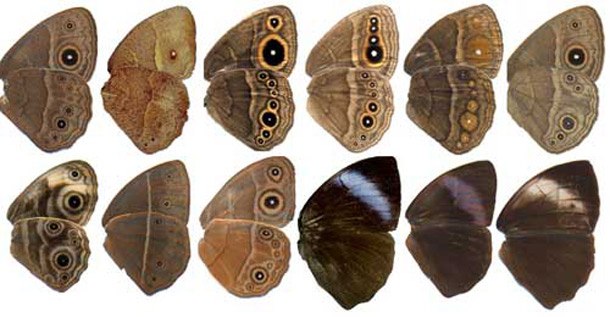
These moths are all the same species. The differences between their wings is an example of ________________
a)
Natural Selection
b)
Variation
c)
Homeostasis
d)
Extinction
31.

This type of reproduction involves two parents.

a)

Asexual reproduction

b)

Sexual reproduction

32.

Which type of reproduction produces an identical copy of the parent?

a)

Sexual reproduction

b)

Asexual reproduction

33.

Which statement does NOT describe asexual reproduction?

a)

takes a short amount of time

b)

provides genetic variation - all offspring are different

c)

no mate required in order to reproduce

d)

provides no genetic variation - all offspring are the same

34.

In sexual reproduction, how much DNA is given by each parent?

a)

10%

b)

30%

c)

100%

d)

50%

35.
Sexual reproduction requires _____ parents and asexual reproduction requires ___ parents
a)
1,1
b)
2,2
c)
2,1
d)
1,2 
36.
Which process creates genetically DIFFERENT offspring?
a)
sexual 
b)
asexual
37.
What are some of the facts about sexual reproduction?
a)
Takes two mates to reproduce and takes a longer time to reproduce
b)
Takes one mate to reproduce and takes a shorter amount of time to reproduce
c)
Takes two mates to reproduce and takes a shorter amount of time to reproduce
d)
Takes one mate to reproduce and takes a shorter amount of time to reproduce