
 Worksheets
Electrochemistry UPS1
Total questions: 11
Worksheet time: 22mins
What is a redox reaction?
A reaction where both reactants get reduced.
A reaction where both reactants get oxidized.
A reaction that involves a transfer of electrons between reactants.
A reaction that involves the combustion of at least one reactant.
What is a galvanic (voltaic) cell?
It is a cell that destroys electrons on one side and creates electrons on the other side.
It is a cell that contains only one metal bar and one aqueous ion solution.
It is a type of battery that drives a redox reaction when electricity is applied.
It is a type of battery that generates an electrical current from redox reactions.
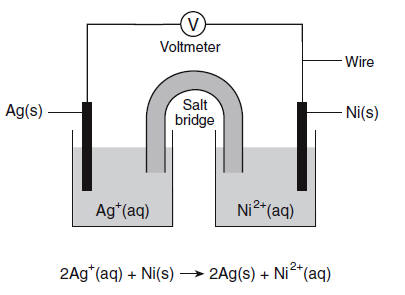
What reaction occurs at the anode?
Ag+/Ag = 0.80V
Ni2+/Ni = -0.25V
Ag+ + e- →Ag
Ag → Ag+ + e-
Ni2+ + 2e- → Ni
Ni → Ni2+ + 2e-
Which of the following is false regarding galvanic cells?
It converts chemical energy into electrical energy
The electrolytes taken in the two beakers are different
The reactions taking place are non-spontaneous
To set up this cell, a salt bridge is used

Given their standard reduction potentials, which of the species is going to be oxidized?
Cu2+/Cu = 0.34V
Zn2+/Zn = -0.76V
Cu
Zn
CuSO4
ZnSO4
In an electrolytic cell the electrode at which the electrons enter the solution is called the ______ ; the chemical change that occurs at this electrode is called _______.
anode, oxidation
anode, reduction
cathode, oxidation
cathode, reduction
In voltaic cells, the salt bridge _______ .
is not necessary in order for the cell to work
drives free electrons from one half-cell to the other
allows charge balance to be maintained in the cell
is tightly plugged with firm agar gel through which ions cannot pass
Which of the following statements is FALSE?
Oxidation and reduction half-reactions occur at electrodes in electrochemical cells.
Reduction occurs at the cathode.
Oxidation occurs at the anode.
All voltaic (galvanic) cells involve the use of electricity to initiate nonspontaneous chemical reactions.
Which of the following represents the reaction that occurs at the negative electrode in the above cell?
Pb / Pb(NO3)2 (1.0 M) || AgNO3 (1.0 M) / Ag
Pb2+ + 2 e- → Pb
Pb → Pb2+ + 2 e-
Ag+ + e- → Ag
Ag → Ag+ + e-
In the standard notation for a voltaic cell, the double vertical line "||" represents:
a phase boundary
gas electrode
a wire (metal) connection
a salt bridge

When water is electrolyzed, gas collected at cathode, is
sulphur
oxygen
hydrogen
sulphur dioxide

