wayground logo

Free Printable Worksheets

Font size

S
M
L
XL
Worksheets

Evolution

Total questions: 50

Worksheet time: 28mins

Name
Class
Date
1.
Which term refers to the process by which individuals that are better suited to the environment survive and reproduce therefore passing down their genes to their offspring? 
a)
Evolution 
b)
Variation 
c)
Adaptation
d)
Natural Selection 
2.
Which species’ DNA is most similar to the DNA of the toothed whale? 
a)
Hippopotamus 
b)
Baleen Whale
c)
Grazing Mammals
d)
Camels
3.
The environment around Manchester, England, changed during the Industrial Revolution.  How did this change affect peppered moths living in the area?
a)
Natural selection favored moths with dark wings because predators could not see them on the soot-colored trees.
b)
Natural selection favored moths with white wings that were easy for predators to see.
c)
Natural selection favored moths with white wings because predators could not see them on the soot-colored trees.
d)
Natural selection caused moths with white wings to become extinct.
4.
When an organism completely dies out, it is called.....
a)
Adaption
b)
Extinction
c)
Fossilization
d)
Mutation
5.

Individuals undergo evolution.

a)

True

b)

False

6.

The pelvic bone of whales is not needed for movement within the water. This is an example of a(n) ______________ structure.

a)

vestigial

b)

analogous

c)

homologous

7.

The forelimbs of mammals have similar anatomy because these groups descended from a recent common ancestor. Their bone structure is an example of a(n) ______________ structure.

a)

vestigial

b)

analogous

c)

homologous

8.

What type of speciation would involve mating during different seasons?

a)

geographic isolation

b)

reproductive isolation

c)

habitat isolation

d)

gametic isolation

9.

How do species change over time?

a)

frequency (amount) of certain alleles in a population

b)

towards perfection

c)

through individual evolution

d)

through acquired traits

10.

What is the term for a feature that allows an organism to survive better in its environment?

a)

variation

b)

adaptation

c)

homologous structure

d)

vestigial structure

11.
Mutations are important because they bring about
a)
death of the organism in which they develop
b)
genetic variation needed for a population to evolve
c)
benefits for the individual, not for the population
d)
Hardey-Weinberg equilibrium within a population
12.
What is the process in which humans breed organisms for certain traits?
a)
natural selection
b)
inheritance
c)
artificial selection
d)
descent withOUT modification
13.

Some female peacocks prefer males with large, colorful tales while other female peacocks prefer males with no tail at all. Females are beginning to only mate with the type of males with the tail they prefer. What is this an example of?

a)

reproductive isolation

b)

geographic isolation

c)

adaptation

14.

Adaptations are:

a)

physical or behavioral tendencies.

b)

physical or behavioral characteristics that help an organisms survive and reproduce.

c)

physical or behavioral characteristics that do not help the organism in any way.

d)

genetic mutations that have gone wrong.

15.

Use the dichotomous key to classify fish A.

(a)  

16.
What characteristic did Darwin observe about the finches on the Galapagos Islands?
a)
Their feathers 
b)
Genotypes 
c)
Their beaks
d)
Their body sizes
17.

Which organisms are no longer alive today?

a)

A

b)

J

c)

E

d)

C

18.
Which of the following is NOT an example of natural selection? 
a)
People selectively breeding hamsters.
b)
Insect populations developing resistance to certain pesticides.
c)
Bacteria becoming resistant to antibiotics.
d)
Male birds of certain species developing colorful feathers to attract female mates.
19.

All life evolved from

a)

a virus

b)

a single-celled bacterium

c)

monkeys

d)

fungi

20.

The emergence of new rivers or streams is a type of ____________ isolation.

a)

Temporal

b)

Mechanical

c)

Behavioral

d)

Geographic

21.

A bacteria has become resistant to a certain antibiotic. This bacteria has adapted to its environment.

a)

True

b)

False

22.

Natural selection states that if a parent has a trait, their offspring will also have that trait.

a)

True

b)

False

23.

What number is the common ancestor of C and D

a)

1

b)

2

c)

4

24.

The physical separation of two populations of the same species

a)

natural selection

b)

species

c)

geographic isolation

d)

artificial selection

25.

In a cold environment what would be some adaptive traits? Sellect all that apply.

a)

thick blubber

b)

thick fur

c)

thin fur

d)

strong muscles

26.

Can mutations be passed down to offspring?

a)

Yes

b)

No

27.
A flash flood carried a raft of Amazon ants away from their original population. There is enough distance between the two groups, that they will never meet in nature again. What type of reproductive barrier is this?
a)
behavioral isolation
b)
temporal isolation 
c)
gametic isolation
d)
geographic isolation 
28.
What is the advantage of having different shaped beaks?
a)
To look different from other species.
b)
To be able to eat the food readily available in the environment.
c)
To protect itself against predators.
d)
To protect itself against prey.
29.
Do organisms "decide" to evolve and change?
a)
Yes, they know they need to change to survive 
b)
No, they change because of natural selection
30.
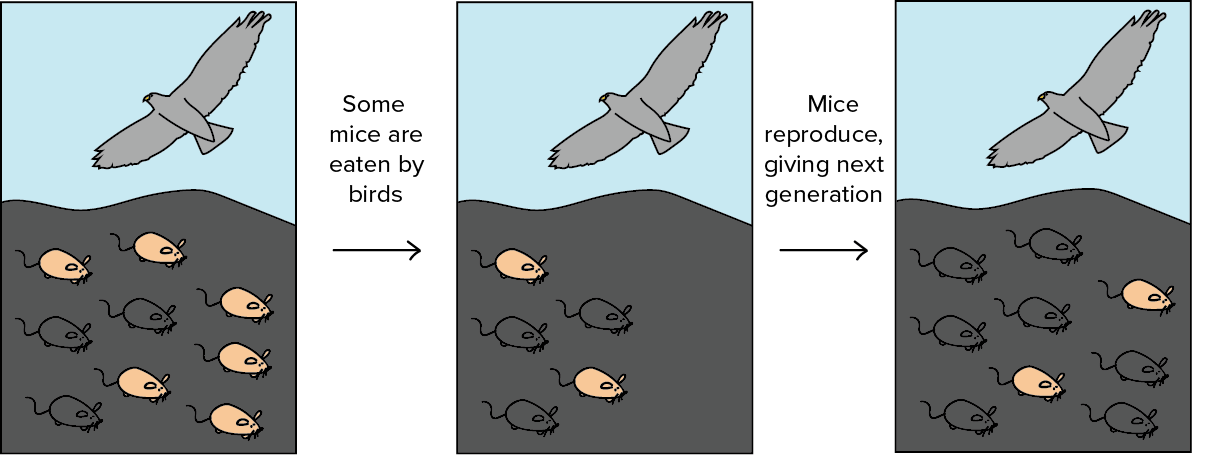
Why is the mouse population changing over time?
a)
The light mice can reproduce more successfully than the dark mice
b)
The hawks eat more dark mice than light mice because the dark mice taste better
c)
The hawks eat more light mice than dark mice because they can see the light mice more easily
d)
The hawks eat more dark mice than light mice because they can see the dark mice more easily
31.
Viruses are
a)
easily killed
b)
destroyed by antibiotics
c)
nonliving
d)
different kinds of bacteria
32.
What process is being shown in this image?
a)
Variation
b)
Natural Selection
c)
Selective Breeding
d)
Homeostasis
33.

Which best describes the role of mutations in natural selection?

a)

Mutations help an organism to better survive in their environment

b)

An organism may acquire a helpful mutation by interacting with the environment

c)

A mutation may result in a beneficial trait that makes an organism more likely to survive and reproduce

d)

Organisms with certain traits are more likely to win competitions for mutations

34.

The more genetic variation a population has,

the more likely it is for some individuals to

a)

evolve

b)

migrate

c)

survive

d)

mutate

35.
People are making antibiotic resistance worse by:
a)
taking antibiotics only when they need them
b)
putting antibiotics into our food and environment
c)
not sharing antibiotics with others
36.
The term for the formation of new and distinct species over the course of evolution is...
a)
speciation
b)
biological species concept
c)
reproductive barrier
d)
natural selection
37.
Bacteria undergo which type of reproduction? 
a)
asexual
b)
sexual
38.

You look at two species and see very similar DNA. What does this likely tell you?

a)

These are the same animal.

b)

These animals are not likely related.

c)

These animals have a common ancestor.

39.

When the Grand Canyon in Arizona formed, two populations of one squirrel species were separated by the giant canyon. This is an example of _____________.

a)

Temporal isolation

b)

Behavioral isolation

c)

Geographic isolation

40.
What is a species? 
a)
A group of organisms that can mate with each other and produce fertile offspring. 
b)
A group of organisms that can mate and produce offspring even if those offspring are infertile.
c)
A group of organisms that genetically are very different from each other. 
d)
Indivual organisms that live in the same environment. 
41.

What is the common ancestor of Letters A, B, C, D, E?

a)

1

b)

2

c)

3

42.

What type of isolation has occurred in the image?

a)

Geographic isolation

b)

Temporal isolation

c)

Behavioral isolation

43.

Antibiotic resistant bacteria are a problem because:

a)

we do not have antibiotics that will kill them

b)

bacteria reproduce sexually

c)

they can turn into viruses

d)

they are not a problem

44.

Who is most closely related to Taxidea taxus?

a)

Lutra lutra

b)

Panthera pardus

c)

Canis latrans

d)

Canis lupus

45.

Which group of animals on this tree are most closely related to birds?

a)

Saurischian dinosaurs

b)

Ornithischian dinosaurs

c)

Crocodiles

d)

None of these are related to birds

46.

A superbug is ...

a)
that kills you quickly
b)
a very large bacteria
c)
a bacteria that is resistant to pesticides
d)
a bacteria that is resistant to antibiotics
47.

In the early stages of development, the embryos of dogs, pigs, and humans resemble one another. This observation suggests that these animals may have

a)

a similar number of chromosomes

b)

similar habitats

c)

common ancestry

d)

the same blood components

48.

Which two factors could lead to the evolution of a species over time?

a)

overproduction of offspring and no variation

b)

changes in the genes of body cells and extinction

c)

struggle for survival and fossilization

d)

changes in the genes of sex cells and survival of the fittest

49.

Natural selection produces changes most quickly in

a)

species with short reproductive cycles

b)

individual pathogens killed by antibiotics

c)

complex multicellular organisms

d)

individuals that produce a small number of offspring

50.

Male turkeys are birds that naturally strut and display their large tail feathers, which attracts female turkeys. This display is an example of

a)

a behavioral adaptation

b)

a learned behavior

c)

asexual reproduction

d)

selective breeding