

wayground logo

Free Printable Worksheets

Font size

S
M
L
XL
Worksheets

AP Bio -DNA Structure & Replication

Total questions: 30

Worksheet time: 23mins
Name
Class
Date
1.
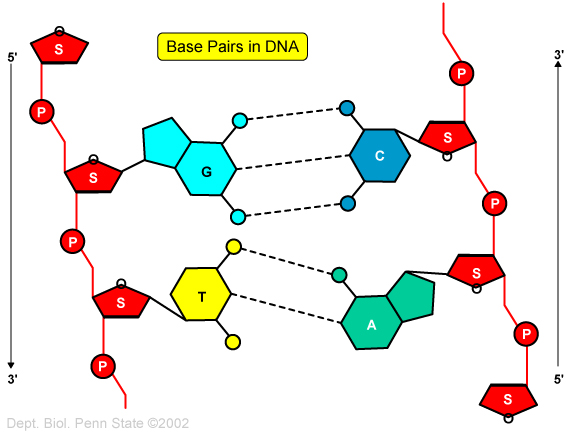
Which 2 molecules form the sides (backbone) of the DNA ladder?
a)
deoxyribose sugar and adenine
b)
deoxyribose sugar and a hydrogen bond
c)
deoxyribose sugar and the nucleus
d)
deoxyribose sugar and phosphate
2.
Nitrogenous bases are joined by which type of bond?
a)
polar bonds
b)
ionic bonds
c)
covalent bonds
d)
hydrogen bonds
3.
Replicate the following strand of DNA: 
AATCATGGA
a)
AATCATGGA
b)
TTAGTACCT
c)
UUAGUACCU
d)
GGATAUCUA
4.
If there is 17% thymine in a portion of DNA, how much cytosine is there?
a)
17%
b)
33%
c)
34%
d)
66%
5.
The two ring nucleotides are called:
a)
Thymine and Cytosine
b)
Adenine and Thymine
c)
Thymine and Guanine
d)
Adenine and Guanine 
6.
purines are made of ____ rings in their structure
a)
1
b)
2
c)
3
d)
7
7.
Nucleotide pairing is always
a)
purine and purine
b)
pyrimidine and pyrimidine
c)
purine and pyrimidine
d)
none of the above-pairing is random
8.
DNA replication results in two DNA molecules,
a)
each one with two original strands
b)
each one with two new strands
c)
each one with one new strand and one original strand
d)
one with two new strands and the other with two original strands
9.
Which enzyme seals okazaki fragments together on the lagging strand?
a)
Topoisomerase
b)
Helicase
c)
DNA Polymerase
d)
Ligase
10.
Which enzyme breaks the hydrogen bonds between the two DNA strands?
a)
Topoisomerase
b)
Helicase
c)
DNA polymerase
d)
Ligase
11.
Which of the following sequences expresses the correct order of enzyme function in DNA replication?
a)
Helicase--primase--DNA polymerase--ligase
b)
ligase--helicase--primase--DNA polymerase
c)
DNA polymerase--primase--helicase--ligase
12.
Consider the replication bubble diagrammed at the right. Which letters represent leading strands? 
a)
W and X
b)
Y and Z
c)
W and Z
d)
X and Y
13.
Why are there multiple replication bubbles?
a)
It increases the time to replicate so there won't be errors in copying
b)
It decreases the time of replication
c)
They occur at each A T T set of nucleotides
d)
There is no reason
14.
DNA is a polymer made of:
a)
Nucleotides
b)
Ribosomes
c)
Purines
d)
Pyrimidines
15.

Prokaryotic organisms typically have ________ chromosomes, while eukaryotic organisms typically have multiple ________ chromosomes.

a)

linear, circular

b)

circular, linear

16.

In DNA Replication, relaxes supercoiling in front of the replication fork?

a)

Helicase

b)

Topoisomerase

c)

DNA Polymerase

d)

Ligase

17.

When DNA replicates, one strand is formed continuously while the other strand is formed in fragments because new nucleotides can only be added to the _______ end of DNA

a)

3'

b)

5'

c)

7'

d)

9'

18.

DNA is synthesized in the _________________ direction

a)

3' to 5'

b)

5' to 3'

19.

In DNA Replication, which strand is formed in Okazaki fragments?

a)

Leading

b)

Lagging

20.

What type of bond holds nitrogen bases to the sugar and phosphate to form a nucleotide?

a)

Covalent

b)

Hydrogen

c)

Ionic

d)

Phosphodiester

21.

When does DNA Replication occur?

a)

Just before the cell divides

b)

Just after the cell divides

c)

The M phase

d)

The S phase

22.
Which enzyme is responsible for adding nucleotides?
a)
Topoisomerase
b)
DNA Polymerase
c)
Ligase
d)
Primase
23.
What are the three components of a nucleotide?
a)
sugar, hydrogen, nitrogen base
b)
sugar, oxygen, nitrogen base
c)
sugar, phosphate, nitrogen base
d)
sugar, phosphate, protein
24.

Identify which of the following best describes purines and pyrimidines.

a)

Purines (C, T, & U) have single ring, Pyrimidines (A & G) have double ring

b)

Purines (C, T, & U) have double ring, Pyrimidines (A & G) have single ring

c)

Purines (A & G) have single ring, Pyrimidines (C, T, & U) have double ring

d)

Purines (A & G) have double ring, Pyrimidines (C, T, & U) have single ring

25.
order of replication
a)
3, 4, 2, 1
b)
3, 1, 4, 2
c)
2, 1, 4, 3
d)
3, 4, 1, 2
26.
Place the following in sequential order
1. Recoil
2. Straightens the double helix
3. Breaks Hydrogen bonds
4. Adds Free nucleotides
a)
1, 2, 3, 4
b)
3, 4, 2, 1
c)
3, 2, 4, 1
d)
2, 3, 4, 1
27.

Which enzyme joins the Okazaki fragments on the lagging strand?

a)

helicase

b)

topoisomerase

c)

primase

d)

ligase

28.

The picture below shows an enzyme unwinding and unzipping DNA.

​What is the name of this enzyme?

a)

DNA Helicase

b)

DNA Ligase

c)

DNA polyermase

d)

RNA Polymerase

29.

DNA replication puts down nucleotides ______' to _____' and is said to be ______________________

a)

5, 3, antiparallel

b)

3, 5, antiparallel

c)

5, 3, parallel

d)

3, 5, parallel

30.

What does DNA polymerase do? (2 answers)

a)

creates RNA primers

b)

unzips the hydrogen bonds between base pairs

c)

attaches free nucleotides

d)

proofreads the new strands
