
 Worksheets
PHYSICS YEAR 11
Total questions: 23
Worksheet time: 46mins
Name
Class
Date
1.
The splitting of a nucleus into smaller nuclei is
a)
fusion
b)
fission
c)
half-life
d)
gamma radiation
2.
The product of nuclear fission includes
a)
neutrons and electrons
b)
several nuclei and neutrons
c)
several nuclei and electrons
d)
several nuclei and protons
3.
Which of the following is true about nuclear fission?
a)
The mass of the product is greater than the mass of the original nucleus
b)
The mass of the product is less than that of the original nucleus
c)
The mass of the product is the same as the mass of the original nucleus
d)
The mass of the product is 100 times greater than the original nucleus
4.
What is a beneficial aspect of nuclear fission?
a)
The ability to absorb energy
b)
The ability to release tremendous amounts of energy
c)
The ability to produce more energy than nuclear fusion
d)
There are no beneficial aspects of nuclear fission
5.
Two nuclei with low masses are combined to form one nucleus of larger mass is called what?
a)
Nuclear fission
b)
Nuclear fussion
c)
Nuclear half-life
d)
Half-life
6.
Which of the following is true about nuclear fusion?
a)
It is easy to implement.
b)
It produces less energy than nuclear fission.
c)
It produces more energy than nuclear fission.
d)
It has the ability to occur easily in everyday life.
7.
What is true about nuclear fusion?
a)
The mass of the product is less than that of the original nucleus
b)
The mass of the product is 100 times less than that of the original nucleus
c)
The mass of the product is the same as that of the original nucleus
d)
The mass of the product is greater than that of the original nucleus
8.
How do nuclear power-plants work?
a)
Fusion
b)
Half-life
c)
Fission
d)
Fusion or fission
9.
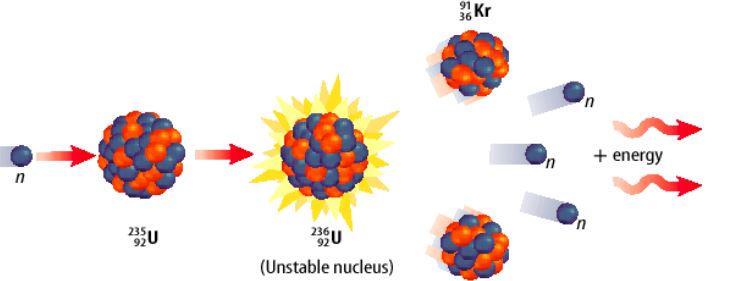
This is an example of...
a)
Fission reaction
b)
Fusion reaction
c)
Decomposition reaction
d)
Decay
10.
Where does fusion occur naturally?
a)
Underwater
b)
All around us
c)
In the radioactive waste
d)
On the sun
11.
An example of an uncontrolled fission reaction is _______________
a)
Nuclear power plants
b)
Radio active decay
c)
Atomic Bomb
d)
On the surface of the sun
12.
What metal gives off radiation?
a)
carbon
b)
cobalt
c)
uranium
d)
titanium
13.
Is radiation used to help people?
a)
True
b)
False
14.
Which atoms combine together during fusion reaction on the sun?
a)
Helium and Hydrogen atoms
b)
Hydrogen atoms
c)
Hydrogen and Lithium atoms
d)
Hydrogen and Carbon atoms
15.
The splitting of a nucleus into smaller nuclei is
a)
fusion
b)
fission
c)
half-life
d)
gamma radiation
16.
Two nuclei with low masses are combined to form one nucleus of larger mass is called what?
a)
Nuclear fission
b)
Nuclear fussion
c)
Nuclear half-life
d)
Half-life
17.
How do nuclear power-plants work?
a)
Fusion
b)
Half-life
c)
Fission
d)
Fusion or fission
18.
Which of the following is true about nuclear fusion?
a)
It is easy to implement.
b)
It produces less energy than nuclear fission.
c)
It produces more energy than nuclear fission.
d)
It has the ability to occur easily in everyday life.
19.
Takes two small nuclei and combines them into a larger nucleus
a)
fission
b)
fusion
20.

Why do scientists most want to learn more about fusion?
a)
To win the Nobel prize
b)
To make energy for people to use
c)
To destroy the world
d)
To know more about stars
21.
The major drawback to nuclear fission reactors is the difficulty of achieving safe disposal of radioactive waste products.
a)
true
b)
false
22.
Which of the following is true about nuclear fusion?
a)
It is easy to implement.
b)
It produces less energy than nuclear fission.
c)
It produces more energy than nuclear fission.
d)
It has the ability to occur easily in everyday life.
23.
The major drawback to nuclear fission reactors is the difficulty of achieving safe disposal of radioactive waste products.
a)
true
b)
false
100 %

