
 Worksheets
GCSE Physics Paper 2 Megamix
Total questions: 41
Worksheet time: 47mins
What is the frequency of a wave?
# of oscillations produced in a certain amount of time
The distance the wave oscillates from it's resting position
The lowest point of a transverse wave
Resting point of a wave - no wave movement
What is the amplitude of a wave?
Where there is no wave movement
The distance the wave oscillates from it's resting position
A disturbance that transfers energy from one place to another
The distance between two corresponding parts of a wave
If the wavelength of a wave increased, what would happen to the frequency?
decrease
increase
stay the same
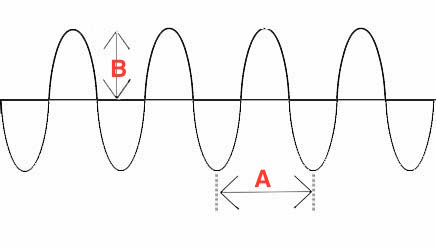
What property of this wave is represented by the letter "A"
amplitude
crest
trough
wavelength
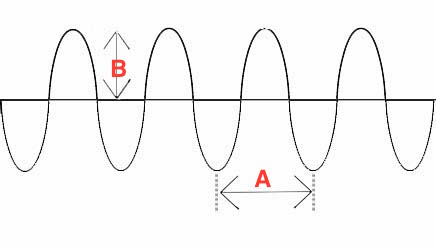
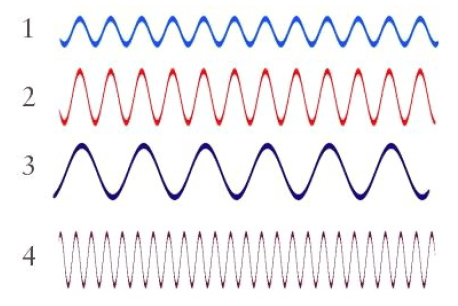
The units of frequency are...
metres
seconds
Hertz
degrees
Light is an example of a transverse wave
True
False
Sound is an example of a transverse wave
True
False
Which of the following statements describes the period of a wave?
Number of waves per second
Distance from crest to crest
Distance from resting position to top of the wave
Time taken to produce one wave
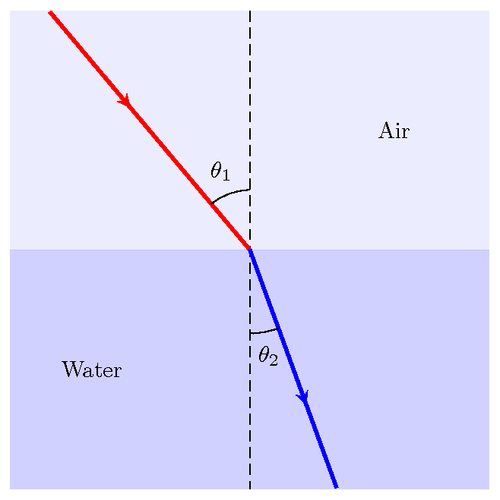
The following image demonstrates...
Reflection
Refraction
Interference
Diffraction
When an object is ....
What other information is needed to calculate the useful work done in lifting the bricks?

A spring has a spring constant of 5 N/cm. What is its extension when loaded with 15 N?
3 cm
5 cm
3 m
5 m
Acceleration is defined as the "change in..."
the time it takes to move from one place to another.
velocity of an object.
distance, divided by the time taken.
velocity, divided by the time taken.
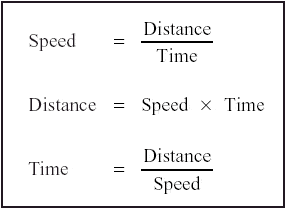
Calculate the average speed (in m/s) if a cheetah runs 180 metres in 10 seconds.
198 m/s
170 m/s
12 m/s
18 m/s
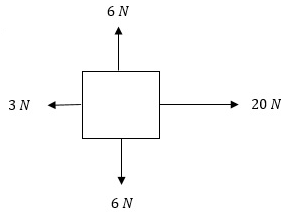
What is the resultant force in this diagram?
17 N, right
17 N, left
23 N, right
12 N, up
What is the unit of work?
Newton
Joule
Watt
meter
What is the momentum of a toy car of mass 500 g, travelling at a velocity of 30 m/s?
0.15 kgm/s
15 kgm/s
15 000 kgm/s
15 000 000 kgm/s

Which type of wave is illustrated in the diagram?
Longitudinal
Slinky
Transverse
Water

Max is sitting in his boat observing water waves enter the harbour. He counts 20 waves passing into the harbour in one minute. What is the frequency?
0.33 Hz
3.0 Hz
20 Hz
1200 Hz

A compass needle responds to a magnetic field, because the compass needle is a
A. generator
B. motor
C. magnet
D. transformer
Electric current is measured in ____________.
Newtons (N)
Amperes (A)
Hertz (Hz)
Volts (V)

A _______________ is a current-carrying coil of wire with lots of loops.
magnet
electromagnet
solenoid
compass
What happens if you cut a magnet in half?
Nothing
The magnets repel
There will be two magnets

How can you increase the magnetic field strength in an electromagnet?
Increase the number of coils.
increase the voltage
increase the current by reducing the resistance of the coil
all of the above
How can you decrease the magnetic field strength in an electromagnet?
Increase the number of coils.
increase the voltage
decrease the current by increasing the resistance of the coil
all of the above

Choose what the forefinger represents in Flemings left hand law.
Field (South to North)
Force
Field (North to South)
What causes the motor effect?
A current carrying wire exerting a force on an electromagnet
A current carrying wire exerting a force on a temporary magnet
A current carrying wire exerting a force on a permanent magnet
What do speakers contain?
Magnet
Magnet and electromagnet
Electromagnet

Looking at this diagram of a transformer, describe the movement of electricity through the national grid.
Why is electrical power transmitted at high voltages in the national grid?
Travels faster through the wires
Lower current which means less heat loss
Higher voltages doesn't electrocute people

