

Wayground logo

Free Printable Worksheets

Font size

S
M
L
XL
Worksheets

cell membrane and cells

Total questions: 21

Worksheet time: 14mins
Name
Class
Date
1.
A phospholipid has 2 parts. What are they called? 
a)
Hydrophilic Head, Hydrophobic Tail 
b)
Hydrophobic Head, Hydrophilic Tail 
2.
"Water Loving"
a)
Hydrophobic
b)
Hydrophilic 
c)
Hydroelectric 
d)
Hydroloric
3.
"Water Fearing" 
a)
Hydrophobic
b)
Hydrophilic 
c)
Hydroelectric 
d)
Hydroloric
4.
Describes the arrangement of the cell membrane as bendable and made of many parts. 
a)
The Fluid Mosaic Model 
b)
The Major Mobility Model 
c)
The Crazy Cell Model
d)
The Maze Model
5.
___________ form the two layers of the cell membrane. 
a)
Carbohydrates 
b)
Proteins 
c)
Phospholipids 
d)
Cholesterol
6.
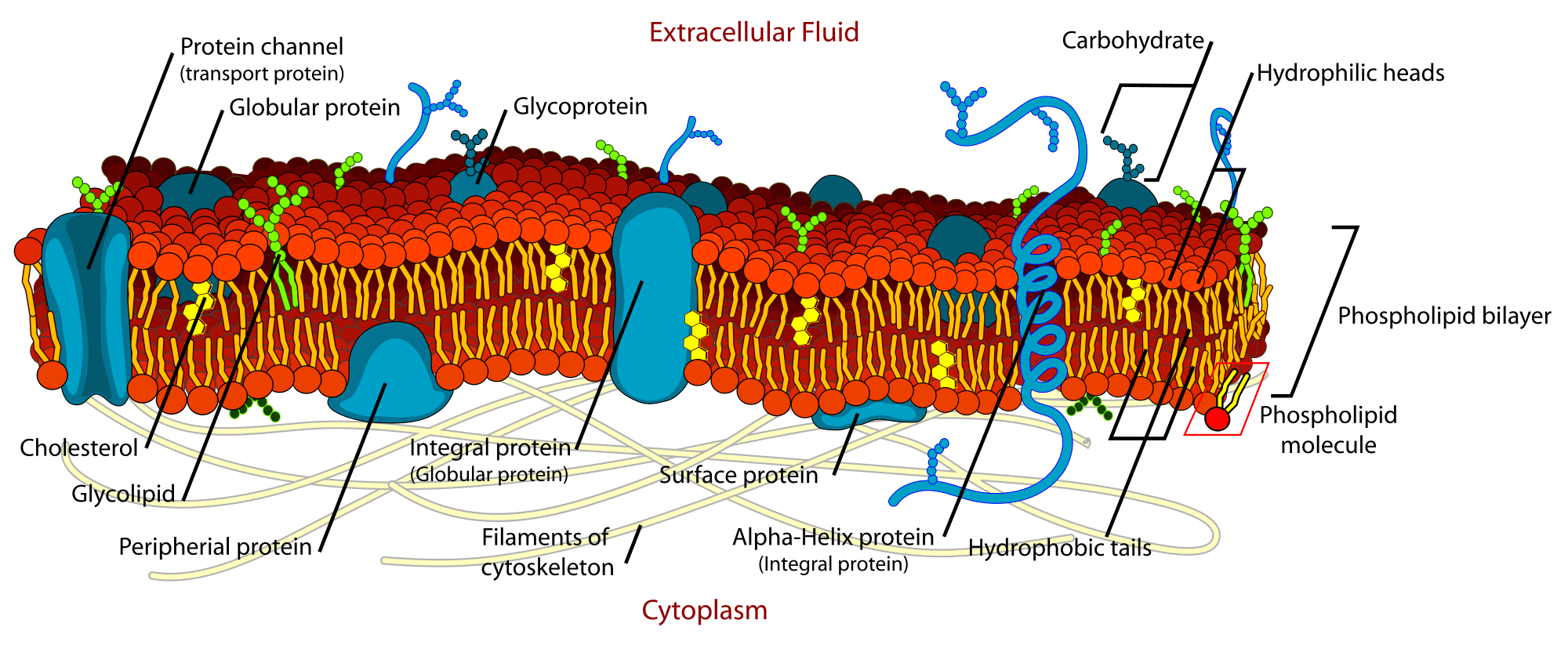
What is this image?
a)
cell membrane
b)
proteins
c)
carbohydrates
d)
lipids
7.
What does "bilayer" mean?
a)
one layer
b)
two layers
c)
laminated
d)
bilateral
8.
Hydrophilic means...
a)
water-loving
b)
water-fearing
c)
nonpolar
d)
lipid soluble
9.
Hydrophobic region of the cell membrane?
a)
E
b)
B
c)
C
d)
A 
10.
What is another term for "selectively permeable"?
a)
porous
b)
completely permeable
c)
permanent
d)
semipermeable
11.
Which of the following is NOT part of the cell membrane?
a)
Lipids
b)
Carbohydrates
c)
Proteins
d)
Nucleic Acids
12.
The function of the plasma membrane is....
a)
to regulate what enters and leaves the cell.
b)
fight bacteria and viruses that enter the cell.
c)
provide rigid support and protection to the cell.
d)
make sure each cell can move
13.
A phospholipid has 2 parts. What are they called? 
a)
Hydrophilic Head, Hydrophobic Tail 
b)
Hydrophobic Head, Hydrophilic Tail 
14.

In passive transport, the concentration gradient goes from..

a)

Low to low

b)

High to low

c)

Low to high

d)

High to high

15.
Passive transport requires no
a)
concentration gradients
b)
osmosis
c)
motion
d)
energy
16.
This cell organelle helps organisms maintain homeostasis by controlling what substances may enter or leave cells.
a)
vacuole
b)
nucleus
c)
cell membrane
d)
cell wall
17.

Plants and animal cells have...

a)

Mitochondria and chloroplasts

b)

Nucleus and chloroplast

c)

Cell wall and chloroplast

d)

Mitchochodria and cytoplasm

18.

How can you tell that this is a prokaryote or eukaryote cell?

a)

It is a prokaryote because it doesn't have a nucleus

b)

It is a eukaryotic cell because it has a cell wall and a nucleus

c)

It is eukaryotic because it does not a nucleus nor a cell membrane

d)

It is prokaryote because it has a cell wall

19.

What is the difference between mitochondria and chloroplast?

a)

Mitochondria produces energy and chloroplasts breaks down energy

b)

There is no difference. They are the same.

c)

Mitochondria breaks down energy from food and chloroplasts produce energy from sunlight.

d)

Mitochondria contains DNA and chloroplasts are green

20.

What is the jelly-like substance that keeps the organelles floating?

a)

Cell Membrane

b)

Nucleus

c)

ER

d)

Cytoplasm

21.

allows nutrients/waste IN and OUT of cell

a)

endoplasmic reticulum

b)

cell membrane

c)

nucleus

d)

cell wall
