wayground logo

Free Printable Worksheets

Font size

S
M
L
XL
Worksheets

Weathering, Erosion, and Streams

Total questions: 37

Worksheet time: 23mins

Name
Class
Date
1.
What type of weathering is it when acid rain breaks down and changes the rock.
a)
chemical weathering 
b)
physical or mechanical weathering
c)
erosion
d)
Deposition
2.
How do plants weather rocks?
a)
during photosynthesis
b)
when roots grow into cracks of rocks and expand the rock
c)
when the plant moves water from the roots to the leaves
3.
A process that breaks up rocks using PHYSICAL changes that don't change the actual substance.  
a)
Chemical Weathering 
b)
Animals 
c)
Plants 
d)
Mechanical Weathering 
4.
The process of breaking up rocks caused by CHEMICAL changes that DOES change the actual substance of the rock. 
a)
erosion
b)
Acid Rain
c)
Chemical Weathering
d)
Rocks
5.
These rocks were broken apart from the continuous freeze/thaw of water in the cracks of the rocks. This is an example of:
a)
ice wedging
b)
dumptruck
c)
permeability
d)
acid rain
6.
What happens to a rock when it weathers?
a)
It settles out of water that is carrying it.
b)
It creates a valley.
c)
It forms a delta.
d)
It breaks into small pieces.
7.
Abrasion is the process by which rocks
a)
become cemented together to form bigger rocks.
b)
become pitted (covered with small holes).
c)
are rubbed or banged against one another.
d)
break apart when water freezes.
8.
Which of these is an example of erosion
a)
Light Shinning onto a mountain
b)
Rain breaking down rock 
c)
Wind blowing away sediment
d)
All of the above
9.
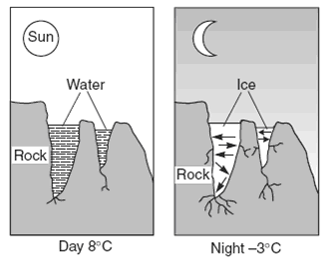
The diagrams  shows a natural process that weathers rock.
 Which statement best explains why this process results in weathering?
a)
frozen water acts as a solute
b)
water expands when it freezes
c)
the mass of water increases when it freezes
d)
frozen water dissolves most types of rock
10.
How does freezing water cause the weathering of rocks?  The freezing water—
a)
keeps the rocks in place
b)
makes the rocks last longer
c)
expands cracks and breaks rocks
d)
causes rocks to fall in landslides
11.
How does vegetation in the soil affect the rate of erosion?
a)
It doesn't affect erosion.
b)
It decreases erosion.
c)
It increases erosion.
12.
The process in which sediments, soil and rocks are added to a land form or land mass.
a)
erosion
b)
deposition
c)
mouth
d)
divide
13.
An area which drains into a common river system.
a)
watershed
b)
tributary
c)
drainage divide
d)
riparian zone
14.
As the current in a stream becomes stronger, what will happen to its erosional power?
a)
it will increase
b)
it will decrease
c)
it will stay the same
d)
it will increase then decrease
15.

Which graph best represents the relationship between the discharge of a stream and the velocity of stream flow?

a)
b)
c)
d)
16.

At which stage would a river have a lot of sediment deposition?

a)

old

b)

mature

c)

youthful

d)

rejuvenated

17.

______________________ is the amount of water a river or stream can carry in a given amount of time.

a)

Load

b)

Gradient

c)

Discharge

d)

Alluvium

18.

Deposition is likely to occur in a river

a)

on the outside bank, when the water speeds up

b)

on the outside bank where the water slows down

c)

along the inside bank where the water speeds up

d)

along the inside bank where the water slows down

19.
What is a narrow channel carved by surface runoff?
a)
tributary
b)
stream
c)
rill
d)
decomposition
20.

Erosion is most likely greatest at locations

a)

A and B

b)

B and C

c)

C and D

d)

D and A

21.
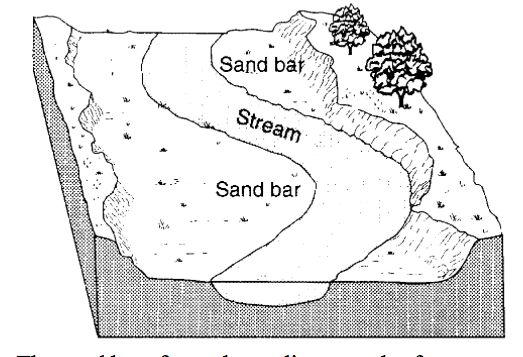
The diagram below shows a portion of a stream. The sand bar formed as a direct result of 
a)
erosion due to a decrease in stream velocity 
b)
erosion due to an increase in stream velocity
c)
deposition due to a decrease in stream velocity
d)
deposition due to an increase in stream velocity 
22.
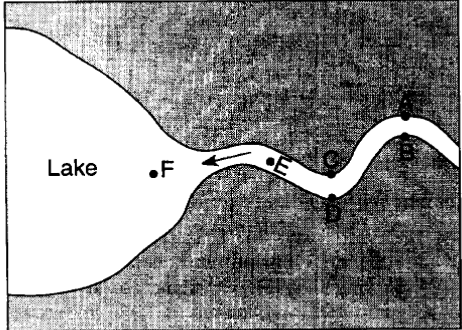
The map below represents a river as it enters a lake. 
At which locations is the amount of deposition greater than the amount of erosion?
a)
A,C and E
b)
B, D and F
c)
B, C, and F
d)
A, D and E
23.

Which letter has a higher velocity?

a)

A

b)

B

24.

Which letter is there more deposition occurring?

a)

A

b)

B

25.

Which letter has the lowest velocity?

a)

A

b)

B

26.

Which letter has the most erosion occurring?

a)

A

b)

B

27.

What kind of river produces meanders like the ones in the image?

a)

Young

b)

Old

28.

A bend or curve in a stream channel

a)

headwaters

b)

meanders

c)

divide

d)

ridge

29.

The region near a stream bed where water from the stream overflows during floods.

a)

floodplain

b)

floodwaters

c)

riparian zone

d)

meadow

30.
What agent of erosion most likely created this landform?
a)
wind
b)
water
c)
glacier
d)
gravity
31.
This sand dune most likely formed by
a)

water flowing to the left

b)

water flowing to the right

c)

wind blowing to the left

d)

wind blowing to the right

32.

Select all factors affect the amount of runoff?

a)

Vegetation

b)

Amount of Rain

c)

Slope of Land

d)

Timespan of Rainfall

e)

Type of Land/Soil

33.

What are the 3 ways streams transport sediments?

a)

Erosion, Leaching, and Suspension

b)

Abrasion, Suspension, and Solution

c)

Traction, Bedload, and Solution

d)

Solution, Suspension, and Bedload

34.

New deposition seals off the ends and the cut-off becomes an ________________ that will eventually dry up.

a)

Oxbow Lake

b)

Kidney scar

c)

Flood Plain

d)

Meander

35.
What landform can you see in the picture?
a)
Floodplain
b)
Delta
c)
Waterfall
d)
Oxbow lake
36.

What are the 4 agents of erosion?

a)

Abrasion, Wind, Streams, and Climate

b)

Wind, Water, Glacier/Ice, and Gravity

c)

Wind, Water, Weathering, and Gravity

d)

Weathering, Abrasion, Streams, and Glacier/Ice

37.

As surface area decreases, the rate of weathering will...

a)

Increase; due to more area of exposure

b)

Decrease; due to less area of exposure