
 Worksheets
Fossils Test Review
Total questions: 25
Worksheet time: 17mins
What kind of fossil is made when bones, shells, or teeth turn to stone?
preserved remains
trace fossil
cast fossil
petrified fossil

Scientists have found many fossil remains of an animal called an ammonite. This organism lived millions of years ago, but it is now extinct. An octopus is a living relative of the ammonite. What conclusion can be drawn based on the pictures of the two animals?
Fossils are not helpful in learning which organisms might be related.
Organisms living today may be similar to organisms that lived long ago.
Organisms living today have nothing in common with organisms that lived long ago.
Organisms living today will probably be extinct in ten years.
A scientist finds a fossil of a fern near a fossil of a small mammal.Which of the following is likely true about the organisms that made the fossils?
They lived in different countries.
They had nothing in common with each other.
They are the same kind of organism.
They were alive during the same time period.
A scientist found a fossil of a plant. The plant looked much like a pine tree. The plant that made the fossil most likely...
lived in shallow lake water
lived in sandy soil like the soil that cacti live in today
lived in climates like the climates pine trees live in today
lived in the deeper parts of the ocean

Andrew looked at the fossil in the picture.
The fossil was found in the desert. What detail about the fossil would show that the desert used to be a forest?
The fossil shows leaves from an oak tree.
The fossil doesn't show any fish or marine plants.
The fossil is brown, rounded, and 6 feet tall.
The fossil shows a lizard that lived in the desert.

Scientists found the fossil remains below in a valley during a fossil dig. They identified the organism as a plesiosaur, which was a very large reptile with a long neck and fins. What type of environment likely used to exist where the valley is now located?
ocean
rainforest
grassland
mountain
Why are there more animal fossils than plant fossils?
Animals are smaller than plants.
Plants have harder bodies than animals.
Plants have softer bodies than animals.
Animals eat plants.
Which type of fossil would look just like the body part of a once-living thing?
mineral
footprint
cast
petrified wood
Which is an imprint fossil?
bone
a cast
an animal track
amber fossil
Which type of rock are most fossils found?
sedimentary rock
metamorphic rock
igneous rock
fossils
What statement is true about fossils?
All living organisms leave behind fossils.
Fossils show that camels never change.
Some living things have not really changed in millions of years.
Plant fossils have never changed.
What needs to happen FIRST for a fossil to form?
A plant or animal must be covered by sediment.
A plant or animal must die and decompose.
Sediments fill a a mold to form a cast.
An earthquake shifts the land up.
What replaces the wood of a once-living thing to form petrified wood?
amber
cast
mold
minerals

This type of fossil is tree sap hardened and replaced by minerals.
petrified wood
imprint
amber
mold

What type of fossils provide evidence of the activities of ancient organisms?
molds and casts
petrified fossils
trace fossils
carbon films
What is an extremely thin coating of carbon on rock?
sediment
sap
tar
carbon film
A hollow area in sediment in the shape of an organism or part of an organism is.....
a cast
a mold
a trace fossil
a petrified fossil
A ______________________ is a scientist who studies fossils.
biologist
chemist
paleontologist
astronomer
Which of the following substances is NOT able to preserve entire organisms?
sticky tar
water
amber
ice
Which is NOT a reason scientists study fossils?
They tell us how long a species existed on Earth.
To learn how organisms are related to each other.
How organisms communicated with each other.
Fossils tell scientists the types of environments that organisms lived in.
Which is NOT a way an organism could become a fossil?
It can be frozen in ice.
It can be quickly buried in sediment after death.
It can be trapped in the resin of a tree.
It can be left out in the sun to decompose.
An organism should be buried quickly after it dies if it has a chance of becoming a fossil.
True
False
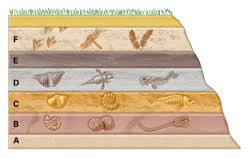
Which rock layer contains the newest fossils?
C
F

