wayground logo

Free Printable Worksheets

Font size

S
M
L
XL
Worksheets

Land & Sea Breeze

Total questions: 25

Worksheet time: 19mins

Name
Class
Date
1.

Do sea breezes typically happen during the day or night?

a)

Day

b)

Night

2.
Do land breezes typically happen during the day or night?
a)
Day
b)
Night
3.
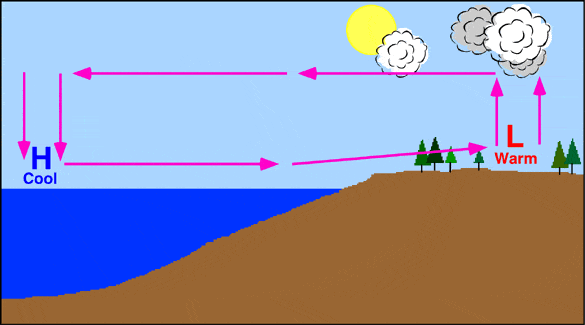
Is this a land or a sea breeze?
a)
land breeze
b)
sea breeze
4.
In a sea breeze, the air is warmer above the _____.
a)
land
b)
ocean
c)
sky
d)
beach
5.
Why do land breezes occur at night?
a)

Land cools slower than water, so the air above water is cooler.

b)

Water cools faster than land, so the air above land is warmer.

c)
Land heats up slower than water, so the air stays cooler during the day.
d)

Water cools slower than land, so the air above water is warmer.

6.
When warm air rises, ______ pressure forms at the surface of the land or sea.
a)
high
b)
some
c)
low
d)
none
7.
In a sea breeze, the air is warmer above the _____.
a)
land
b)
ocean
c)
sky
d)
beach
8.

Air moves from _______ pressure to ________ pressure.

a)

high to low

b)

low to high

c)

high to high

d)

low to low

9.
During a land breeze which way does the wind blow?
a)
from the sea to the land
b)
from the land to the sea
10.
During a sea breeze which way does the wind blow?
a)
from the land to the sea
b)
from the sea to the land
11.
When warm air rises, ______ pressure forms at the surface of the land or sea.
a)
high
b)
some
c)
low
d)
none
12.
How does the air move in a land breeze?
a)
From east to west
b)
From west to east
c)
From the land to the ocean
d)
From the ocean to the land
13.
The strength of a sea breeze depends on
a)
the heat of the day
b)
the difference between the temperature of the sea and the land
c)
the wind speed
d)
the amount of precipitation that day
14.
How does the air move in a sea breeze?
a)
wind moves from north to south
b)
wind moves from ocean to the land
c)
wind moves from the land to the ocean
d)
wind moves from south to north
15.

Which statement is true of sea breezes?

a)
They originate in the day and blow toward the land.
b)
They originate in the day and blow toward the water.
c)
They originate in the evening and blow toward the land.
d)
They originate in the evening and blow toward the water.
16.

Which best describes why winds at the beach change direction between day and night?

a)

Because the temperatures over land and over water change 

b)

Because warm air over land sinks and stays in place over land

c)

Because cool air rises and is replaced by warm air from the ocean 

d)

Because cool air sinks and stays in place over land 

17.
What occurs when cool air moves from the beach toward the ocean during the night? 
a)
a land breeze 
b)
prevailing winds 
c)
a sea breeze 
d)
updrafts
18.
Which statement correctly defines wind?
a)
Wind is the movement of air from areas of low pressure to areas of high pressure
b)
Wind is the movement of air to a colder area in the atmosphere.
c)
Wind is the movement of air from areas of high pressure to areas of low pressure.
d)
Wind is the movement of air pushed around and bouncing off Earth's surface.
19.
What causes wind to blow?
a)
Differences in longitude 
b)
Shock waves from clouds 
c)
Differences in air temperature and pressure 
d)
The rotation of the earth
20.

When air particles gain energy and rise into the atmosphere, how does this affect the air pressure on the earth's surface?

a)

Air pressure increases, creating regions of high pressure.

b)

It does not affect the air pressure on the earth's surface.

c)

Changes in air pressure is not dependent on temperature

d)

Air pressure fall, creating regions of low pressure

21.

Land and sea breezes are small-scale local winds which are experienced at ________ areas.

a)

coastal

b)

inland

22.

Which of the following sentences DOES NOT describe the formation of Sea Breeze?

a)

In the day, the coastal land is heated up faster than the sea

b)

Air over the coastal land heats up, expands and rises, a low-pressure area forms over it

c)

Since the sea does not heat up as fast as the land, the air over it is cooler and an area of high pressure forms over it

d)

A sea breeze starts blowing from the high-pressure area over the land to the low-pressure area over the coastal sea

23.

At (a)   , the coastal land loses heat faster than the sea, the cooler air over the coastal land sinks, forming a high-pressure area

24.

At night, since the sea loses heat slowly, the warmer air over it rises and an area of (a)   pressure forms over it

25.

A (a)   breeze starts blowing from the high-pressure area over the coastal land to the low-pressure area over the sea