
 Worksheets
Electrochemical Cells - Chem
Total questions: 22
Worksheet time: 16mins
Which species is oxidized in the following reaction?
2 Ag+(aq) + Cu(s) ⟶ 2 Ag(s) + Cu2+(aq)
Ag
Ag+
Cu
Cu2+

What happens to the cell voltage when the salt bridge is removed?
The cell voltage drops to zero.
The cell voltage increases.
The cell voltage becomes negative.
The cell voltage is unchanged.
Reduction happens at the ____.
anode
cathode
salt bridge
voltmeter
Oxidation happens at the ____.
anode
cathode
salt bridge
voltmeter
This electrode in a voltaic cell gains mass as the cell operates.
anode
cathode
This electrode loses mass as the cell operates.
anode
cathode
Which of the following statements correctly describes the movement of electrons in a voltaic cell.
Electrons flow through the salt bridge from the cathode to the anode
Electrons flow from left to right as the cell operates.
Electrons flow through the external wire from the anode to cathode
Electrons flow from right to left as the cell operates.
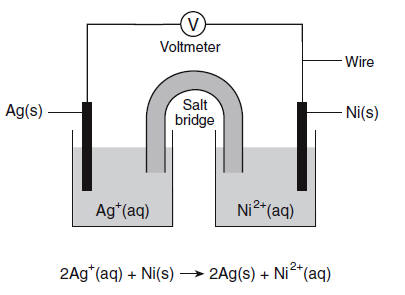
Consider the diagram of a voltaic cell represented here. What reaction occurs at the anode?
Ag+ + e- →Ag
Ag → Ag+ + e-
Ni2+ + 2e- → Ni
Ni → Ni2+ + 2e-
A voltaic cell is established based on the redox reaction below.
Mg(s) + Fe2+(aq) → Mg2+(aq) + Fe(s)
Which statements are correct as the cell runs? (Select all that apply)
Magnesium atoms lose electrons.
The mass of the iron electrode decreases.
Electrons flow from the iron electrode to the magnesium electrode.
Anions flow into the iron half-cell.
Anions flow into the magnesium half-cell.
The overall reaction in an electrochemical cell is
Zn(s) + Cu2+(aq) → Zn2+(aq) + Cu(s)
As the reaction in this cell takes place, the
mass of the Zn(s) electrode decreases
Zn2+(aq) concentration remains the same
mass of the Cu(s) electrode decreases
Cu2+(aq) concentration remains the same
Which half-reaction correctly represents reduction?
Ag --> Ag+ + e-
F2 --> 2 F- + 2e-
Au3+ + 3e- --> Au
Fe2+ + e- --> Fe3+
What is an electrolyte?
The liquid part of the electrochemical cell
The metal part of the electrochemical cell
The part that measures the voltage in an electrochemical cell
Gatorade
How do you complete the circuit when using 2 half-cells?
acid bridge
base bridge
salt bridge
Different pairs of metals produce different voltages.
True
False
The circuit must be complete for the electrons to flow.
True
False
The ions in a solution which conduct electricity are known as
Electrolytes
Colloids
Electrodes
Charge of the anode
Positive
Negative
Reduction is the ___________ of electrons.
loss
gain
sharing
transfer
Oxidation is the _________ of electrons.
loss
gain
sharing
transfer
A redox (net-ionic) equation has...
electrons on the left side
electrons on the right side
electrons on both sides
no electrons on either side

