
 Worksheets
Population Variation and Biotechnology
Total questions: 44
Worksheet time: 19mins
Natural selection requires which of the following?
Variations in DNA
Competition
Survival of the Fittest
High allele frequency
A change in your proteins
Mutations in DNA can cause _______ changes in traits.
helpful
harmful
no
all of these are possible changes
What is the term for a feature that allows an organism to survive better in its environemtn?
variation
adaptation
homologous structure
vestigial structure

What is the variation shown here?
height of flight
types of beaks
habitat
size
Based on the picture, what are these birds competing over?
food
water
shelter
predators

Which moth has better fitness before the industrial revolution?
Black
White
Birds
Pollution

Which of the following will likely occur if these two tortoises were placed on an island with only high bushes to eat.
normal shell tortoise will mutate to hood shell
hood tortoise will survive and reproduce
normal shell tortoise will starve
hood tortoise will starve

What is the dependent variable in this graph?
Drought year
Beak depth
Number of finches

What are the rabbits shown competing over?
Food
Water
Shelter
Not being prey
What is the adaptation in the rabbits shown?
Fur thickness
Camouflage
Speed
Size

What happens to the allele frequency of crooked tails in cheetahs over time?
decreases
stays the same
increases

Based on these moth population numbers, which of the following is most likely true?
Dark is the recessive allele for moth color.
Pollution has darkened the trees
More trees are white
The white moths are poisonous to predators

What would cause a new color of bug in the scenario pictured?
Mutation
Overpopulation
Allele frequency
Predation
Crossing similar individuals to keep certain characteristics is known as
hybridization
inbreeding
natural selection
cloning
Crossing different individuals to get certain characteristics from each is known as
hybridization
inbreeding
natural selection
cloning

What process is shown in this picture?
CRISPR
GMO
cloning
hybridization
Which of the following is true of GMO crops?
Grow bigger
Grow more quickly
Resist drought or disease
Better nutrition
Which of the following are examples of GMO animals?
Cows that make more milk
Goats that make spider silk
Pigs that have no fat
Salmon that grow faster and bigger
Which of the following gives scientists the ability to swap out DNA traits in an organism?
cloning
hybridization
pedigrees
CRISPR

Which is true?
allele Z increased in the population over time
allele Z decreased in the population over time
the frequency of allele Z remained constant in the population over time

What is the x axis?
Allele frequency
Generation
Change in allele frequency over generations.
What is the y axis?
Allele frequency
Generation
Change in allele frequency over generations.
What would a title be for this graph?
Allele frequency
Generation
Change in allele frequency over generations.
Evolution graph
Based on this graph, which allele is worse?
Dominant
Heterozygous
Recessive.

What does this graph demonstrate?
Cortisol levels
Natural selection
Both populations increased
Drought is causing the moths to become smaller
If a population of lizards is isolated on an island, with no new immigrants over many years, any new genetic variations are most likely to come from
recessive alleles
natural selection
mutations
speciation
There are 3 T alleles and 7 t alleles in a population. Calculate the frequency of the recessive allele.
30%
70%
10%
4%
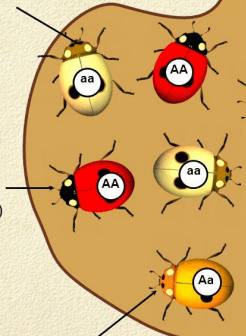
Calculate the frequency of the dominant allele in this population of beetles. Make sure to write your answer in percent form with the percent sign and no numbers after the decimal. (example: 24%)
(a)
What do scientists use the CRISPR/Cas9 tool for?
To create new people.
To alter an organism's protein.
To alter an organism's genome.
To fight off viruses in RNA.
Which of the following could CRISPR accomplish?
No more genetic diseases
Modifying and selecting traits
Reverse aging
Creating mutant powers

What is a GMO?
gene monitoring organizer
genetically modified organism
genome mining organization
gene mobilizing organelle
How have farmers created crops with desired genes in the past?
pollination
hybridization
self-fertilizing plants
growing monocultures
GMOs can be
plants only
animals only
plant, animal, and bacteria
plant and animal only
What is a good argument for genetically modifying animals?
Produce more meat
Figure out how to make Spiderman
Modifying your kids to make them more awesome
New genes are needed to create new species
In which ways can genetic engineering improve crops?
Improve yield
Make them pest resistant
Increase nutritional value
Make them drought resistant
Why are GMO's controversial?
It leads to overuse of pesticides
The health effects may be unknown
GMO's have extra chemicals in them
They can change your DNA
In a cross between a red flower (RR) and a white flower (WW) showing incomplete dominance, what would be the phenotype of the offspring?
Red
White
Pink
Red and white patches
In a codominant cross between a black chicken (BB) and a white chicken (WW), what would be the phenotype of the offspring?
Black
White
Gray
Black and white speckled
Which two chromosomes do females have?
XX
XY
Which two chromosomes do males have?
XX
XY
X-Linked traits are more common in
males
females
Color-blindness is an x-linked recessive trait. Which genotype represents a colorblind female?
XBXB
XBXb
XbXb
XBY
XbY
A single gene has 3 or more alleles. These are called
multiple genes
multiple alleles
codominance
polygenic traits

