wayground logo

Free Printable Worksheets

NEW

Font size

S
M
L
XL
Worksheets

# 90 Lines & Systems Test

Total questions: 72

Worksheet time: 4hrs 44mins

Name
Class
Date
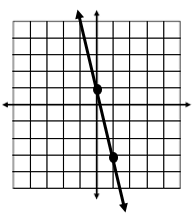
1.

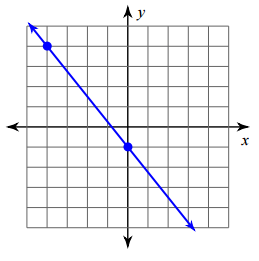
Find the slope of the graphed line.

a)

-1/2

b)

1/2

c)

-2

d)

2

2.

Which of the following is always true about the graph of a horizontal line?

a)

The graph will always have a positive y-intercept.

b)

The graph will always have a negative y-intercept.

c)

The slope is undefined.

d)

The slope is zero.

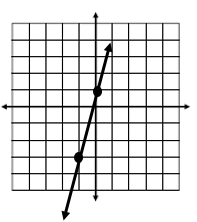
3.

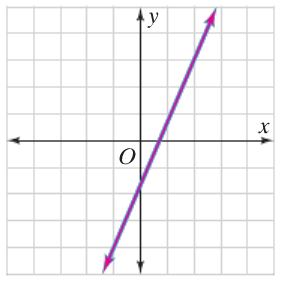
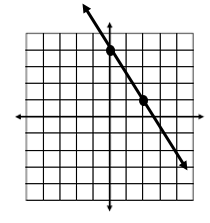
What is the equation of the graphed line?

a)

y = -1/4x + 2

b)

y = 1/4x + 2

c)

y = -4x + 2

d)

y = -4x + 2

4.

Which of the following has a positive slope and a negative y-intercept?

a)

y = 2x + 4

b)

y = -15x - 6

c)

y = 7x - 10

d)

y = -3x + 5

5.

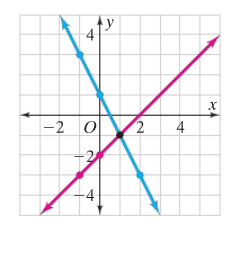
State the solution for the graph:

a)

One Solution

b)

Two Solutions

c)

Infinitely Many Solutions

d)

No Solution

6.
8x + 4y= 16
a)
y = -8x + 16
b)
y = 2x -4
c)
y = -2x + 4
d)
y = -8x + 12
7.

 y=13x2y=\frac{1}{3}x-2  
 y=52x+5y=-\frac{5}{2}x+5  
Which of the following graphs represents the system of equations pictured?

a)
b)
c)
d)
8.

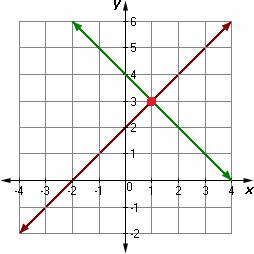
What is the solution to this system of equations?

y = -2x - 8

y = x + 1

a)

(3, 2)

b)

(-3, -2)

c)

(-2, -3)

d)

(2, 3)

9.
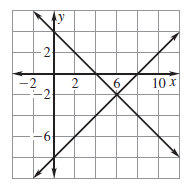
What is the solution to the system?
a)
(0, 3)
b)
(1, -1)
c)
(-3, 1)
d)
(1, 3)
10.


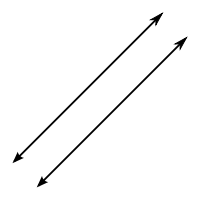
How many solutions?
a)
One Solution
b)
No solution
c)
Infinitely Many Solutions
11.

A system of equations with no solution will have lines that...

a)

are the same

b)

cross in one place

c)

are parallel and never touch

12.
Write the following equation in slope intercept form:
-x + 3y = 9
a)
y = 1/3x + 3
b)
y = 1/3x + 9
c)
y = -1/3x + 3
d)
3y = x + 9
13.
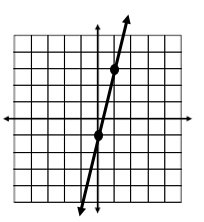
Which equation represents the following graph?
a)
y = 3x + 2
b)
y = -2x + 3
c)
y = 2x + 3
d)
y = -3x + 2
14.

The system shown is

a)

y = -2x + 1

y = x - 1

b)

y = 2x + 1

y = -x - 1

c)

y = 2x - 1

y = -x + 1

d)

y = -2x - 1

y = x + 1

15.
What is the first step in solving this equation? 
5x + 7 = 12
a)
Divide by 5
b)
Subtract 5
c)
Multiply by 7
d)
Subtract 7
16.
What is the solution?
a)
(1, -1)
b)
(-1, 1)
c)
(0, -2)
d)
(0, 1)
17.
If a system of equations has no solution, what does the graph look like? 
a)
intersecting lines
b)
parallel lines
c)
skew lines
d)
intersecting lines
18.
How many solutions does this system of equations have?
a)
One Solution
b)
No solution
c)
Infinitely Many Solutions
d)
Two Solutions
19.
If a system of linear equations has one solution, what does this mean about the two lines? 
a)
Parallel lines
b)
the same line 
c)
Intersecting lines
20.
Solve the system of equations.
y = 4x+1
3x + 2y = 13
a)
(1, 5)
b)
(5, 1)
c)
(0.25, 2)
d)
21.

What is the solution to the system of equations?

a)

(-1, -3)

b)

(3, 1)

c)

(1, 3)

d)

(-3, -1)

22.
Find the slope of the line.
a)
-5/4
b)
5/4
c)
-4/5
d)
4/5
23.
Determine the slope and y-intercept.         y = 3/2x + 3
a)
slope: 5   y-intercept:  (0,3) 
b)
slope: 3/2   y-intercept:  (0,3) 
c)
slope:  4  y-intercept:  (0,3/2)
d)
slope: 1/5   y-intercept:  (0,5) 
24.
Write the equation of the line.
a)
y = -2/3x + 4
b)
y = 2/3x + 4
c)
y = 3/2x + 4
d)
y = -3/2x + 4
25.
How many solutions does the system have?
a)
one
b)
none
c)
infinitely many
26.

What is the solution to the system of equations below?


 2x+7=9y2x+7=9y  
 x=5y3x=5y-3  

a)

 (8, 1)\left(-8,\ -1\right)  

b)

 (8, 1)\left(8,\ 1\right)  

c)

 (1, 8)\left(-1,\ -8\right)  

d)

 (1, 8)\left(1,\ 8\right)  

27.

Based on the equations for each line, determine how many solutions the system would have.

y=-3x+2

y=-3x+2

a)

Infinite Number of Solutions

b)

No Solution

c)

One Solution

28.

Based on the equations for each line, determine how many solutions the system would have.

y=2x+3

y=-4x+3

a)

Infinite Number of Solutions

b)

No Solution

c)

One Solution

29.
What is the solution?
a)
(6, 3)
b)
(3, 6)
c)
(-6, 3)
d)
No solution
30.
What is the solution?
a)
(1, -1)
b)
(-1, 1)
c)
(0, -2)
d)
(0, 1)
31.
What is the solution to the system?
a)
(3, -1)
b)
(2, -6)
c)
No Solution 
d)
(6, -2)
32.
Parallel Lines never intersect because...
a)
they have the same slopes. 
b)
they have the same y-intercept.
c)
they have different slopes.
d)
they have different y-intercepts. 
33.
Solve the system of equations:
y=2x
x + y = 9
a)
(6, 3)
b)
(3, 6)
c)
(-3, -6)
d)
no solution
34.
Solve for x and y
5x + 3y = 7
y = 4
a)
(4,1)
b)
(4,-1)
c)
(1,4)
d)
(-1,4)
35.

Solve the following system:

 y=2y=-2  

 4x3y=184x-3y=18  

a)

 (3, 2)\left(3,\ -2\right)  

b)

 (3, 2)\left(3,\ 2\right)  

c)

 (2,3)\left(-2,3\right)  

d)

 (2, 3)\left(2,\ 3\right)  

36.

Solve the following system:

 7x2y=13-7x-2y=-13  

 x=2y+11x=2y+11  

a)

 (3, 4)\left(3,\ -4\right)  

b)

 (3, 4)\left(3,\ 4\right)  

c)

 (3, 4)\left(-3,\ -4\right)  

d)

 (3, 4)\left(-3,\ 4\right)  

37.

Which graph best represents the equation y = -3x + 4?

a)
b)
c)
d)
38.

Which could be the graph of the equation y = 1/3x - 2?

a)
b)
c)
d)
39.

Rewrite in slope intercept form.

a)

y = − 6 /5 x − 3

b)

y = − 6/ 5 x + 3

c)

y = 3/5x + 6

d)

y = 3/5x - 6

40.

Which graph represents 2x + 4y = 12?

a)
b)
c)
d)
41.
Solve the system of equations:
y=2x
x + y = 9
a)
(6, 3)
b)
(3, 6)
c)
(-3, -6)
d)
no solution
42.
Solve the system of equations.
y = 4x+1
3x + 2y = 13
a)
(1, 5)
b)
(5, 1)
c)
(0.25, 2)
d)
43.
Give the solution to the system.
a)
(3,1)
b)
(1,3)
c)
(-1,3)
d)
(1, -3)
44.

What is the graph of

 y=35x + 5?y=-\frac{3}{5}x\ +\ 5?  

a)
b)
c)
d)
45.
Write in slope intercept form
5x - 3y = -9
a)
y = (5/3)x - 3
b)
y = (5/3)x + 9
c)
y = (5/3)x + 3
d)
y = (3/5)x + 3
46.
Write the equation in slope-intercept form:
-3y + 5x = 12
a)
y = -4 + 5x
b)
y = -4 + 5/3x
c)
y = 4 - 5/3x
d)
y = 12 + 5x
47.
What are the steps for graphing a line?
a)
1. Plot y-intercept
2. count slope ratio plot second point
3. Draw the line.
b)
1. Make a table
2. Plot slope
3. Draw line
c)
1. Plot two points
2. Check slope
3. Draw line
d)
1. Draw line
2. Hope it is right
48.
How can you tell if a point is a solution to a system?
a)
It makes the first equation true.
b)
The (x,y) coordinates satisfy both equations
c)
It makes logical sense
d)
It makes neither equation negative
49.
What is the solution to a systems of equations? 
a)
The point or points where they intersect
b)
What the lines have in common
c)
Either a single point, infinite number of points or no points
d)
ALL OF THE ABOVE 
50.
Identify the y-intercept for the function:
y=-3x
a)
-3
b)
0
c)
1
d)
-1
51.
What is the
slope-intercept form
of the equation
-8x+2y=4
a)
none
b)
y=2-4x
c)
y=4x+2
d)
y=4x-8y
52.

Which graph represents the equation  y=4x1y=4x-1  

a)
b)
c)
d)
53.

Which image shows a system of linear equations with one solution?

a)
b)
c)
d)
54.

Which image shows a system of linear equations with no solutions?

a)
b)
c)
d)
55.

Which image shows a system of linear equations with infinitely many solutions?

a)
b)
c)
d)
56.

When you graph a line using slope-intercept form (y=mx+b), you graph the ___________ first and then use the ___________ to find the second point.

a)

origin; slope

b)

slope; y-intercept

c)

y-intercept; x-intercept

d)

y-intercept; slope

57.

Which line has a y-intercept of -5?

a)
b)
c)
d)
58.

Which graph has a slope of

 13\frac{1}{3}  ?

a)
b)
c)
d)
59.

Which graph represents the equation  y=4x1y=4x-1  

a)
b)
c)
d)
60.

Match the equation to the correct graph:

 y=6x+4y=6x+4  

a)
b)
c)
d)
61.

Match the equation to the correct graph:

 y=12x+7y=-\frac{1}{2}x+7  

a)
b)
c)
d)
62.

Which graph is correct for the given equation?

a)
b)
c)
d)
63.
y -intercept is where the line ______________.
a)
begins
b)
crosses the x-axis 
c)
crosses the y-axis 
d)
crosses each other
64.

Graph

a)
b)
c)
d)
65.

Graph

a)
b)
c)
d)
66.

Graph

a)
b)
c)
d)
67.

Graph

a)
b)
c)
d)
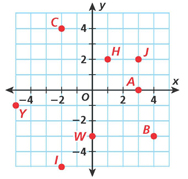
68.
Give the coordinates for POINT I.
a)
(-2, 5)
b)
(-2, -5)
c)
(2, 5)
d)
(2, -5)
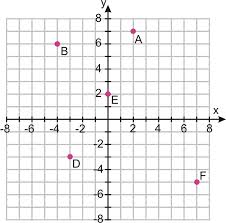
69.
Where is point E located?
a)
( 2, 0 )
b)
( 2 , 2 )
c)
( 0 , 2 )
d)
( 0 , 0 )
70.

Put the following equation into slope-intercept form:
7x + y = 5

a)

y = - 7x + 5

b)

y = 7x + 5

c)

y = -2x

d)

y = -7x - 5

71.
What is the ordered pair for C?
a)
(-6, 7)
b)
(2, -4)
c)
(-8, 2)
d)
(2, -8)
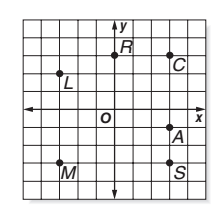
72.
What is the letter is a the the ordered pair (0, 3)?
a)
A
b)
M
c)
R
d)
L