
 Worksheets
Quantum and Nuclear Physics
Total questions: 26
Worksheet time: 36mins
The equation of half life period is
a)T1/2=0.693/λ
b)T1/2=0.963/λ
c)T1/2=0.639/λ
d)T1/2=0.699/λ
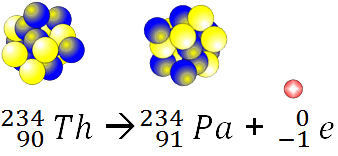
C612 absorbs an energetic neutron and emits a β particle. Resulting nucleus is
N714
B712
N713
none of above
What is a beta particle made of?
One proton
A helium particle
One electron
One proton and one neutron
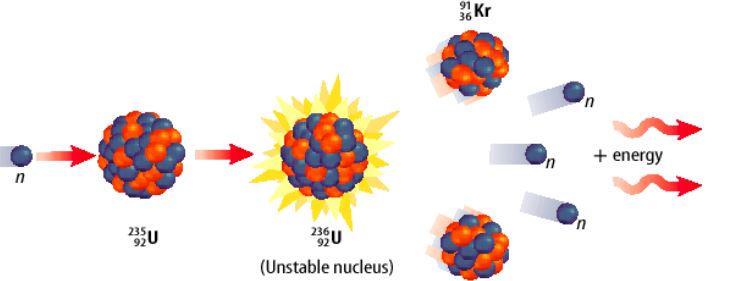
Which of these processes describes a nuclear fusion reaction?
A nucleus absorbs energy to produce lighter nuclei.
A nucleus splits to produce energy and lighter nuclei
Two nuclei bind together to produce energy and heavier nuclei.
Two nuclei bind together to produce energy and a lighter nuclei.
If there are 146 neutrons in 238U, how many neutrons
are found in the nucleus of 235U?
141
143
145
147
A wave with a frequency of 1.150 x 10^3 Hz has a wavelength of
2.7 x 10^5 m
2.51 m
2.61 x 10^5 m
50 m
Calculate the energy of a gamma ray photon whose frequency is 5.02 x 10²⁰ Hz?
4.73 x 1072 J
2.07 x 10 6 J
3.33 x 10⁻¹³ J
1.21 x 10 35 J
If waves can behave like particles, then particles can behave like a wave. This is the idea behind...
Quantization of Energy
Photoelectric Effect
Compton Effect
deBroglie Waves
Uncertainty Principle
Photoelectrons will be ejected from a material surface if?
The threshold frequency is greater than the photon frequency
The work function is less than the photon energy
The intensity of light is high enough
The wavelength of photon is maximum
A monochromatic light beam with a quantum energy of 9.0 eV is incident upon a photocell. The work function of the photocell is 4.1 eV. What is the maximum kinetic energy of the electron.
4.2 eV
4.4 eV
4.7 eV
4.9 eV
In an experiment, photoelectric effect is observed in metal A when light with frequency (f ) falls on the metal. If the light frequency used in this experiment is doubled, the photoelectrons
Will not be ejected
Will be ejected as observed in the previous
Will be ejected with greater number of photoelectrons
Will be ejected with greater kinetic energy
A particle of light is called a……
Photon
Photoelectron
Proton
Electron

The graph shows maximum kinetic energy of emitted electrons against frequency of incident light for a number of different metals.
The threshold frequency is determined by:
the x-intercept
the y-intercept
the gradient
the area under the graph

The graph shows maximum kinetic energy of emitted electrons against frequency of incident light for a number of different metals.
The work function is determined by:
the x-intercept
the y-intercept
the gradient
the area under the graph
A gamma-ray photon has energy 3 MeV. What is the frequency of this photon?
(h = 6.63×10⁻³⁴ J s, e = 1.6×10⁻¹⁹ C, c = 3.0×10⁸ m s−1)
7.2 × 10²⁰ Hz
4.5 × 1039 Hz
3.2 × 10−46 Hz
1.4 × 10²¹ Hz
UV light of wavelength 2 × 10⁻⁷ m falls on surface of gold. Work function of gold is 4.9 eV. What is the maximum energy of emitted electrons?
(h = 6.63×10⁻³⁴ J s, e = 1.6×10⁻¹⁹ C, c = 3.0×10⁸ m s−1)
1.3 eV
2.6 eV
3.9 eV
6.2 eV
In an experiment to demonstrate the photoelectric effect, a charged metal plate is illuminated with light from different sources. The plate loses its charge when an ultraviolet light source is used but not when a red light source is used.
What is the reason for this?
The intensity of the red light is too low.
The wavelength of the red light is too short.
The frequency of the red light is too high.
The energy of red light photons is too small.
Light with a wavelength of 304.2 nm illuminates a metal surface whose cutoff wavelength is 352.8 nm.
What is the stopping potential?
0.56 eV
0.65 eV
0. 67 eV
0.76 eV

