
 Worksheets
Invertebrates Review
Total questions: 30
Worksheet time: 15mins
What does a crustacean do to grow larger?
Attach itself to substrates
Reproduce
Molt
Use jointed appendages
All crustaceans:
have stinging tentacles
are soft-bodied
have jointed appendages (legs)
are bioluminescent
Which of these is NOT a crustacean?
Barnacle
Copepod
Hermit crab
Coral
All crustaceans:
Have an exoskeleton
Have more than 10 legs
Are sessile
Have an internal skeleton/backbone
Why are barnacles considered crustaceans? (Two answers!!)
Live in an exoskeleton
Attach itself to substrates
Have jointed appendages
Filter feed
Why do crustaceans have to shed their exoskeletons?
Which of these is not a crustacean?


How do crustaceans breathe?
With lungs
With their gills

Which type of defense mechanism is shown here?
Toxins/Poisons
Using other organisms' body parts
Camouflage
Secreting mucus

Which part of the crab is shaded in here?
Chela
Pereopod
Carapace
Dactylus

Jellyfish have what type of body structure
Medusa
Polyp
Hydra
Branched

Sea anemones have what type of body structure?
Medusa
Polyp
Down
Sessile
T/F: Cnidarians have eyes that function just like ours do.
True
False
What is the name of the algae that inhabit the coral?
green algae
euglenoids
zooxanthellae
Hydra reproduce asexually by
budding
nematocysts
gland cells
gametes
Corals and jellyfish are classified together mainly because they
share the same habitat
have stinging tentacles
are tropical
are planktonic
What is an invertebrate?
An animal that has a shell
An animal that lives in the water
An animal with no backbone
An animal that can fly
What are the three main groups of Mollusks?
Gastropods
Cephalopods
Annelids
Myriapods
Bivalves

To which group of mollusks does this squid belong?
cephalopod
bivalve
gastropod

To which group of mollusks this clam belong?
Gastropods
Cephalopods
Bivalves
Arthropods
Which is the group of mollusks that has a spiral-shaped shell?
Gastropods
Cephalopods
Myriapods
Bivalves
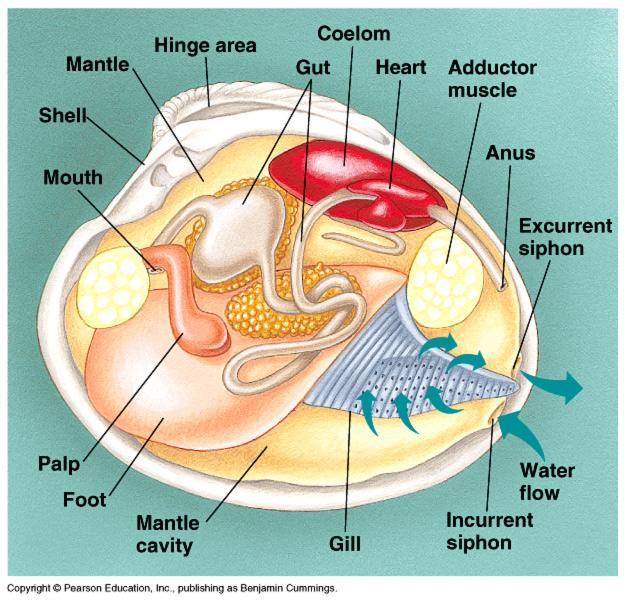

Which part of the Mollusk body contains most of the organs?
Foot
Visceral Mass
Trochophore
Mantle
What are filter feeders?
A large pile of living organisms and the animals that live among them.
An organism that attaches onto another organism and feeds off of it.
Animals that feed by removing tiny bits of food from the water.
Animals that use sunlight to obtain nutrients.
Echinoderms are found in both fresh and salt water.
True
False
Echinodermata means...
stomach foot
spiny skin
segmented body
jointed foot
The spines on an echinoderm are actually...
part of the skin.
made of chitin.
part of the endoskeleton.
part of the water vascular system.
These structures resemble long suction cups, and are part of the water vascular system.
madreporite
radial canals
tube feet
ampullae
What is the process of regeneration?
When an animal sheds its exoskeleton.
When an animal can clean the ocean floor.
When an animal can regrow a body part.
When an animal recycles plastic bottles and cans.
In a dichotomous key, organisms should be classified based on their
diet
habitat
observable features
sounds they make

