wayground logo

Free Printable Worksheets

NEW

Font size

S
M
L
XL
Worksheets

Phases, Energy, and Radioactivity Make-up Quizizz

Total questions: 50

Worksheet time: 3hrs 30mins

Name
Class
Date
1.
Energy cannot be created or destroyed in any reaction. This law is known as......
a)
Energy Transfer 
b)
Energy Transformation 
c)
Conservation of Energy 
d)
Gravitational Limits 
2.

Batteries and food are examples of which type of energy?

a)
electrical 
b)
chemical
c)
kinetic 
d)
heat
3.
Wood burning in a fireplace produces which kind of energy as the end result?
a)
solar
b)
mechanical 
c)
heat
d)
chemical 
4.
Energy use?
a)
Thermal
b)
Mechanical
c)
Electrical
d)
Light
5.
Sound energy is...
a)
heat energy
b)
electric current through a conductor
c)
vibrations; movement of energy through a substance in waves
d)
energy that moves in waves through empty space
6.

Radiation is a method of thermal energy transfer. It refers to the transfer of heat energy that moves–

a)

through a gas or empty space.

b)

when objects touch.

c)

only through solids.

d)

in the motion of fluids.

7.

What energy transformation takes place when a hair dryer is used?

a)

Energy from the sun is transformed to chemical energy.

b)

Sound energy is transformed to thermal energy and electrical energy.

c)

Electrical energy is transformed to thermal energy, sound energy, and mechanical energy

d)

Electrical energy is transformed to thermal energy and sound energy.

8.

The energy that travels in electromagnetic waves. It is also known as radiant energy.

a)

Light

b)

Electrical

c)

Thermal

9.
What is the energy transformation?
a)
Nuclear to Electrical
b)
Mechanical to Electrical
c)
Electrical to Thermal
d)
Kinetic to Sound
10.
Some students observing a classroom device being used, noticed the below energy transformations. 
Electrical → Mechanical → Sound
Which device were the students most likely observing?
a)
A triple beam balance measuring an object’s mass.
b)
A pencil sharpener plugged into a wall outlet.
c)
A projector displaying a diagram on the screen.
d)
A working flashlight used to light up a dark corner.
11.

The energy of flowing electrons. Lightning is a natural form.

a)

Light

b)

Electromagnetic

c)

Electrical

12.

What is the energy transformation of a lit up computer monitor with speakers on?

a)

Nuclear ---> Thermal and Radiant

b)

Chemical ---> Sound and Thermal

c)

Electrical ---> Radiant and Sound

d)

Gravitational ---> Radiant and Thermal
13.
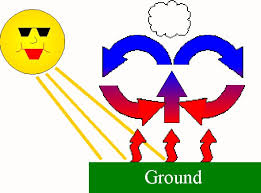
Warm air rises and the cool air sinks. This is...
a)
conduction
b)
convection
c)
radiation
14.
Heat transfers from an area of ________temperature to an area of ______ temperature.
a)
high to low
b)
low to high
c)
high to high
15.
A high specific heat means...
a)
It requires less energy to change temperature
b)
It requires more energy to change temperature
c)
It heats up very quickly
16.
Copper, Stainless Steel, Carbon Steel, and Zinc were all heated using 10,000 JOULES of thermal energy.  Based on the chart, which material would be have the SMALLEST change in temperature?
a)
Copper
b)
Carbon Steel
c)
Zinc
d)
Stainless Steel
17.
If you place some Gatorade in a cooler with ice...
a)
It's particles will speed up.
b)
It's particles will slow down.
18.
Water has a specific heat of 4184 J/KgºC.  Wood has a specific heat of 1760 J/KgºC.  What material needs more energy to raise the temperature 1ºC
a)
Wood
b)
Water
c)
Both are the same
19.
The time taken for half of an amount of radioactive atoms to decay.
a)
Nuclear fusion
b)
Full-life
c)
Dead time
d)
Half-life
20.
Which process involves the splitting of large nuclei?
a)
Beta decay
b)
Alpha decay
c)
Nuclear fission
d)
Nuclear fusion
21.
The nuclear process occurring at a nuclear power plant.
a)
Nuclear fusion
b)
Nuclear fission
c)
Combustion
d)
Multiplication
22.
Classify this process.
a)
Nuclear fission
b)
Nuclear fusion
c)
Alpha decay
d)
Beta decay
23.
What is one problem with using nuclear fission as an energy source?
a)
finding radioactive elements that have longer half-lives
b)
finding ways of storing radioactive wastes
c)
finding compounds to cool heated water
d)
finding non-radioactive elements for reactors
24.

Which diagram best represents the percentage of this radioactive isotope sample that will remain after 2 half-lives?

a)
b)
c)
d)
25.
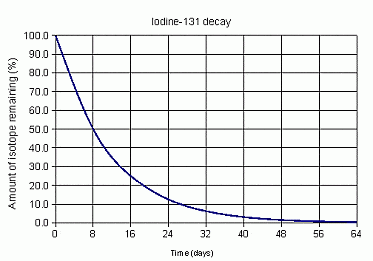
What is the half-life of iodine-131?
a)
32 days
b)
8 days
c)
16 days
d)
24 days
26.

What phase of matter has an indefinite shape and a definite volume?

a)

solid

b)

liquid

c)

gas

d)

All of them

27.

What phase of matter is shown in the picture?

a)

Solid

b)

Liquid

c)

Gas

28.

Which phase has the highest density?

a)

solid

b)

liquid

c)

gas

d)

plasma

29.
Which of these is an example of sublimation?
a)
water turning to ice
b)
ice cream dripping
c)
a puddle drying up
d)
dry ice being used to make fog
30.
In what state of matter, do the particles vibrate back and forth?
a)
Solid
b)
Liquid
c)
Gas
31.
What happens to the particles of a substance when heat energy is added?
a)
particles speed up and move closer
b)
particles slow down and move apart
c)
particles slow down and move closer
d)
particles speed up and move apart
32.
What happens to particles of a substances when heat energy is taken away?
a)
particles speed up and move closer
b)
particles slow down and move apart
c)
particles slow down and move closer
d)
particles speed up and move apart
33.

Examples of endothermic processes:

a)

melting and freezing

b)

freezing and condensing

c)

melting and evaporating

d)

freezing and evaporating

34.
Phase change from a gas to a liquid.
a)
condensation
b)
evaporation
c)
melting
d)
deposition
35.

What phase of matter exists in part C of the graph?

a)

Gas

b)

Liquid

c)

Solid

d)

Plasma

36.

What phase of matter exists in part D of the graph?

a)

Gas

b)

Liquid

c)

Solid

d)

Plasma

37.

What phase change occurs when you start at D and end at E?

a)

Freezing

b)

Melting

c)

Condensing

d)

Vaporization

38.

The temperature changes the most during a phase change.

a)

True

b)

False

39.

On which parts of the graph does the temperature change?

a)

Between C and D

b)

Between D and E

c)

At C, D, or E

d)

On both flat sections

40.

On which parts of the graph does the temperature remain the same?

a)

Between C and D

b)

Between D and E

c)

At C, D, or E

d)

On both flat sections

41.

What kind of energy conversion occurs after a candle is lit?

a)

friction to electrical energy

b)

light energy to heat energy

c)

chemical energy to light energy

d)

mass to kinetic energy

42.
What is produced during ALL energy transformations?
a)
Sound Energy
b)
Mechanical Energy
c)
Thermal Energy
d)
Chemical Energy
43.
Electrical Energy is transferred to _____ Energy.
a)
Mechanical
b)
Solar
c)
Electrical
d)
Thermal
44.
Which of the following shows the correct order of the energy transformations that occur when green plants produce their food from the Sun’s energy?
a)
chemical to thermal
b)
light to chemical
c)
thermal to light
d)
chemical to electrical
45.

When nuclei decay or fuse, massive amounts of __________ is released.

a)

energy

b)

jello

c)

protons

d)

neutrons

46.
Gamma rays damage human cells/tissue.
a)
True
b)
False
47.

The half life of Thorium-234 is 24 days. What fraction of the element remains after 72 days

a)

1/2

b)

1/4

c)

1/8

d)

1/16

48.
The nuclear process occurring at a nuclear power plant.
a)
Nuclear fusion
b)
Nuclear fission
c)
Combustion
d)
Multiplication
49.
The original element that undergoes radioactive decay is known as the...
a)
daughter element
b)
half-life
c)
parent element
d)
carbon-14
50.
What element is usually used to date fossils?
a)
uranium-235
b)
carbon-14
c)
mercury-203
d)
thorium-234