
 Worksheets
Biology Review
Total questions: 29
Worksheet time: 59mins
Name
Class
Date
1.

What word describes when water is attracted to other substances?
a)
cohesion
b)
adhesion
c)
capillary action
d)
surface tension
2.

Attractions between the negative Oxygen atom of one water molecule and the positive Hydrogen atom of another water molecule are called
a)
Covalent bonds
b)
Ionic bonds
c)
Polar bonds
d)
Hydrogen bonds
3.
Which end of the water molecule has a slightly positive charge?
a)
the oxygen end
b)
the hydrogen end
c)
both ends are slightly positive
d)
neither end is positive
4.
Water is a universal solvent because it...
a)
It can be found anywhere
b)
It freezes when it gets cold
c)
floats when frozen
d)
Dissolves most substances
5.
Why does ice stay at the top of oceans instead of sinking to the bottom?
a)
Ice is colder than liquid water.
b)
Ice is less dense than liquid water.
c)
Ice is more dense than liquid water.
d)
Ice is warmer than liquid water.
6.
Water makes up approximately 60% of the human body and plays a vital role in regulating body temperature. Which property of water makes it good at regulating temperature?
a)
Water is a good solvent.
b)
Water exhibits strong cohesion.
c)
. Water has an unusual crystalline structure.
d)
Water has a high capacity for heat.
7.
A florist places a bouquet of white carnations in water containing blue dye. After a time, the flowers turn blue. What process helped the carnations to change color?
a)
Specific heat
b)
Surface tension
c)
Cohesion and adhesion of water molecules
d)
Formation of covalent bonds between hydrogen and oxygen molecules
8.
What is water's molecular formula
a)
H2O
b)
H2O2
c)
O2H
d)
CO2
9.
Who are the three scientists credited with creating the Cell Theory?
a)
Schlieden, Schwann, Virchow
b)
Schindler, Schmeil, Vanderhoot
c)
Schwimmer, Shanazzek, Van Halen
10.
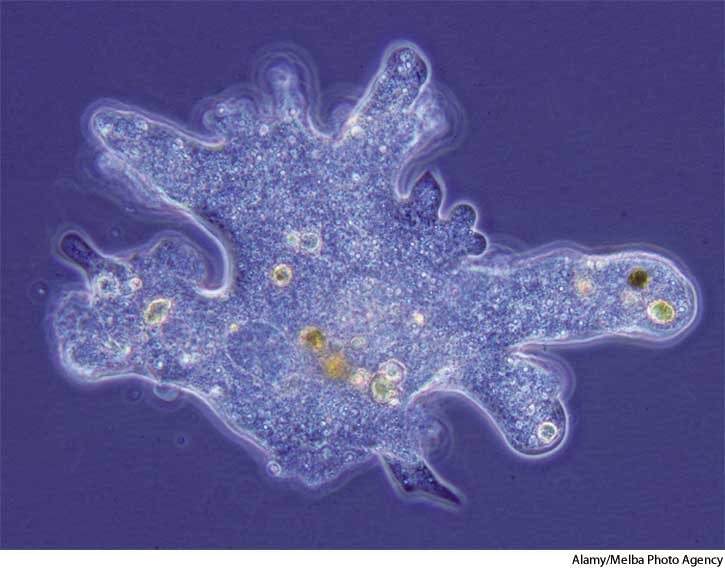
An Amoeba is a unicellular, animal-like protist that lives in ponds and streams. According to cell theory, where did this cell come from?
a)
another pre-existing amoeba cell.
b)
energy from sun that allowed the protist to reproduce.
c)
a multicellular organism.
d)
the nonliving environment.
11.

Robert Hooke, Anton van Leeuwenhoek, Theodor Schwann, Rudolf Virchow, and Matthias Schliden were all responsible for what theory?
a)
The Theory of Gravity
b)
The Theory of Relativity
c)
The Cell Theory
d)
The Theory of Continental Drift
12.

What tool do you use to view the cells?
a)
metric ruler
b)
centrifuge
c)
microscope
d)
telescope
13.

Which of the following is NOT a cell theory.
a)
All non-living things are made of cells
b)
All cells come from pre-existing cells
c)
Cells are the basic unit of structure and function of all living things
14.
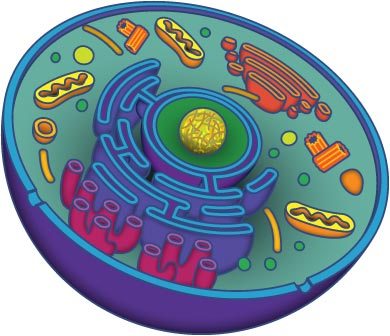
All living things are made up of...
a)
cells
b)
cell tissues
c)
organ
d)
organ systems
15.
Rocks are not living because
a)
they never move
b)
they aren't needed for humans
c)
they are not made of cells
d)
they don't break down
16.
What is the basic structural and functional unit of all living things?
a)
atom
b)
cell
c)
molecule
d)
human
17.
An organism made of one cell is called
a)
unicellular organism
b)
multicellular organism
18.
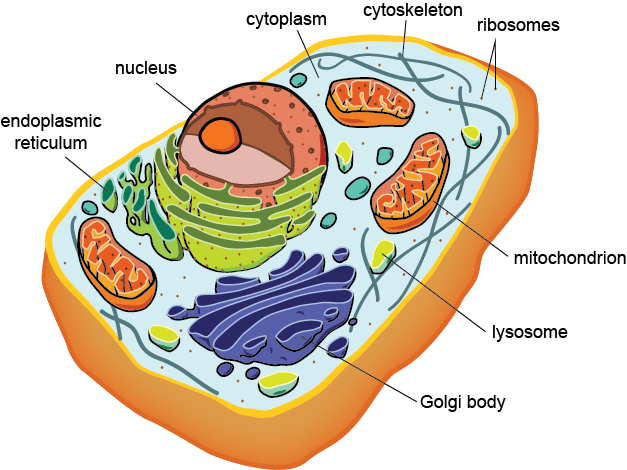
Which of the following statements is not part of the cell theory?
a)
Cells are the basic unit of structure and function in all living things.
b)
All cells are produced from other cells.
c)
Only animal cells are composed of cells.
d)
All living things are composed of cells.
19.
Which one of the following is a characteristic of life?
a)
Growth
b)
Breathing
c)
Expelling toxins
d)
Photosynthesis
20.
A worm turns away from light is an example of a worm
a)
reproducing
b)
doing cellular respiration
c)
having cells
d)
responding to its environment
21.
Which of the following characteristics of living things best explain a cat having a litter of kittens?
a)
living things respond to their environment
b)
living things maintain homeostasis
c)
living things reproduce
d)
living things are based on a genetic code
22.
Which of the following characteristics of living things best explains why your legs and arms get longer and stronger as you get older?
a)
living things respond to their environment
b)
living things maintain internal balance
c)
living things are made of cells
d)
living things grow and develop
23.
Before a soccer game Charlie always eats a big dinner. Which characteristic of life does this face best describe?
a)
living things use energy
b)
living things reproduce
c)
living things grow and develop
d)
living things are based on a universal genetic code
24.

This is a __________________cell.
a)
Prokaryotic
b)
Eukaryotic
25.

This cell has a nucleus, that means it is ...
a)
Prokaryotic
b)
Eukaryotic
26.

These are simple, small cells that do not have a nucleus. They are also bacteria. What are they?
a)
Prokaryotic
b)
Eukaryotic
27.

Which cell has Membrane-bound organelles? (Little organs)
a)
Prokaryotic
b)
Eukaryotic
28.
When experimenting with the growth of a plant, a scientist uses three (of the same type of) plants, two different fertilizers, equal light, and equal water. What type of variable is the fertilizer?
a)
Dependent
b)
Independent
c)
Control
d)
Compound
29.
An experiment is performed on plants to see how different liquids affect plant growth. Each plant in the experiment is given a different liquid; water, apple juice, or milk. Each plant has the same amount of soil, sunlight, and listens to the same music. In this investigation, what is the dependent variable?
a)
Type of plant
b)
Water, apple juice, milk
c)
Plant growth
d)
Color of the plant's leaves
100 %

