Wayground logo

Free Printable Worksheets

Font size

S
M
L
XL
Worksheets

Ashley

Total questions: 226

Worksheet time: 20hrs 34mins

Name
Class
Date
1.
Find the zeros.
a)
0 and 4
b)
0 and -4
c)
0
d)
-4
2.
True or false:
The solution, root, x-intercept, and zero of a problem are all the same thing.
a)
True
b)
False, because the solution and root are the same but the x-intercept and zero are different
c)
False, because the x-intercept and root are the same but the zero and solution are different
d)
False, they are all different
3.
What are the solutions to this equation? (x-3)(x+2)=0
a)
x=3,-2
b)
x=-3,2
c)
x=2,3
d)
x=3,2
4.

Solve using any method.

x2 + 4x= 12

a)

x = 2 and -2

b)

x = -6 and 2

c)

x = 6 and -2

d)

x = 1 and -1

5.

Solve the equation by graphing:

5x2 - 35x + 60 = 0

a)

x = 3, -4

b)

x = -3, 4

c)

x = 3, 4

d)

x = -3, -4

6.

Solve the equation using any method:

4x2+2x - 6 = 0

a)

x = 1 & -1.5

b)

x = -1 & 1.5

c)

x = (-2 ±√92)/8

d)

x = (-2 ± √100)/8

7.

Solve for x:

(x + 6)2 = 49

a)

x=7,12

b)

x=±7

c)

x=1,-13

d)

x=43,-55

8.

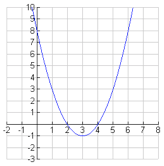
Determine the solutions of the graph:

a)

No Solutions

b)

(-3, 0) and (-1, 0)

c)

Infinity Many Solutions

d)

(-1, 0)

9.

Solve the equation by graphing: −x2−7x=6-x^2-7x=6  

a)

x=1 and x=6x=1\ and\ x=6  

b)

x=−6x=-6  

c)

x=−6 and x=−1x=-6\ and\ x=-1  

d)

No Solutions

10.

Determine how many solutions:

a)

One Solution

b)

Two Solutions

c)

No Solutions

d)

Infinitely Many Solutions

11.

Determine how many roots:

a)

One Solution

b)

Two Solutions

c)

No Solutions

d)

Infinitely Many Solutions

12.
Solve:
x2 - 49 = 0
a)
x = -7, x = 7
b)
x = -7
c)
x = 7
d)
x = -7, x = 1
13.
Convert x2 - 9x + 20 to factored form and solve.
a)
(x-10)(x+2); x = -2, 10
b)
(x+4)(x+5); x = -5, -4
c)
(x-4)(x-5); x = 4, 5
d)
Not factorable
14.

According to the graph, where are the solutions to the equation 0 = -x2-2x+3?

a)

x = 2

b)

x = -3, x = 1

c)

x = 3, x = 0

d)

No Solutions

15.

  What are the roots / zeros / solutions of the equation  
x2−14x+48=0x^2-14x+48=0  ?

a)


undefined

b)

−6 and 8-6\ and\ 8  

c)

6 and −86\ and\ -8  

d)

6 and 8 6\ and\ 8\  

16.

The solutions of 2x2−8x = 0 areThe\ solutions\ of\ 2x^2-8x\ =\ 0\ are  

a)

−2 and  2-2\ and\ \ 2  

b)

0, −2, and  20,\ -2,\ and\ \ 2  

c)

0 and −40\ and\ -4  

d)

0 and 40\ and\ 4  

17.

Given:  x2−10x + 21 = 0Given:\ \ x^2-10x\ +\ 21\ =\ 0  

What are the solutions of the equation

a)

1  and  211\ \ and\ \ 21  

b)

  −5  and  5-5\ \ and\ \ 5  

c)

3  and  73\ \ and\ \ 7  

d)

−3  and  −7-3\ \ and\ \ -7  

18.

 Solve the quadratic function using any method. Select the solutions.
x2+4x=12x^2+4x=12  

a)

x = 2

b)

x = -6

c)

x = 6

d)

x = 1

e)

x = -2

19.

Determine the values of
a, b, and c for
the quadratic equation:
4x2−8x=34x^2-8x=3  

a)

a = 4, b = -8, c = 3

b)

a = 4, b =-8, c =-3

c)

a = 4, b = 8, c = 3

d)

a = 4, b = 8, c = -3

20.

Lisa solves the equation below:

x2 + 4x - 12 = 2

(x - 2)(x + 6) = 2,

by setting x -2 = 0 and x + 6 = 0.

Her solutions are x = 2 and x = -6.

Is Lisa correct? Why or why not?

a)

Yes, she factored correctly.

b)

Yes, she factored correctly and then square rooted.

c)

No, she did factor correctly, but solved it wrong. It should be equal to 2

d)

No, she didn't set the equation to zero.

21.
What are the x- intercepts?
a)
x= 0 and x= -4
b)
x= 0 and x= 4
c)
y= 0
d)
x= 2
22.
a)
± 1/4
b)
± 9/36
c)
± 1/2
d)
No real solution
23.
a)
±81
b)
±9
c)
±3
d)
No real solution
24.
x2 - 15 = 0
a)
{15, -15}
b)
{3.87, -3.87}
c)
{7.5, -7.5}
d)
No Solution
25.
Solve.
a)
A
b)
B
c)
C
d)
D
26.
If the graph of a quadratic does not intercept the x-axis at any point, then it has:
a)
1 Real Solution
b)
2 Real Solutions
c)
Half a Solution
d)
No Real Solution
27.
What  are the solutions of this graph?
a)
-2 and 3
b)
-1/2 and -6
c)
-2 and -6
d)
3 and -6
28.
What are the solutions?
a)
0 and 8
b)
-2 and -4
c)
3 and -1
d)
2 and 4
29.
What are the x- intercepts?
a)
x= 0 and x= -4
b)
x= 0 and x= 4
c)
y= 0
d)
x= 2
30.
Solve
16a2 - 9 = 0
a)
a = -3/4, 3/4 
b)
a = -4/3, 4/3 
c)
a = -9/16, 9/16 
d)
a = -16/9, 16/9 
31.
Solve by taking square roots:
5m2 + 1 = 6
a)
m = 0
b)
m = 1 or -1
c)
m = √7
d)
m = 7/5 m = -7/5
32.
Solve for x
x2 - 3 = 78
a)
-9,9
b)
9
c)
-9
d)
-√75, √75
33.
Solve for x: 
(x+6)2=49
a)
x=7,12
b)
x=±7
c)
x=1,-13
d)
x=43,-55
34.
Solve for x: 
(x+6)2=49
a)
x=7,12
b)
x=±7
c)
x=1,-13
d)
x=43,-55
35.
3.  Solve the equation
4x2 - 25 = 0
a)
5/2, -5/2
b)
5/2, 5/2
c)
-5/2, -5/2
d)
-5/2, 5/2
36.
12.  Solve by factoring 
(x - 2 )2 = 49
a)
-5, 9
b)
7, -7
c)
9, -5
d)
9, -9
37.
a)
1
b)
2
c)
3
d)
4
38.
Solve by taking square roots:
5b2 - 4 = 41
a)
b = 9, b = -9
b)
b = 3, b = -3
c)
b = 8, b = -8
d)
no solution
39.
Solve by taking square roots:
k2 - 6 = 43
a)
k = √37
b)
k = 37 or - 37
c)
k = 7, k = -7
d)
no solution
40.
Solve
4m2 - 100 = 0
a)
m=25, -25
b)
m=96
c)
m=5, -5
d)
m=-96
41.
a)
A
b)
B
c)
C
d)
D
42.
Does this graph in the back have maximum or minimum value?
a)
maximum
b)
minimum
c)
neither
d)
both
43.
A raft is dropped from a helicopter 256 feet in the air above the ocean.  Its approximate height, h, after t seconds is given by the function h(t) = -16t2 + 256.  How many seconds did it take the raft to hit the water? (Round to the nearest whole number)
a)
-4
b)
2
c)
4
d)
8
44.

Determine the values of a, b, and c for the quadratic equation:

4x2 – 8x = 3

a)

a = 4, b = -8, c = 3

b)

a = 4, b =-8, c =-3

c)

a = 4, b = 8, c = 3

d)

a = 4, b = 8, c = -3

45.

Use the quadratic formula to find the solutions for

y = -x2 - 5x + 12

a)

No Real Solution

b)
c)
d)
46.

What should you do first in solving this equation?

x2 + 6x - 13 = 3

a)

Factor

b)

Write down: a = 1, b = 6, c = -13

c)

Subtract 3 from both sides.

d)

Add 3 to both sides.

47.
Solve using the quadratic formula.
2x2 - 9x - 35 = 0
a)
x = 7/2, x = -6
b)
x = -5/2, x =5
c)
x = -3/7, x =6
d)
x = -5/2, x = 7
48.
2x2-x -3=0
a)
x=-3/2  x=1
b)
x= 3/2 x= -1
c)
x= -3/2 x= -1
d)
x= 3/2 x= 1
49.

2r2+3r−1=02r^2+3r-1=0  


Solve using the quadratic equation.

4 lines
50.

2m2=−2m+122m^2=-2m+12  
Solve using the quadratic formula.

a)

x=2,−3x=2,-3  

b)

x=3,−2x=3,-2  

c)

x=1±13x=1\pm\sqrt{13}  

d)

No Solution

51.

Solve using the quadratic formula...

9x2 = 4 + 7x

a)
b)
c)
d)

No solution

52.

Solve using the quadratic formula:

4x2 + 4x + 1 = 0

a)

x = -½

b)

x = -2

c)

x = 0

d)

x = ½

53.

What is the "c" value in the equation..

4x2=184x^2=18  

a)

4

b)

18

c)

0

d)

-18

54.

Use the quadratic formula to find the solutions for

y = -x2 - 5x + 12

a)

No Real Solution

b)
c)
d)
55.
In the equation
y = x2 +5x +7, match each leading coefficient with its correct letter 
a)
a=0, b=5, c=7
b)
a=1, b=5, c=7
c)
a=7, b=5, c=1
56.
What should you do first in solving this equation?
x2 + 6x - 13 = 3
a)
Get factored form
b)
Write down: a=1, b=6, c=-13
c)
Make it equal 0 by subtracting 3 on each side
d)
Type it all in a calculator.
57.
Solve Using the Quadratic Formula 
2x2 + 7x - 15 = 0
a)
-1.5 or 5
b)
No Solution
c)
-5 or 1.5
d)
0.7 or 5
58.
Identify the 'c' value: y = 16x2 -8x -24
a)
16
b)
-8
c)
24
d)
-24
59.
Use the quadratic formula to find the solutions for
y = 3x3 + 8x - 1
a)
0.1167 and -2.7833
b)
.7 and -16.7
c)
.35 and -8.35
d)
0.2358 and -1.236
60.
Use the quadratic formula to find the solutions for
y = -x2 - 5x + 12
a)
-4.9 and -0.1
b)
-8.54 and 8.54
c)
-0.45 and 3.55
d)
-6.77 and 1.77
61.
When do you use the plus or minus symbol?
±
a)
After taking the square root of both sides
b)
After adding the square to both sides
c)
After taking half of b
d)
After setting the equation equal to zero
62.
Use the graph to determine the solutions.
a)
-1 and -3
b)
1 and -3
c)
1 and 3
d)
-1 and 3
63.
Name "c" for the equation
4x2 - 5x + 7 = 10
a)
7
b)
17
c)
-5
d)
-3
64.
Solve using the Quadratic Formula.
a)
A
b)
B
c)
C
d)
D
65.
Solve Using the Quadratic Formula
 x2 + 4x - 40 = -8
a)
-10 & -4
b)
-4 & 10
c)
-8 & 4
d)
8 & -4
66.
a)
A
b)
B
c)
C
d)
D
67.
Use the quadratic formula to solve 2x2 + 2x - 12?
a)
-2, 3
b)
2, 3
c)
2, -3
d)
-2, -3
68.
In the equation
y = x2 +5x +7, match each leading coefficient with its correct letter 
a)
a=0, b=5, c=7
b)
a=1, b=5, c=7
c)
a=7, b=5, c=1
69.
Solve    
2x2 + 7x - 15 = 0
a)
-1.5 or 5
b)
No Solution
c)
-5 or 1.5
d)
0.7 or 5
70.
Solve using the quadratic formula...
9x2 = 4 + 7x
a)
x = 2 and x = 3
b)
x = -1 and x = .25
c)
x = 1 and x = -.45
d)
x = 1.16, and x = -.38
71.
a)
A
b)
B
c)
C
d)
D
72.
How many solutions does the equation 4x2 + 4x + 1 = 0 have?
a)
0
b)
1
c)
2
d)
More than 2
73.
find x for
2x2-8x-24=0
a)
x= 6, -2
b)
x= 2, -6
c)
x= 4, 2
d)
x= 2, 6
74.
Use the quadratic formula to find the solutions for
y = -x2 - 5x + 12
a)
-4.9 and -0.1
b)
-8.54 and 8.54
c)
-0.45 and 3.55
d)
-6.77 and 1.77
75.
Solve Using the quadratic formula
a)
A
b)
B
c)
C
d)
D
76.
a)
4,1/8
b)
3, -1/5
c)
5,2
d)
3,0
77.
a)
4,-1
b)
8/3,9/5
c)
1/5,3/7
d)
7,-2
78.
a)
4, -5/3
b)
2/3, 6
c)
4/7,6
d)
-3/8,-7
79.
If the discriminant is zero you will have
a)
no real solutions
b)
two real solutions
c)
1 real solution
d)
1 imaginary solution
80.
If the discriminant is a perfect square you will have.....
a)
two real solutions
b)
two irrational solutions
c)
one solution
d)
two imaginary solutions
81.
If the discriminant is not a perfect square, then you will have
a)
two real solutions
b)
two irrational solutions
c)
two imaginary solutions
d)
one solution
82.
If the discriminant is negative, you will have....
a)
two real solutions
b)
two irrational solutions
c)
two imaginary solutions
d)
one solution
83.
What is this?
a)
This is the speed of light formula.
b)
This is the quadratic formula.
c)
This is the zero product property.
d)
This is scary.
84.
Determine the values of
a, b, and c for
the quadratic equation: 
4x2 – 8x = 3
a)
a = 4, b = -8, c = 3
b)
a = 4, b =-8, c =-3
c)
a = 4, b = 8, c = 3
d)
a = 4, b = 8, c = -3
85.
Identify the 'a' value: y = 16x2 -8x -24
a)
16
b)
8
c)
-8
d)
-24
86.
Identify the 'b' value: y = 16x2 -8x -24
a)
16
b)
-8
c)
8
d)
-24
87.
Identify the 'c' value: y = 16x2 -8x -24
a)
16
b)
-8
c)
24
d)
-24
88.
Solve     8x2 - 6x + 1 = 0
a)
No Solution
b)
0 or 1
c)
-0.5 or -0.25
d)
0.25 or 0.5
89.
What do you do to the b value to correctly complete the square?
a)
square it
b)
divide it by 2 and square the result
c)
divide it by 2 and take the square root of the result
d)
divide it by 2 only
90.
Solve    2x2 + 7x - 15 = 0
a)
-1.5 or 5
b)
No Solution
c)
-5 or 1.5
d)
0.7 or 5
91.
Factor the following perfect square trinomial using the rule(b/2)2 :

x2 + 18x + 81                       
a)
(x + 9)(x – 9)
b)
(x + 18)2
c)
(x + 9)2
d)
(x + 6)2
92.

Use the quadratic formula to find the solutions for

y = 2x2 - 9x + 5

a)

-8.14 and 6.14

b)

-4.07 and 3.07

c)

3.9 and 0.6

d)

ZERO solutions

93.
Complete the square.
x2 + 14x + ____
a)
x2 + 14x - 196
b)
x2 + 14x + 49
c)
x2 + 14x - 49
d)
x2 + 14x + 196
94.
Solve
2x2 + 17x + 21 = 0
a)
x= -21/2, -17
b)
x= 2/3, 16
c)
x=-7, -3/2
d)
x=15, -3/7
95.
Solve by factoring: x2 - 9x + 20 = 0
a)
x = -4 and x = -5
b)
x = 20 and x = -9
c)
x = 4 and x = 5
d)
x = -4 and x = 5
96.
When factoring
x2 - 4x + 4 = 20,
what goes in the blank?
(x - __ )2 = 20
a)
4
b)
2
c)
8
d)
20
97.
a)
A
b)
B
c)
C
d)
D
98.
a)
A
b)
B
c)
C
d)
D
99.
a)
A
b)
B
c)
C
d)
D
100.
a)
A
b)
B
c)
C
d)
D
101.
Determine the values of
a, b, and c for
the quadratic equation: 
4x2 – 8x = 3
a)
a = 4, b = -8, c = 3
b)
a = 4, b =-8, c =-3
c)
a = 4, b = 8, c = 3
d)
a = 4, b = 8, c = -3
102.
What is this formula?
a)
This is the speed of light formula.
b)
This is the quadratic formula.
c)
This is the zero product property.
d)
This is scary.
103.
Solve    2x2 + 7x - 15 = 0
a)
-1.5 or 5
b)
No Solution
c)
-5 or 1.5
d)
0.7 or 5
104.
Solve using the quadratic formula.
2x2 - 9x - 35 = 0
a)
x = 7/2, x = -6
b)
x = -5/2, x =5
c)
x = -3/7, x =6
d)
x = -5/2, x = 7
105.
QUESTION 1
a)
A
b)
B
c)
C
d)
D
106.
Solve using the quadratic formula.
2x2 - 9x - 35 = 0
a)
x = 7/2, x = -6
b)
x = -5/2, x =5
c)
x = -3/7, x =6
d)
x = -5/2, x = 7
107.
Solve using the Quadratic Formula:
x2 + 4x + 3 = 0
a)
x = 1 and x = 3
b)
x = 6 and x = -2
c)
x = -1 and x = -3
108.
Solve Using the Quadratic Formula
 x2 + 4x - 40 = -8
a)
-10 & -4
b)
-4 & 10
c)
-8 & 4
d)
8 & -4
109.
Square root of 16 is..
a)
4 or -4
b)
32
c)
8
d)
4
110.
find x for
x2+2x-8=0
a)
x= -4, 2
b)
x= -4, -2
c)
x= 4, 2
d)
x= -2, 4
111.
The quadratic equation can be used to solve quadratic equations that cannot be factored.
a)
True
b)
False
112.

Solve the equation by factoring.

a)

x = {3,8}

b)

x = {-3,8}

c)

x = {3,-8}

d)

x = {-3,-8}

113.

Solve the equation by factoring.

a)

x = {1}

b)

x = {-1}

c)

x = { }

d)

no solution

114.

Solve the equation by factoring.

a)

x = {-5,-3}

b)

x = {5,-3}

c)

x = {-5,3}

d)

x = {5,3}

115.

How many solutions can a quadratic have?

a)

1 solution

b)

3 solutions

c)

0 solutions

d)

2 solutions

116.

What can the roots to a quadratic equation be called?

a)

zeros

b)

solutions

c)

x-intercepts

d)

none of the choices

117.

What is the quadratic formula?

a)
b)
c)
d)
118.

What is the axis of symmetry formula?

a)

y = mx+b

b)

y = ax2+bx+c

c)

b2 - 4ac

d)

x = -b/2a

119.

Solve the equation using the quadratic formula.


x2 + 7x = x - 10

a)

-6/2 + √4

b)

-6/2 - √4

c)

no solution

d)

∅

120.

Solve the equation using the quadratic formula.


4x2 +9x = 12x

a)

x = {0, 3/4}

b)

x = {0, -3/4}

c)

x = {0, 4/3}

d)

no solution

121.

Use the discriminant to find the number of solutions for the following equation.


y = x2 +10x + 25

a)

2 solutions

b)

1 solution

c)

0 solutions

122.

Use the discriminant to find the number of solutions for the following equation.


y = -3x2 +5x - 8

a)

2 solutions

b)

1 solution

c)

0 solutions

123.

Use the discriminant to find the number of solutions for the following equation.


y = 4x2 - 9

a)

2 solutions

b)

1 solution

c)

0 solutions

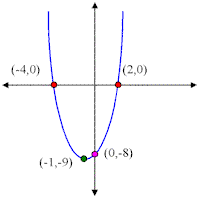
124.

Which value is the vertex?

a)

(-4, 0)

b)

(-1, -9)

c)

(0, -8)

d)

(2, 0)

125.

Which value is the y-intercept?

a)

(-4, 0)

b)

(-1, -9)

c)

(0, -8)

d)

(2, 0)

126.

What are the zeros of this graph?

a)

x = {-4, 2}

b)

(-4, 0 ) and (2, 0)

c)

x = {-1, 0}

d)

(-1, 9 ) and (0, -8)

127.

Does this graph have a maximum or a minimum?

a)

maximum

b)

minimum

c)

I am not sure.

d)

neither

128.

Does this graph have a maximum or a minimum?

a)

maximum

b)

minimum

c)

I am not sure.

d)

neither

129.

Does this graph have any roots?

a)

yes

b)

no

c)

I am not sure.

130.

Does this graph have a y-intercept?

a)

yes

b)

no

c)

I am not sure.

131.

What is the equation for standard form?

a)

y = x2 + bx + c

b)

y = ax2 + bx + c

c)

y = mx + b

d)

Ax + By = C

132.

Solve the equation by factoring.

a)

x = {3,8}

b)

x = {-3,8}

c)

x = {3,-8}

d)

x = {-3,-8}

133.

Solve the equation by factoring.

a)

x = {1}

b)

x = {-1}

c)

x = { }

d)

no solution

134.

Solve the equation by factoring.

a)

x = {-5,-3}

b)

x = {5,-3}

c)

x = {-5,3}

d)

x = {5,3}

135.

How many solutions can a quadratic have?

a)

1 solution

b)

3 solutions

c)

0 solutions

d)

2 solutions

136.

What can the roots to a quadratic equation be called?

a)

zeros

b)

solutions

c)

x-intercepts

d)

none of the choices

137.

What is the quadratic formula?

a)
b)
c)
d)
138.

What is the axis of symmetry formula?

a)

y = mx+b

b)

y = ax2+bx+c

c)

b2 - 4ac

d)

x = -b/2a

139.

Solve the equation using the quadratic formula.


x2 + 7x = x - 10

a)

-6/2 + √4

b)

-6/2 - √4

c)

no solution

d)

∅

140.

Solve the equation using the quadratic formula.


4x2 +9x = 12x

a)

x = {0, 3/4}

b)

x = {0, -3/4}

c)

x = {0, 4/3}

d)

no solution

141.

Use the discriminant to find the number of solutions for the following equation.


y = x2 +10x + 25

a)

2 solutions

b)

1 solution

c)

0 solutions

142.

Use the discriminant to find the number of solutions for the following equation.


y = -3x2 +5x - 8

a)

2 solutions

b)

1 solution

c)

0 solutions

143.

Use the discriminant to find the number of solutions for the following equation.


y = 4x2 - 9

a)

2 solutions

b)

1 solution

c)

0 solutions

144.

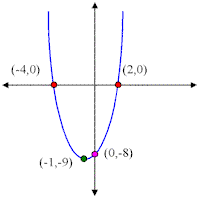
Which value is the vertex?

a)

(-4, 0)

b)

(-1, -9)

c)

(0, -8)

d)

(2, 0)

145.

Which value is the y-intercept?

a)

(-4, 0)

b)

(-1, -9)

c)

(0, -8)

d)

(2, 0)

146.

What are the zeros of this graph?

a)

x = {-4, 2}

b)

(-4, 0 ) and (2, 0)

c)

x = {-1, 0}

d)

(-1, 9 ) and (0, -8)

147.

Does this graph have a maximum or a minimum?

a)

maximum

b)

minimum

c)

I am not sure.

d)

neither

148.

Does this graph have a maximum or a minimum?

a)

maximum

b)

minimum

c)

I am not sure.

d)

neither

149.

Does this graph have any roots?

a)

yes

b)

no

c)

I am not sure.

150.

Does this graph have a y-intercept?

a)

yes

b)

no

c)

I am not sure.

151.

What is the equation for standard form?

a)

y = x2 + bx + c

b)

y = ax2 + bx + c

c)

y = mx + b

d)

Ax + By = C

152.
If a system of equations has no solution, what does the graph look like? 
a)
intersecting lines
b)
parallel lines
c)
skew lines
d)
intersecting lines
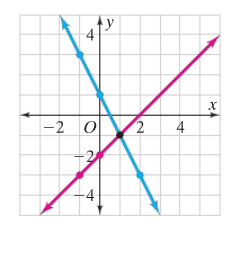
153.
What is the solution?
a)
(1, -1)
b)
(-1, 1)
c)
(0, -2)
d)
(0, 1)
154.
How many solutions does this system of equations have?
a)
One Solution
b)
No solution
c)
Infinitely Many Solutions
d)
Two Solutions
155.
Solve for x and y
3x + 2y = 16
7x + y = 19
a)
(-2,5)
b)
(-2,-5)
c)
(2,-5)
d)
(2,5)
156.
If a system of linear equations has one solution, what does this mean about the two lines? 
a)
Parallel lines
b)
the same line 
c)
Intersecting lines
157.
Solve using substitution.
x - 2y = 2
3x + 4y = 3
a)
(1.4, -0.3)
b)
(3.1, 5)
c)
(-2.5, 3.5)
d)
(6.9, 1.02)
158.
This system has _____ solutions
a)
0
b)
1
c)
2
d)
Infinitely many
159.
Find the solution to the system of equations:
3x + 2y = 16
y = -7x + 19
a)
(-2,5)
b)
(-2,-5)
c)
(2,-5)
d)
(2,5)
160.
y = -6x + 5
-2x + y = 5
a)
(-3, -6)
b)
(-6, 3)
c)
(0, 5)
d)
(-3, 5)
161.
A system of linear equations is... 
a)
Math Magic
b)
One Equation
c)
Always more than 2 equations
d)
A set of 2 or more equations
162.
Determine if (4, 1) is a solution for the system of equations.
y = -x + 5
y = 2x - 7
a)
yes
b)
no
163.
Solve the system of equations by elimination.
-x + y = -13
-8x - 4y = -8 
a)
(5, 8)
b)
(5, -8)
c)
(-5, -18)
d)
(-5, 8)
164.
Which of the following are ways to solve systems of equations? 
a)
Graphing
b)
Substitution
c)
Elimination
d)
All of the above
165.
Solve the system by elimination. 
−4x − 4y = 0
4x + 4y = 0 
a)
(−6, −4) 
b)
Infinite number of solutions  
c)
(−6, 10) 
d)
(6, 4) 
166.
Solve the system of equations by substitution.
y = -4x + 5
y =  3x - 16
a)
(-3, -25)
b)
(3,-7)
c)
(11, 17)
d)
(21, 47)
167.
Solve for x and y.
y = 2/3x - 2
y = -x + 3
a)
(0,3)
b)
(0,-3)
c)
(3,0)
d)
(-3,0)
168.
What is the solution to the system?
8x + 4y = 12
y = -2x + 3
a)
(0,3)
b)
(3,0)
c)
No solution(parallel lines)
d)
Infinitely many solutions
169.
Solve the system of equations.
y = 4x+1
3x + 2y = 13
a)
(1, 5)
b)
(5, 1)
c)
(0.25, 2)
d)
∅
170.
If a system of equations has no solution, what does the graph look like? 
a)
intersecting lines
b)
parallel lines
c)
skew lines
d)
intersecting lines
171.
What is the solution?
a)
(1, -1)
b)
(-1, 1)
c)
(0, -2)
d)
(2, 0)
172.
When you graph the exact same equation twice,
a)
you will have no solution. 
b)
you will have one solution.
c)
you will have infinite solutions. 
d)
you will graph a giraffe. 
173.
How many solutions will this system have? 
a)
No solution
b)
One Solution
c)
I Don't Know
d)
Infinitely Many Solutions
174.
What is the solution?
a)
(6, 3)
b)
(3, 6)
c)
(-6, 3)
d)
No solution
175.
Solve the following system by graphing.  What is the solution?
a)
(-4, 2)
b)
(4, 2)
c)
(2, -4)
d)
(2, 4)
176.
Solve the following system by substitution.  What is the solution?
a)
(1, -2)
b)
(-2, 1)
c)
(-4, 1)
d)
(2, 1)
177.
Solve the system using any method. 
−4x − 4y = 0
4x + 4y = 0 
a)
(−6, −4) 
b)
Infinite number of solutions  
c)
No solutions
d)
(6, 4) 
178.
Solve for x and y using any method we've learned!
y = 2x + 1
y = 4x - 1
a)
(1,3)
b)
(-1,-3)
c)
(-1,3)
d)
(3,1)
179.
Solve the system of equations below:
9x - 4y = 1
-3x + 8y = -47
a)
(3, -7)
b)
(-3, 7)
c)
(-3, -7)
d)
(-7, -3)
180.
Solve by elimination:
3x+7y=23

-3x-7y=-17
a)
No solution
b)
ARN
c)
(-3,3)
d)
(3,3)
181.
Solve by elimination:
4x+9y=28
-4x-y=-28
a)
(-7,0)
b)
(6,0)
c)
(-6,0)
d)
(7,0)
182.
Solve by graphing:
y=5x+3

y=-2x-4
a)
(2,-1)
b)
(-1,-2)
c)
(1,-2)
d)
(-2,-1)
183.
Solve by elimination:
9x-4y=7

x-4y=-17
a)
(-1,5)
b)
(-7,5)
c)
(7,5)
d)
(3,5)
184.
Solve by elimination:
7x-9y=29

7x+2y=-15
a)
(-4,-1)
b)
(-1.-4)
c)
(-1,4)
d)
(-1,6)
185.
What does the x represent in this situation?
Manny’s Music Rental charges a fee of $40 plus $25 per month to rent a saxophone. Sid’s Saxophones charges $25 plus $30 per month to rent the same saxophone.
y = 25x + 40
y = 30x + 25
a)
price of a saxophone
b)
rental fee
c)
total cost
d)
number of months
186.
The solution of a system of linear equations is...
a)
the y-intercept (b)
b)
the intersection of the two equations on a graph
c)
the second equations' answers
d)
the slope (m)
187.
solve by substitution: y=3x+14
y=-4x
a)
y=3
b)
y=1
c)
y= - 2
d)
y=4
188.
Solve by elimination:
7x+y=-9

-3x-y=5
a)
No solution
b)
(1,8)
c)
(-2,-3)
d)
(-1,-2)
189.
What is the solution?
a)
One Solution
b)
No solution
c)
Infinitely Many Solutions
d)
(0, -1.5)
190.
What is the solution?
a)
(1, -1)
b)
(-1, 1)
c)
(0, -2)
d)
(0, 1)
191.
If a system of equations has no solution, what does the graph look like? 
a)
intersecting lines
b)
parallel lines
c)
skew lines
d)
intersecting lines
192.
How many solutions does this system of equations have?
a)
One Solution
b)
No solution
c)
Infinitely Many Solutions
d)
Two Solutions
193.
There are 50 donkeys and chickens on a far.  There are a total of 174 legs.  Which system below can be used to figure out how many of each animal the farm has?
a)
d + c = 174
4d + 2c = 50
b)
d + c = 50
4d + 2c = 174
c)
d + c = 50
2d + 4c = 174
d)
d + c = 174
2d + 4c = 50
194.
If a system of linear equations has one solution, what does this mean about the two lines? 
a)
Parallel lines
b)
the same line 
c)
Intersecting lines
195.
Solve for x and y
3x + 2y = 16
7x + y = 19
a)
(-2,5)
b)
(-2,-5)
c)
(2,-5)
d)
(2,5)
196.
This system has _____ solutions
a)
0
b)
1
c)
2
d)
Infinitely many
197.
Alexandra finds that she can give 3 haircuts and 2 hair dyes in 315 minutes. Giving 2 haircuts and 4 hair dyes takes 450 minutes.  Which system of equations represents the situation?
a)
3x + 2y = 315
2x + 4y = 450
b)
3x + 2y = 450
2x + 4y = 315
c)
2x + 2y = 315
3x + 4y = 450
198.
Solve using substitution.
x - 2y = 2
3x + 4y = 3
a)
(1.4, -0.3)
b)
(3.1, 5)
c)
(-2.5, 3.5)
d)
(6.9, 1.02)
199.
Find the solution to the system of equations:
3x + 2y = 16
y = -7x + 19
a)
(-2,5)
b)
(-2,-5)
c)
(2,-5)
d)
(2,5)
200.
y = -6x + 5
-2x + y = 5
a)
(-3, -6)
b)
(-6, 3)
c)
(0, 5)
d)
(-3, 5)
201.
Determine if (4, 1) is a solution for the system of equations.
y = -x + 5
y = 2x - 7
a)
yes
b)
no
202.
Solve the system of equations by elimination.
-x + y = -13
-8x - 4y = -8 
a)
(5, 8)
b)
(5, -8)
c)
(-5, -18)
d)
(-5, 8)
203.
Which of the following are ways to solve systems of equations? 
a)
Graphing
b)
Substitution
c)
Elimination
d)
All of the above
204.
When you graph an inequality, you used a solid line when you use which symbols?
a)
≤, ≥ 
b)
<, >
205.
When graphing an inequality, you use a dotted line when you use which symbol?
a)
<, >
b)
≤, ≥ 
206.
In an equation or inequality, you want to get the variable...
a)
on one side
b)
to disappear
c)
isolated (by itself)
207.
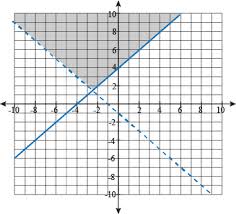
Which system of linear inequalities is represented by the graph?
a)
y≤2x-1
y>-2x+3
b)
y>2x-1
y≤-2x+3
c)
y<2x-1
y≥-2x+3
d)
y≤2x-1
y>2x+3
208.
Which point is a solution?
a)
(0, 6)
b)
(-3, 4)
c)
(1, 0)
d)
(-4, 3)
209.
Is (-2,4) a solution to the system?
a)
Solution
b)
Not a solution
210.
Is (0,0) a solution to the system?
a)
Solution
b)
Not a solution
211.
The solution to a system of equations is any ordered pair that makes both equations true. 
a)
TRUE
b)
FALSE
212.
What is the solution? 
a)
1
b)
-2
c)
(1, 2)
d)
(1, -1)
213.
Parallel Lines never intersect because...
a)
they have the same slopes. 
b)
they have the same y-intercept.
c)
they have different slopes.
d)
they have different y-intercepts. 
214.
This system has _____ solutions
a)
0
b)
1
c)
2
d)
Infinitely many
215.
What is the solution?
a)
One Solution
b)
No solution
c)
Infinitely Many Solutions
216.

You can solve systems using these methods:

a)

graphing, substitution, and elimination

b)

rearranging, thinking, and guessing

c)

only by graphing

217.

Solve this system by substitution.

a)

(1, -4)

b)

(1, 4)

c)

(-4, -7)

d)

(-7, -4)

218.
The solution (x, y) to a system of equations is the point where they...? 
a)
Run off the graph
b)
Don't touch
c)
Intersect
d)
Exist
219.

What variable do you eliminate?


4x + 8y = 20

−4x + 2y = −30

a)

X because they have opposite signs

b)

Y because they have opposite signs

220.

What variable do you eliminate, and what do you multiply the equation(s) by?

5x + y = 9

10x − 7y = −18

a)

You eliminate x, and multiply the top equation by 11

b)

You eliminate y, and multiply the top equation by 7

221.
Solve the system given:
3x - y = 7
2x + y = 3
a)
(-1,2)
b)
(5,4)
c)
(4,5)
d)
(2,-1)
222.
Solve using elimination. 
−4x − 4y = 0
4x + 4y = 0 
a)
(−6, −4) 
b)
Infinite number of solutions  
c)
(−6, 10) 
d)
(6, 4) 
223.
Solve using elimination.
-4x - 6y = 6
4x + 6y = -4
a)
no solution
b)
(2,0)
c)
(-4,0)
d)
(0,0)
224.

Solve the following systems of equations using substitution:


x = 6

y = 2x - 3

a)

(6, 6)

b)

(6, 9)

c)

(9, 6)

d)

(9, 9)

225.
If the solution is infinitely many the lines will ________?
a)
intersect at exactly one point
b)
be parallel
c)
overlap each other
d)
never exist
226.

Solve the following system:

y=−2y=-2  

4x−3y=184x-3y=18  

a)

(3, −2)\left(3,\ -2\right)  

b)

(3, 2)\left(3,\ 2\right)  

c)

(−2,3)\left(-2,3\right)  

d)

(2, 3)\left(2,\ 3\right)