
 Worksheets
Benchmark Exam Review
Total questions: 118
Worksheet time: 1hrs 4mins
Which of these is NOT true about the geography of Ancient Greece?
Greece is made up of small islands and peninsulas
Greece had a lot of good farmland
Greece is rocky and mountainous
The mountains and seas isolated Greek city-states
What did the ancient Greeks become very good at building because of their geography?
Castles
Pyramids
Ships
Weapons
Athens, Sparta, or both: Required men to serve in the military
Athens
Sparta
Both
Athens, Sparta, or both: Valued education and the arts.
Athens
Sparta
Both
Athens, Sparta, or both: used helots to do most of the work;
Athens
Sparta
Both


The foundation for Greece's economy was:
sea trade
farming
military conquest
bartering
Greek city-states were run by their
soldiers
politicians
citizens
kings
Under the Greek definition of citizen, who qualified for citizenship?
free, native-born men who owned land
any woman, whether she owned land or not
wealthy men or women who owned slaves and land
foreign-born or native-born men, who may or may not have been landowners
The type of leader in power in Greece around 600 B.C. due to growing political unrest among city-states was a(n)
democrat
oligarch
ephor
tyrant
The Mycenaean palatial (palace) system is most similar to which feature of the polis?
oligarchy
democracy
acropolis and agora
city-state
This is Greek for City.
Acropolis
Agora
Polis
Helot
This part of a Greek city was typically built on a cliff or mountain side to make it easier to defend from enemies.
Acropolis
Polis
Agora
Helot
Open area in the city that is used as a market and gathering place.
Acropolis
Polis
Agora
Parthenon
The _________ civilization was the first to arise in ancient Greece on the island of Crete.
Phoenician
Dorian
Mycenaean
Minoan
The type of leader who rallied the common people and took power in Greece around 600 B.C. was
democrat
oligarch
ephor
tyrant
Name the Athenian ruler who, in 594 B.C., became popular among the common people for cancelling debts.
Peisistratus
Cleisthenes
Plutarch
Solon
A new settlement that keeps close ties to its homeland is called a(n)
polis
colony
agora
acropolis
Ancient Greeks made their living raising
Sheep
Cattle
Horses
Rabbits
Where was Sparta located?
Southern Peloponnesus
Attica
Asia Minor
Crete
In Sparta, publicly-owned slaves were called
peninsulas
hoplites
poleis
helots
Slavery was common
Athens
Sparta
Both
a form of government in which all citizens can participate firsthand in the decision-making process
philosopher
direct democracy
representative democracy
a form of government in which citizens elect officials to govern on their behalf
philosopher
direct democracy
representative democracy
the governor of a province in ancient Persia
Zoroastrianism
satrapy
satrap
a Persian religion based on the belief of one god
Zoroastrianism
satrapy
satrap
control by a small group
democracy
oligarchy
satrapy
tyranny
formed to defend its members from the Persians
Delian League
Athenian League
Macedonian League
gathering place, marketplace
bard
agora
polis
colony
a Greek city-state
polis
agora
colony
ephor
ordinary citizens in the army
polis
satrap
hoplite
ephor
Prominent Persians: Father of Xerxes and the previous king
Darius I
Hydarnes
Mardonius
Masistius
During the 2nd Persian War a Spartan force of 300 held off the Persian army at a place called __________.
Marathon
Salamis
Thermopylae
Ionia
This naval battle fought in 480 BCE was a decisive victory for the Greeks
Thermopylae
Marathon
Salamis
Sardis
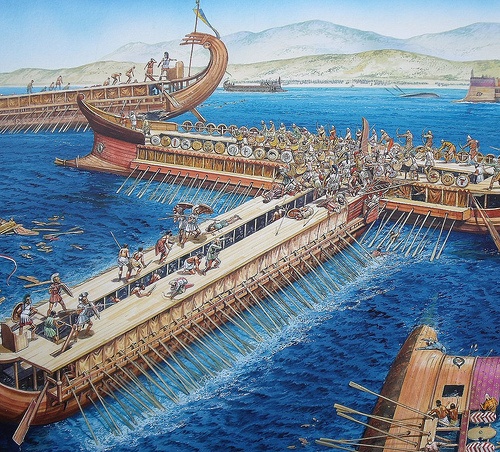
Which battle did the Greeks lose?
Marathon
Thermopylae
Salamis
Plataea
The Greeks won the Battle of Salamis because their ships
Could move around quickly
Outnumbered their enemies
Came from the Spartan Navy
sank
How did Pericles decide who should hold public office?
Class
Election
Wealth
Ability
How did the Greeks apply the law?
Everyone was equal
Women were better
Poor people were better
Rich people were better
Which of the following did Athenian soldiers promise to do in their oath?
Pay back loans at harvest time
Sell themselves into slavery
Protect the constitution
Obey the oracle
Greece’s northern neighbor, ruled by Philip II in 359BC
(a)


Alexandria, the Greek capital of Egypt and a center of trade, was most famous among scholars for its
Theaters
Trade
Library
Architecture
How many battles did Alexander lose during his lifetime?
0
2
3
True or False: Alexander the Great's empire lasted for hundreds of years after he died.
True
False
Philip II was the king of
Persia.
Macedonia.
Greece.
Egypt.
Which strategy did Philip II borrow from the Greeks?
Iron weapons
Surprise attacks
Phalanx formation
Building a navy
The Greek mathematician whose theories are the basis for modern geometry.
Aristarchus
Euclid
Socrates
Sophocles
What does the term "Hellenistic" mean?
Absolute ruler
To conquer
Greek-like
Having Greek ancestry
What happened to Alexander's Empire after his sudden death?
Alexander's son was the next king.
Alexander's wife rule the empire.
Persians reconquered the empire.
It was divided up by his generals.
After defeating Persia, Alexander now ruled __________.
modern day France and Germany
most of Asia
the largest empire the world had ever seen
all of India
Alexander supported the spread of ___________ culture.
Greek
Socratic
Indian
Buddhist
Who was Alexander the Great's teacher?
Aristotle
Archimedes
Plato
Darius
What impact did the Hellenistic Empire have on Greece?
A major world religion was spread
A deadly plague was spread to the Persian Empire.
Culturally and politically separate areas were unified.
Caste systems from the Hindus were adopted by Greeks.
Who thought that governments should be headed by philosopher-kings?
Alexander the Great
Plato
Aristophanes
Jason
Who freed the Greek cities in Asia Minor from Persian rule?
Philip II
Alexander the Great
Demosthenes
Euclid
Philip II got some Greek cities to join him by ________ them.
Conquering
Inviting
Bribing
All of these
Who told King Ptolemy that “There is no royal way to learn geometry”?
Euclid
Pythagorus
Aristotle
Poseidon
This Macedonian king loved Greek culture and planned to conquer Persia.
Alexander the Great
Aeschylus
Philip II
Homer

Homer’s epic, the Iliad, is about
Alexander the Great
The Trojan War
Gilgamesh
The oracle at Delphi

Who was the goddess of wisdom and crafts?
Aphrodite
Artemis
Athena
Apollo
Herodotus wrote...
The Odyssey.
The History of the Persian Wars.
The Book of the Dead.
Antigone.
Who wrote the Odyssey?
Sophocles
Euripides
Homer
Aesop
Aristotle taught his students to follow the
Golden Rule
Golden Mean
Golden Fleece
None of these
The Hellenistic Era produced a great body of
Scientific Achievement
Art and Architecture
Literature and Philosophy
All of the above
The library here attracted scholars from all over the world
Babylon
Rome
Thebes
Alexandria
Whose armies conquered the land as far east as modern India?
Alexander the Great
Philip II
Ramses II
Cyrus the Great
Who built one of the greatest cities of the ancient world and named it after himself?
Philip II
Macedonia
Alexander the Great
Cyrus
What is a story about gods and heroes?
(a)
Why is Herodotus so significant to the development of historical writing?
he used a lot of different sources
he told history like a story
he used accurate dates
he included gods and goddesses in his histories
What would be an example of a modern-day Sophist?
lawyers
advertisers
politicians
all of the above
What do Sophists care the most about?
finding the truth
winning arguments
developing theories
free education
What is a short story that teaches a moral/lesson?
(a)
How does Greek culture still influence us today?
Why did Alexander's empire fall apart after his death?
The belief in one god.
polytheism
deity
monotheism
holy
The belief in many gods.
polytheism
monotheism
deity
holy
A monotheistic religion. Believers believe in the teachings of Jesus and the Bible.
Christianity
Judaism
Hinduism
Buddhism
Belief in Hinduism that your next life will depend on your good or bad deeds in this life. The cycle of cause and effect.
holy
karma
Siddhartha Gautama
Vedas
A Jewish religious leader
Rabbi
Imam
Torah
Priest
Who is the founder (based on his teaching) of Buddhism?
Jesus
Siddartha Guatama
Abraham
Mohammed


Which world religion was founded by Jesus Christ of Nazareth?
Christianity
Judaism
Hinduism
Islam
Which monotheistic religion was founded by the prophet Muhammad?
Christianity
Islam
Hinduism
Buddhism


What is the polytheistic religion in India?
Islam
Christianity
Judaism
Hinduism

Vedas
Aisha regularly donates time and money to people in need. She is preparing to travel to the holy city of Mecca for Hajj.
What religion is she?
Islam
Buddhism
Christianity
Judaism
Jerry goes to the Synagogue to worship. He celebrates Passover each year to recognize the Hebrews being released from slavery in Egypt.
What religion is he?
Islam
Buddhism
Christianity
Judaism
Kelli's family is from India. They believe in Karma and that the actions they take in this lifetime will determine the form their souls take in the next life.
What religion are they?
Islam
Hinduism
Christianity
Judaism
Which of the following is not a noble truth of Buddhism?
All life is suffering.
To overcome desire, have virtue and compassion for living things.
End pain by overcoming one's desires.
To overcome pain one needs to have desire.
Which TWO religions originated in Israel?
Buddhism
Islam
Judaism
Sikhism
Christianity
Which religion believes in a god called Allah?
Hinduism
Buddhism
Sikhism
Islam

This is the symbol for...
Judaism
Islam
Christianity

This is the symbol for...
Judaism
Islam
Buddhism

This is the symbol for...
Christianity
Islam
Buddhism

