wayground logo

Free Printable Worksheets

Font size

S
M
L
XL
Worksheets

Midterm Review 2

Total questions: 25

Worksheet time: 26mins

Name
Class
Date
1.
Which structures are found in plant cells, but not in animal cells?
a)
Cell membranes and mitochondria
b)
Vacuoles and cholorplasts
c)
Cell walls and cytoplasm
d)
Chloroplasts and cell walls
2.

Which structures keeps plants cells from bursting like animal cells?

a)

cell membrane

b)

nuclear envelope

c)

cell wall

d)

ER

3.

PMAT helps us remember the correct order of the phases of Mitosis. Which of the following has the phases of Mitosis in the correct Order

a)

Interphase, Mitosis, Cytokinesis

b)

Prophase, Metaphase, Anaphase, Prophase

c)

Anaphase, Telophase, Prophase, Telophase

d)

Prophase, Metaphase, Anaphase, Telophase

4.

What is pictured above?

a)

Cleavage furrow in an animal cell

b)

Cleavage furrow in a plant cell

c)

Cell Plate in an animal cell

d)

Cell Plate in a plant cell

5.

Identify the stage of mitosis.

a)

interphase

b)

prophase

c)

metaphase

d)

anaphase

6.

Identify the stage of mitosis.

a)

interphase

b)

prophase

c)

anaphase

d)

cytokinesis

7.
Name the phase:
a)
Anaphase
b)
Telophase
c)
Metaphase
d)
Prophase
8.
a)

telophase

b)

anaphase

c)

metaphase

d)

cytokinesis

9.
Proteins are made of monomers called ___________
a)
Nucleotides
b)
Monosaccharides
c)
Amino Acids
d)
Glycerol and fatty acids
10.
Nucleotides are monomers of
a)
Carbohydrates
b)
Lipids
c)
Proteins
d)
Nucleic Acids
11.
What are the monomers of DNA?
a)
glycerols
b)
amino acids
c)
fatty acids
d)
nucleotides
12.
Which group of biomolecules provide quick energy to organisms?
a)
proteins
b)
carbohydrates
c)
lipids
d)
nucleic acids
13.
Genetic information is stored in which class of organic compounds?
a)
proteins
b)
lipids
c)
nucleic acids
d)
carbohydrates
14.
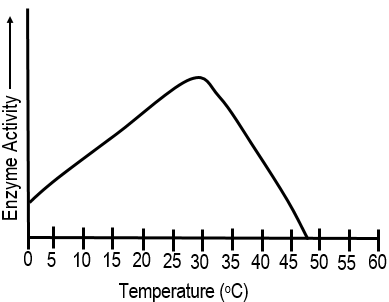
Based on the graph, what is the optimal temperature for this enzyme? 
a)
15oC
b)
40oC
c)
30oC
d)
35oC
15.

Which polysaccharide is used by plants to make their cell wall?

a)

starch

b)

glycogen

c)

cellulose

d)

chitin

16.
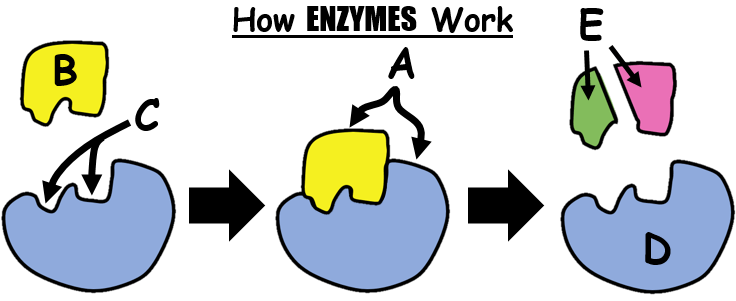
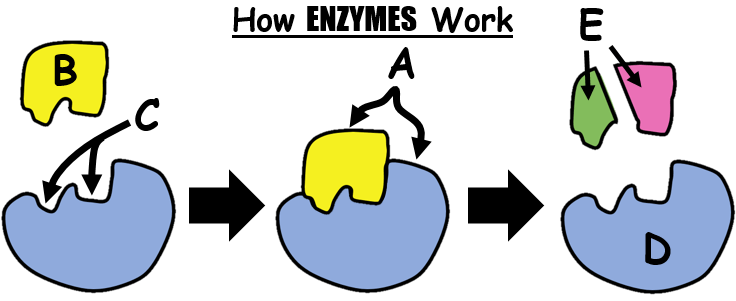
Letter B...
a)
active site
b)
enzyme
c)
substrate
d)
products
17.
Letter E...
a)
active site
b)
enzyme
c)
substrate
d)
products
18.
Which enzyme is most efficient in a basic solution?
a)
A
b)
B
19.
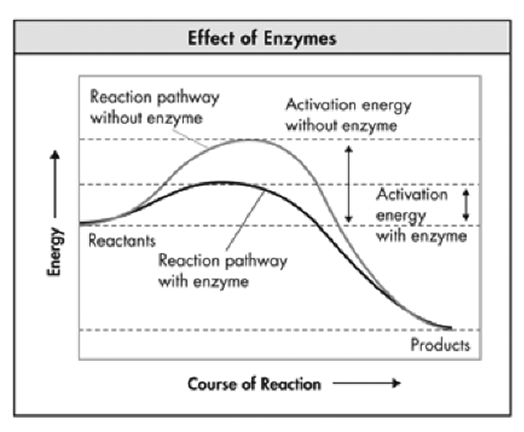
The graph shows how enzymes affect reactions in cells. Which statement best summarizes the information shown in the graph?
a)
Enzymes increase the energy of the reactants.
b)
Enzymes decrease the energy level of the products.
c)
Enzyme decrease the activation energy of the reaction.
d)
Enzymes reverse the direction of the reaction.
20.

If the eyepiece is 10X and we are using the high objective lens (40X), how many times is the image magnified?

a)

40

b)

4000

c)

400

d)

4

21.

The _____________ stores food, water, wastes, and other materials in both plant and animal cells.

a)

Vacuole

b)

Mitochondria

c)

Cytoplasm

d)

Nucleus

22.
Functions in energy production, known as the energy factory of the cell
a)
mitochondria
b)
chloroplast
c)
vacuole
d)
cytoplasm
23.
When looking at the cell membrane, where are the lipid tails located?
a)
Inner part of the bilayer
b)
Outer part of the bilayer
c)
At the end of the bilayer
d)
Goes through each end of the bilayer
24.
During what phase of the cell cycle does the cell prepare for mitosis?
a)
G1 phase
b)
S phase
c)
G2 phase
d)
M phase
25.
During what phase of the cell cycle does the cell grow?
a)
G1 phase
b)
S phase
c)
M phase
d)
Cytokinesis