
 Worksheets
Biology Quiz 2
Total questions: 30
Worksheet time: 20mins
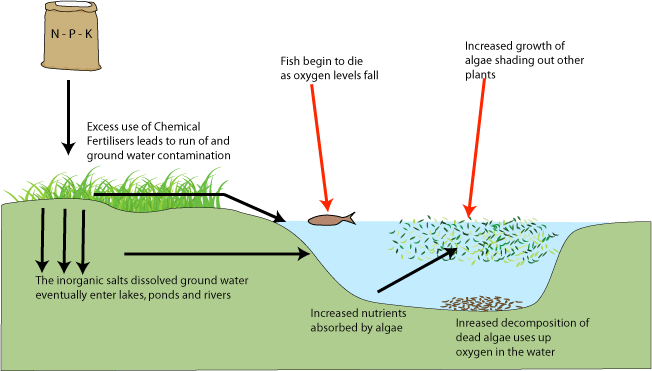
An increase in the amount of nutrients in a lake is known as
calcification
cellular respiration
eutrophication
photosynthesis

Do not forget! There are aquatic plants under the lake too! What do you think the algae would do to the plants at the bottom of the lake?
The aquatic plants will not be affected by the algae
Sunlight cannot reach the bottom of the lake because the surface is covered in algae
Sunlight can reach the bottom pf the lake. There is no problem.
Which of the following is NOT a source of nitrates and phosphates into a river?
Fertilizers
Animal waste
Sewage/
Wastewater
Burning fossil fuels
How does eutrophication cause the death of aquatic organisms
the build up of carbon dioxide in the water
the lack of nitrogen in the water
the lack of carbon dioxide in the water
the lack of oxygen in the water


Deforestation causes an increase in atmospheric carbon dioxide
true
false
Which of the following gases are the cause of acid rain?
methane
carbon dioxide
sulfur dioxide
oxides of nitrogen
Which of the following are the problems caused by acid rain?
It damages the decomposers. Decomposers unable to return nutrients to the soil.
Soil become more acidic and plants unable to absorb important minerals from the soil.
Slowly dissolves any structure made chalk, limestones and marble.
All of the following
A feature of some plants that live in dry places is that the leaves are reduced to spines. What is an advantage of the leaves being reduced to spines?
Decrease in photosynthesis
Decrease in transpiration
Increase in photosynthesis
Increase in transpiration
What type of lichen would you expect to find growing only in very clean air
crusty
leafy
bushy
These organisms only survive in very clean water
red tailed maggots and sludgeworms
Mayfly larvae and stonefly nymph
caddis fly larva and freshwater shrimps
water louse

Which organism would have the most bioaccumulation?
eucalyptus tree
wombats
kookaburras
koalas
Toxin concentrations _____________ as you go up the food chain.
do not change
increase
decrease
What is bioaccumulation?
buildup of toxins in an organism
the total mass/amount of organisms in a given area
the number of different species in an area
Which consumer is the most affected by toxins like mercury?
Primary Consumer
Secondary Consumer
Top Predator
Producers
Which of the following consumers is less affected by bioaccumulation of herbicides or pesticides?
Tertiary consumers
Primary consumers/ Herbivores
Secondary consumers
Top predators
As a part of the water cycle, water from Earth's surface enters the clouds and finally falls back to the ground in the form of rain. What is the correct sequence of processes water undergoes?
Evaporation, Condensation, Precipitation
Precipitation, Condensation, Evaporation
Condensation, Evaporation, Precipitation
Evaporation, Precipitation, Condensation

A student draws a model to represent the precesses involved in the water cycle, as shown. To which process is the formation of clouds related?
Condensation
Evaporation
Freezing
Melting

The image shows various stages in the water cycle. During which stage does water flow back towards the sea as runoff?
W
X
Y
Z
Which of the following is/are greenhouse gases?
Methane
Carbon dioxide
Chlorofluorocarbon
All of the following

Ten 1m2 quadrats were placed in a 40m2 field. On average 2 snails were found in every quadrat. Estimate the population size of the whole field.
2
10
40
80
20
Miss Murdock wants to estimate population size for crabs on Destin Beach. She uses 2 quadrats and counts 11 crabs in the first and 7 crabs in the second. The quadrats are 2m2. The area of the beach is 20m2. What is the estimated population size of crabs?
360
90
18
9
In eutrophication, what makes the oxygen level decrease rapidly?
Increase amount of algae on top of the water
Increase amount of decomposers that break down dead plants under water
Decrease amount of decomposers that break down dead plants under water
Decrease amount of algae on top of the water
How does carbon monoxide harmful to human?
It is one of the greenhouse gases
It can cause acid rain
It affects transport of oxygen in the blood
All of the above
Crusty lichens can live in ___________
a very clean air
heavily polluted air
slightly polluted air
Which of the following statements about sun leaves is/are true?
the colour is dark green
contain more chlorophyll
surface area is bigger
rate of transpiration is high
Which of the following statements about shade leaves is/are true?
rate of transpiration is high
contain more chlorophyll
larger surface area
smaller surface area
Water can be polluted by fertilisers. What is the name of the event that can happen when a lake or river is polluted by fertilisers
water pollution
acid rain
eutrophication
precipitation

