
 Worksheets
Fresh & Saltwater Systems
Total questions: 25
Worksheet time: 1hrs 15mins
Which of the following represents the percentage of the world's water that is freshwater?
50%
23%
97%
3%
Which of the following pairs would represent the majority of freshwater on Earth?
icecaps and groundwater
lakes and streams
groundwater and streams
ice and lakes
The water cycle is a model of what happens to water on the Earth. What is it called as droplets move up and into the atmosphere …
evaporation
condensation
precipitation
storage
What is the difference between a current and a wave?
Waves only happen in freshwater and currents only happen in saltwater.
Waves involve the movement of large bodies of water and currents happen on the surface.
Waves are streams of water that flow deep inside tides.
Waves happen on the surface and currents are streams of water that flow inside larger bodies of water.
What is the difference between a wave and a tide?
Waves only happen in fresh water and tides only happen in salt water.
Waves involve the movement of large bodies of water and tides happen on the surface.
Waves are streams of water that flow deep inside tides.
Waves happen on the surface and tides involve the movement of large bodies of water.
Which of the following is NOT true of glaciers?
They have a great affect on the land around them.
They don't affect the land around them.
They contain vast amounts of fresh water.
They are melting and may eventually disappear.
Which of the following environments would have the greatest diversity?
pond
puddle
lake
sea
A predictable, yearly change in an ecosystem is usually called which of the following?
Long-term change
Seasonal change
Short-term change
Extinction
Which of the following is a positive impact that humans have on the water supply?
Fertilizer runs off fields and enters rivers.
Oil spills from ships.
Sewage (human waste) is dumped.
None of the above.
Which of the following is an example of a situation where an organism was not able to adapt to its environment?
Pond salamanders die when the weather changes and the water disappears.
Star fish have suction cup-like bottoms to cling onto rocks in intertidal zones.
Sewage adds nitrogen to water that makes micro-organisms multiply and provides a lot of food for the fish.
None of the above.
Which of the following is an example of an adaptation an organism has made to its environment?
Star fish have suction cup-like bottoms to cling onto rocks in intertidal zones.
Pond salamanders die when the weather changes and the water disappears.
Sewage adds nitrogen to water that makes micro-organisms multiply and suffocate the fish.
None of the above.
Glaciers affect the water cycle in many direct and indirect ways. Their DIRECT influence is...
they speed up evaporation as they melt
decrease the amount of accumulation
slow down the speed at which water travels through the cycle
prevent groundwater from evaporating
If accumulation exceeds melting in a glacier then it is considered a ________________ glacier.
advancing
retreating
stationary
overflowing
The earth's tides are caused by...
The spin of the earth
The pull of the sun
The gravity of the sun and the moon
The shape of the land

The following graph tells us that over the last 150 years sea levels have been (a)
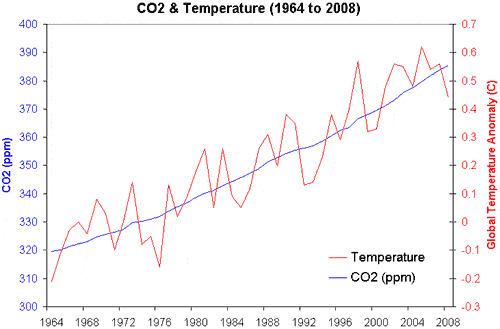
The graph below shows CO2 emissions and temperatures from 1909 to 1949. What conclusion is best supported by the graph?
There is no relationship between carbon dioxide concentrations and temperatures
As carbon dioxide concentrations increase, temperatures increase
As carbon dioxide concentrations increase, temperatures decrease
As carbon dioxide concentrations decrease, temperatures increase
Which of the following is a behavioural adaptation?
Birds have hollow bones to help them fly
A rattlesnake shakes the end of its tail to warn off other creatures
Chimpanzees use sticks to dig bugs out of a tree stump
A shark has gills which it uses to breathe underwater
How many low tides are there is one day?
1
2
4
8
What is erosion?
when sediment is deposited.
when sediment is picked up and moved.
when sediment mixes with the water.
when the sediment mixes with the soil.

Lethbridge and Vancouver have similar latitudes. Why is Lethbridge so much colder in the winter?
The ocean near Vancouver moderates the city's temperature
cold air currents hit Lethbridge from Saskatchewan
Lethbridge is always colder then Vancouver
Alberta is always colder than BC.
All the water on Earth can be generally categorized as
fresh and salt
oceans and lakes
tropical and temperate
rivers and lakes
The total amount of dissolved salts in water is referred to as the water's
purity
salinity
concentration
chlorine content
What is a watershed?
an area of land where all of the surface water drains into the same place
a shed where you keep your extra water bottles.
All of the area where the water drains into the soil
A country where the water all goes to the same place
What are some important things to remember to keep your watershed healthy?
Don't litter into the rivers
Make sure to not put things down the drain that shouldn't go there. (fats etc)
Everything that you put into the water can have effects down stream.
Watershed maintenance isn't really that important.
Where is most of Earth’s water located?
glaciers
lakes
oceans
rivers

