

Wayground logo

Free Printable Worksheets

Font size

S
M
L
XL
Worksheets

USH Quiz 16-18

Total questions: 55

Worksheet time: 9hrs 10mins

Name
Class
Date
1.

What was the primary way flappers of the 1920s challenged the traditional role of women?

a)

fought for increased job opportunities

b)

pressured colleges and universities to accept female students

c)

displayed fashions and behaviors that shocked mainstream society

d)

helped female politicians win campaigns

2.

What was a immediate effect of the radio?

a)

Allowed people to watch their favorite movies

b)

mobility for the working class

c)

improved access to information and created a sense of national identity

d)

helped women get away from traditional roles

3.

The Ku Klux Klan was most closely associated with

a)

Nativism & Racism

b)

Patriotism & liberalism

c)

workers rights & freedom

d)

communism & public ownership

4.

Who did the Palmer Raids target?

a)

anti-imperialists

b)

democrats

c)

suspected communists

d)

fascists

5.

What amendment gave women the right to vote?

a)

16th amendment

b)

18th amendment

c)

19th amendment

d)

21th amendment

6.

What amendment banned alcohol (Prohibition)?

a)

16th amendment

b)

18th amendment

c)

19th amendment

d)

21th amendment

7.

What kind of people were targeted during the Red Scare?

a)

anarchists and socialists

b)

socialist candidates

c)

people with freedom of speech who talk bad about the government

8.

What was one of the biggest reasons why the American economy boomed in the 1920s?

a)

mass production led to goods being made faster and an increase in supply

b)

the arrest of criminals who wouldn't stop killing people

c)

the banning of alcohol

d)

giving women the right to vote

9.

Period of economic prosperity after WWI?

a)

The Roaring 20s

b)

The Great Depression

c)

The Harlem Renaissance

d)

The Wild 40s

10.

The Harlem Renaissance can best be described as

a)

an organization created to help promote African-American businesses

b)

a period of great achievement by African American writers, artists, and performers

c)

a movement that sought to draw people back to the inner cities

d)

a relief program to provide jobs for minority workers

11.

Which one of these events happened during the 1920's?

a)

The Spanish-American War

b)

The bombing of the USS Maine

c)

Prohibition made playing cards in public illegal

d)

Women won the right to vote

12.
What were illegal places where people drank alcohol called?
a)
Speakeasies
b)
Cellars
c)
Hidden spots
d)
Speaksoftly
13.

How did the 18th Amendment affect the United States?

a)

It hurt the economy because the U.S. lost a lot of tax dollars

b)

It causes a lot of unemployment because factories that produced alcohol were forced to close

c)

It costed a lot of money to enforce the 18th Amendment due to organized crime

d)

All of the above are correct

14.
Which of the following was a major cause of the Great Depression?
a)
overproduction and underconsumption
b)
a decrease in the supply of consumer goods
c)
an increase in demand for imported products
d)
an increase in the price of wheat on the world market
15.
Who was the President of the United States when the Stock Market crashed?
a)
Franklin D. Roosevelt
b)
Herbert Hoover
c)
Woodrow Wilson
d)
Theodore Roosevelt
16.
How did "bank runs" impact the American people during the Great Depression?
a)

Banks eventually ran out of money because they could not collect money they loaned and people's life savings were gone.
b)
Banks made loans throughout the Great Depression, helping people pays bills until they could find work.
c)
Banks were able to people's deposits safe, but they could not loan out any more money.
d)
Banks were not at all involved in the Great Depression because people did not use them.
17.
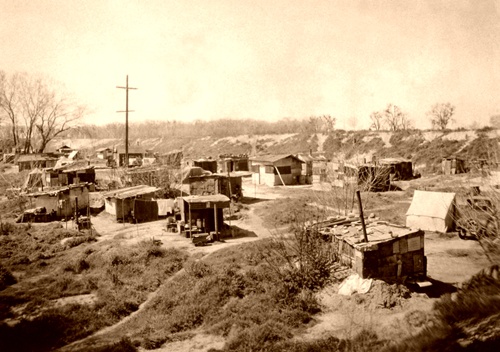
What was the main reason for the emergence of “Hoovervilles” like the one shown in the photograph?
a)
Many Americans had lost jobs during the Great Depression.
b)
Thousands of homes had been destroyed by the effects of the Dust Bowl.
c)
Housing projects could not keep up with the demand for homes needed by the poor.
d)
Preparations for World War I had created a shortage of building materials.
18.
During the 1930s, poor land management and severe drought conditions across parts of the Midwest resulted in the
a)
formation of the United States Department of Agriculture
b)
creation of wheat surpluses
c)
growth of the Populist movement
d)
development of Dust Bowl conditions on the Great Plains
19.
Which of these statements is true of the 1932 presidential election?
a)
Franklin Roosevelt won in a landslide.
b)
Hoover lost by a narrow margin.
c)
Huey Long ran a strong third-party campaign.
d)
Roosevelt won a third term.
20.
A major difference between the philosophies of President Herbert Hoover and President Franklin D. Roosevelt in responding to the Great Depression is that Roosevelt
a)
wanted to rely on private charities to provide assistance
b)
stressed the need for individual rugged individualism
c)
supported direct relief to people out of work
d)
thought the government should not be involved in economic reform
21.
FDR addressed the American public in weekly broadcasts known as:
a)
FDR Hour
b)
Hangin' With Franklin
c)
Fireside Chats
d)
Around the Fire
22.
As part of the New Deal, the Securities and Exchange Commission (SEC) and the Federal Deposit Insurance Corporation (FDIC) were created to
a)
allow for a quick recovery of stock prices
b)
provide direct loans to businesses
c)
protect individual investors from stock fraud and bank failure
d)
allow banks and companies to invest in the stock market
23.
The Civilian Conservation Corps (CCC) and the Works Progress Administration (WPA) were both New Deal programs developed to address the problem of
a)
excessive stock market speculation
b)
high unemployment
c)
increased use of credit
d)
limited income of senior citizens
24.
The TVA is significant because it hired people to 
a)
deliver food to the poverty-stricken Dust Bowl residents
b)
build dams and generators that provided electricity
c)
work on farms to help stabilize agriculture
d)
publish important facts about businesses
25.

An advocate of President Franklin D. Roosevelt’s farm policy, The Agricultural Adjustment Act, would have likely supported which economic strategy?

a)
Reducing agricultural output to increase product values
b)
Utilizing minimum wage laws to stimulate farm productivity
c)
Allowing market forces to operate freely to achieve stabilization
d)
Increasing agricultural production to ensure an affordable food supply
26.
The Fair Labor Standards Act of addressed what labor issue?
a)
Workplace safety
b)
Health insurance
c)
Collective bargaining
d)
Minimum wage
27.
A major reason that President Franklin D. Roosevelt proposed adding Justices to the Supreme Court in 1937 was to
a)
make the Court processes more democratic
b)
end corruption and favoritism in handling cases
c)

influence Court decisions in support of New Deal programs

d)
ensure the appointment of members of minority groups
28.
A major result of the New Deal was that it
a)
eliminated poverty in the US
b)
extended the merit system in the civil service
c)
destroyed the private enterprise system
d)
greatly increased the size and power of the Federal Government
29.
Passage of the Social Security Act (1935) helped American workers by 
a)
creating jobs for the unemployed
b)
guaranteeing a minimum wage
c)
legalizing the right to join labor unions
d)
providing financial assistance after retirement
30.

What day did the stock market crash?

a)
October 28, 1929
b)
October 29, 1928
c)
October 29, 1929
d)
October 29, 1939
31.
Which was NOT a LONG-TERM cause of the Great Depression?
a)
Buying stock on margin
b)
Stock market crash (Black Tuesday)
c)
too much production and consumer spending
d)

Overproduction in areas of farming and consumerism

32.
What were the villages full of shacks located in cities filled with unemployed Americans called?
a)
Hoovervilles
b)
Okies
c)
Bonus Army Bases
d)
Rooseveltowns
33.
Pick the best answer.  Over-production of what led to the Great Depression?
a)

farm goods only

b)

consumer goods only

c)
farm and consumer goods
d)

Cars

34.
What event is being described in the following story?
'The wind howled and the air and land were so dry. The family was worried that they would never be able to farm again because the land was so bad. '
a)
The Crash of the Stock Market
b)
The Polio Epidemic
c)
The Dust Bowl
d)
The Hundred Days
35.
What place is being described in the following story?
Our new living quarters were nothing like I've ever lived in before. The walls were made of disposable items. There wasn't any running water. And all my 'neighbors' are roaming around like ghosts. How could I go from a beautiful home to this? 
a)
Dust Bowl shacks
b)
Hoovervilles
c)
Labor Camps
d)
The Civilian Conservation Corps
36.
Who is being described in the following story?
She was determined. She wanted to be the eyes and ears of her husband. She wanted to let him know how Americans were really living and how they were feeling. She wanted to fix all the injustices across the states whether people loved or hated her. 
a)
FDR getting polio
b)
Jane Addams
c)
Eleanor Roosevelt
d)
The Forgotten Man
37.
What event is being described in the following story?
Everyone was in a hurry and I couldn't figure out why. There was so much panic! I overheard someone shouting 'The bank is closing for good!' I couldn't resist after I heard that, I had to go and I had to go quickly. 
a)
Bank Run
b)
The Crash of Wall Street
c)
The Hundred Days
d)
Bank Holiday
38.
What term is being described in the following story. 
It was cold outside and all that sounded good was a cup of warm milk and sitting by the fireplace. Though the wind was loud outside and you could hear the wood crackle in the fireplace, the sound of his voice on the radio brought me comfort and faith that everything was going to be ok. I was convinced that he knew how he was gonna fix all our problems. 
a)
Fireside Chats
b)
The Crash of the Stock Market
c)
The Dust Bowl
d)
The New Deal
39.

Who is being described in the following story? He screamed from on stage, " now listen here ladies and gentlemen! There is plenty of wealth in our country to solve the Great Depression. The problem is that money is not being distributed the way it should. We need to tax the rich and scatter all the funds amongst every family"

"SHARE THE WEALTH"

"EVERY MAN A KING"

a)
Herbert Hoover
b)
Huey Long
c)
FDR
d)
Father Coughlin
40.
Which government program is being described in the story?
We kept getting flooded. It was as if the water wouldn't stop. It was destroying our land. I heard Roosevelt was going to do something about all of the flooding. Even give us electricity!
a)
Tennessee Valley Authority
b)
The Civilian Conservation Corps
c)
The Social Security Act
d)
The New Deal
41.
The ____ was an agency formed to insure bank deposits up to a certain amount.
a)
Social Security
b)
SEC
c)
FDIC
d)
Tennessee Valley Authority
42.
A major reason for creating the Tennessee Valley Authority in 1933 was to-
a)
Provide health care benefits to southerners
b)
Encourage African-Americans to settle in the valley
c)
Improve economic conditions in a poor rural region
d)
Evacuate farmers from the impoverished region
43.

Which New Deal program employed young men aged 18-25 to work on various projects to improve the country?

a)
Social Security Act
b)
Fair labor Standards Act
c)
Rural Electrification Act
d)
Civilian Conservation Corps
44.
One difference between the administrations of President Roosevelt and President Hoover was that Roosevelt was-
a)
more willing to use government intervention to solve economic problems
b)
unwilling to allow government agencies to establish jobs
c)
able to ignore economic issues for most of his first term in office
d)
opposed to any type of government regulation of financial institutions
45.

The Agricultural Adjustment Act tried to help farmers by

a)

helping them become more efficient

b)

paying them not to grow crops

c)

buying up their surpluses

d)

making land available for farming

46.
Which "R" does NOT belong?
a)
Relief
b)
Recovery
c)
Reform
d)
Redemption
47.
In 1929, the United States entered an economic slowdown called the Great Depression. One of the early events was the stock market crash. What was a major cause of the stock market crash? (Use process of elimination)
a)
Stock prices went up so fast that investors could not keep up with the changes.
b)
Stock prices fell; investors panicked and sold their stocks, which led to more panic.
c)
The government decided to close the stock market in New York.
48.
The New Deal was divided into 3 categories: relief for immediate help, reform to fix problems, and _________________________ to help the people and nation “get back on their feet”. 
a)
RELIEF, RECOVERY, & REFORM
b)
RELIEF, RECOVERY, & REFILL
c)
RELIEF, Reincarnation, & REFORM
49.

Many members of Congress opposed the plan shown in the cartoon because it would

a)

reduce the power of the president

b)

upset the system of checks and balances

c)

destroy the system of federalism

d)

cost too much to implement

50.
Which New Deal law restricted crop production to reduce crop surplus and was ruled unconstitutional by the Supreme Court?
a)
The Agricultural Adjustment Act
b)
The Glass-Steagall Act
c)
The Pure Food and Drug Act
d)
The Truth-in-Labelling Act
51.
What was FDR’s plan to add justices to the Supreme Court called?
a)
The Yes Man Trials
b)
Court Packing Scheme
c)
Operation Puppet
d)
Court Repatriation
52.

Fear of communism in the US during the 1920s.

a)

Black Scare

b)

Communism Scare

c)

Red Scare

d)

Scopes Scare

53.

Passed in 1921, which law began limiting the flow of immigrants to 3% of the number of immigrants based on the population of that nationality in the 1910 Census ?

a)
National Origins Act
b)
Emergency Quota Act
c)
Dawes Act
d)
Teapot Dome Act
54.
One reason for US fears of communism in the 1920's was that
a)
millions of Bolsheviks were migrating to the US
b)
the Bolsheviks had taken over Russia during World War I
c)
a Bolshevik army was sailing to the US
d)
Bolshevik spies were found in the US government
55.

The law passed that limited the amount of immigrants that the United States would take from each country was called

a)

Bolshevik Resolution Act

b)

National Origins Act

c)

The 3% Act

d)

The Emergency Quota Act
