
 Worksheets
Unit 3 Review
Total questions: 30
Worksheet time: 47mins
A car is moving to the right. Any friction present would be pushing the car to the ...
right
left
up
down
A push or pull exerted on an object...
energy
force
motion
none of these
If the net force acting on any moving object is zero, the object will _______________.
stop
accelerate
move in a circle
move in a constant motion in a straight line
Sophia made an electromagnet but it was very weak. How can she make it stronger?
take away the battery
wrap the wire more loosely
coil more copper
none of the above
How old do scientists think the Universe is?
24,000 years old
4.5 billion years old
5 years old
14 billion years old
Most scientists believe the Big Bang Theory explains which of the following questions?
How our planets and moons formed
How our universe began
How the sun turns hydrogen into helium
How fast light travels through space


Most scientists believe the Big Bang Theory explains which of the following questions?
How our planets and moons formed
How our universe began
How the sun turns hydrogen into helium
How fast light travels through space
Which elements are most
abundant in the visible
universe?
Hydrogen and Carbon
Carbon and Helium
Hydrogen and Oxygen
Hydrogen and Helium
Electromagnets are the same as regular magnets.
True
False
Electromagnets can be turned off and on.
True
False
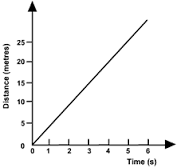
What is this graph showing?
The object is moving away from starting point at a constant speed
The object is moving back towards the starting point at a constant speed
The object is increasing its velocity
The object is decreasing its velocity
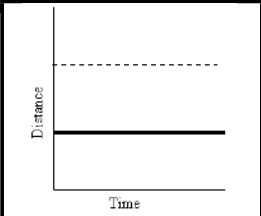
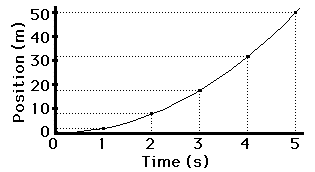
The picture of the position vs. time graph shows an object that is...
speeding up
moving at a constant speed
not moving
slowing down.
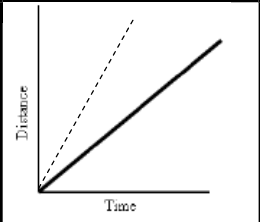
What does either line on this graph represent?
Constant Speed
Speeding up
Not moving

During which interval is the object decelerating?

What is the relation between the two forces acting on the upper magnet?
The one acting upward is greater than the one acting downward.
The one acting downward is greater than the one acting upwards.
Both act in the same direction.
They are equal.
Newton's third law states that any action will have a(n) _______ and ______ reaction
Equal and similar
Equal and opposite
Equal and different
Greater and opposite
What is Newton's First Law
F=ma
Every action has an equal and opposite reaction
An object at rest stays at rest, an object in motion stays in motion.
Friction
Forces that are applied to an object in opposite directions _____ each other
counteract
reinforce
complicate
simplify
Forces that are applied to an object in the same direction ___________ each other
Counteract
Reinforce
Complicate
Compliment

