wayground logo

Free Printable Worksheets

Font size

S
M
L
XL
Worksheets

Natural Selection and Evolution

Total questions: 20

Worksheet time: 10mins

Name
Class
Date
1.

In a cold environment what would be some adaptive traits? Sellect all that apply.

a)

thick blubber

b)

thick fur

c)

thin fur

d)

strong muscles

2.

What is a mutation?

a)

When animals have extra legs

b)

When a frog has 3 eyes

c)

When genes or DNA have been alterd or changed

d)

When RNA is upside down

3.

What is a trait?

a)

a color

b)

the quality or characteristic of an organism

c)

the DNA of an organism

d)

when mutatuons cause extra limbs.

4.

Can mutations be passed down to offspring?

a)

Yes

b)

No

5.

Where are genes located?

a)

on the cell

b)

in the mitochondria

c)

on chromosomes

d)

on an organism

6.
Survival of the Fittest and Evolution were proposed by what scientist?
a)
Charles Darwin
b)
Albert Einstein
c)
Steven Hawking
d)
Isaac Newton
7.
Where the better adapted organisms survive to pass traits along to offspring.
a)
Evolution
b)
Natural Selection
c)
Extinction
d)
Artifical Selection
8.
What is the advantage of having different shaped beaks?
a)
To look different from other species.
b)
To be able to eat the food readily available in the environment.
c)
To protect itself against predators.
d)
To protect itself against prey.
9.
Why are advantageous traits more likely to be passed onto offspring?
a)
Because they are more likely to survive and reproduce.
b)
Because they come from dominant alleles.
c)
Because they come from recessive alleles.
d)
Because the trait is an acquired phenotype.
10.
Do organisms "decide" to evolve and change?
a)
Yes, they know they need to change to survive 
b)
No, they change because of natural selection
11.
The differences among a species, like different bird beaks, are called
a)
genes.
b)
variations.
c)
traits.
d)
theories.
12.
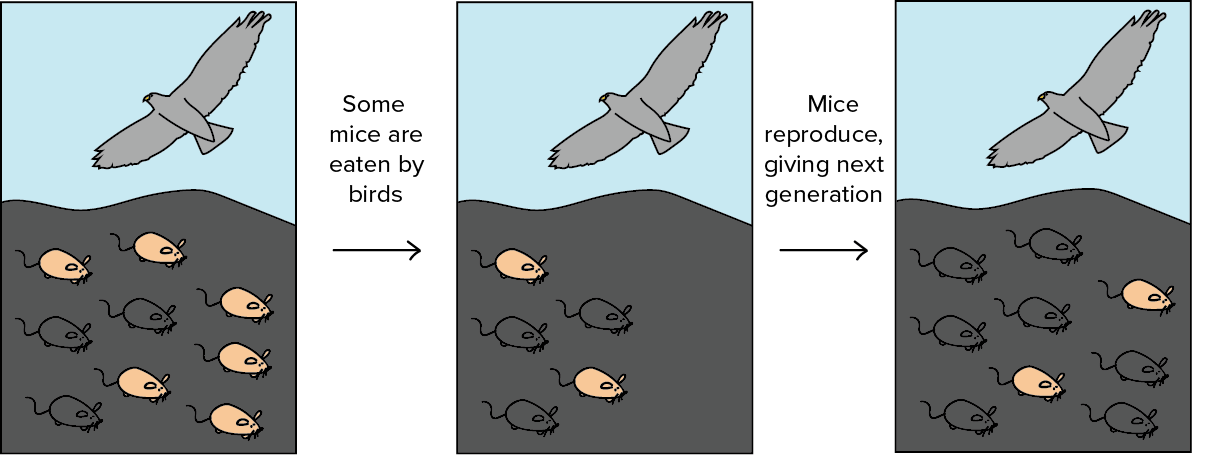
Why is the mouse population changing over time?
a)
The light mice can reproduce more successfully than the dark mice
b)
The hawks eat more dark mice than light mice because the dark mice taste better
c)
The hawks eat more light mice than dark mice because they can see the light mice more easily
d)
The hawks eat more dark mice than light mice because they can see the dark mice more easily
13.

Mutations are important because they bring about

a)

death of the organism in which they develop

b)

genetic variation needed for a population to evolve

c)

benefits for the individual, not for the population

d)

changes in genotype, but not phenotype

14.
Why do frogs and other organism reproduce so many eggs or offspring?
a)
so that their babies can have friends to play with
b)
the more offspring the more likely the offspring will survive
c)
the more offspring the less likely offspring will survive 
d)
the more offspring the less competition
15.
Which organisms are most likely to survive?
a)
the best adapted
b)
the fastest
c)
the strongest
d)
the most domesticated (tamed)
16.
The long and sharp beak of a woodpecker is an example of:
a)
Natural Selection
b)
Selective Breeding
17.
Domesticated dogs are an example of:
a)
Natural Selection
b)
Selective Breeding
18.

Why is competition important for natural selection?

a)

It shows which variations are more successful, allowing the organisms with those variations to survive.

b)

It causes organisms, regardless of which traits they have, to die out, reducing the population size.

c)

It causes organisms to get stronger due to having to outcompete other species.

d)

Competition is not important for natural selection.

19.
If an organism can't adapt fast enough, this might happen.
a)
hibernate
b)
stay the same
c)
live longer
d)
become extinct
20.
Darwin said that within a species there will be _________________________
a)
nothing different
b)
variation/differences