
 Worksheets
2022 12CHM U3T2 L13
Total questions: 9
Worksheet time: 8mins
Name
Class
Date
1.
The anode is where oxidation occurs in...
a)
A Galvanic Cell/ voltaic
b)
A Electrolytic Cell
c)
Both Galvanic and Electrolytic cells
2.
In an electrolytic cell, the positive electrode is the
a)
anode, where oxidation occurs
b)
anode where reduction occurs
c)
cathode where oxidation occurs
d)
cathode where reduction occurs
3.
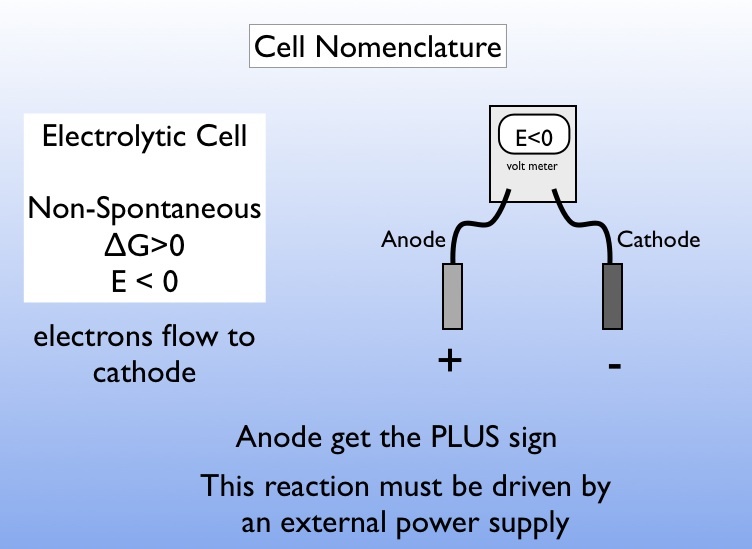
What is an electrolytic cell?
a)
a cell that converts chemical energy into electrical energy
b)
a cell that converts electrical energy into electrical energy
c)
a cell that converts electrical energy into chemical energy
d)
A cell that converts kinetic energy into potential energy.
4.
The reaction is non-spontaneous in ...
a)
A Galvanic/ Voltaic Cell
b)
A Electrolytic Cell
c)
Both Galvanic and Electrolytic cells
5.

Calculate the cell potential of voltaic cell
a)
–1.51
b)
- 0.03
c)
+0.03
d)
+1.51
6.

Voltaic cell is made by connecting two half-cells below. Which statement is correct?
a)
Mn is oxidized and voltage is 1.06 V
b)
Pb is oxidized and voltage is 1.06 V
c)
Mn is oxidized and voltage is 1.32 V
d)
Pb is oxidized and voltage is 1.32 V
7.

Which represents reduction process occurring in standard hydrogen electrode?
a)
H2(g) → 2H+(aq) + 2e–
b)
H+(aq) + OH–(aq) → H2O(l)
c)
2H+(aq) + 2e– → H2(g)
d)
O2(g) + 4H+(aq) + 4e– → 2H2O(l)
8.
What is the oxidation number of chlorine in HClO?
a)
0
b)
-1
c)
+1
d)
+5
9.
Determine the oxidation number of chromate in CrO42-.
a)
+6
b)
0
c)
+2
d)
+3
100 %

