
 Worksheets
Waves and Sound
Total questions: 25
Worksheet time: 22mins
Name
Class
Date
1.
As the fire truck approached Mary, the pitch of the siren got higher. Once the fire truck passed and moved away, the siren's pitch got lower. This change in pitch is because of a change in the sound wave's
a)
concussion.
b)
amplitude.
c)
reflection.
d)
frequency.
2.
Which statement about sound waves is true?
a)
Air travels with them
b)
They travel through a vacuum
c)
They exist only if heard
d)
They can be reflected.
3.
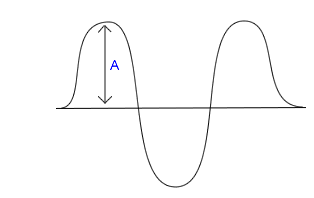
If the distance represented by the letter A were increased, how would it change the way the sound was heard?
a)
The sound would be higher.
b)
The sound would be lower.
c)
The sound would be softer.
d)
The sound would be louder.
4.

When comparing the two waves that are shown, how would Wave A (green wave) differ than Wave B (black wave)?
a)
Wave A and B have the same amplitude, but wave B (black) has a lower pitch.
b)
Wave A and B have the same amplitude, but Wave A has a lower pitch.
c)
Wave A and B have the same pitch, but Wave A is a softer sound.
d)
Wave A and B have the same pitch, but Wave B is a softer sound.
5.
What does pitch depend on?
a)
amplitude
b)
frequency
c)
intensity
d)
volume of sound
6.
A wave with a large wavelength will have a ______ frequency and _____ energy
a)
high, low
b)
high, high
c)
low, high
d)
low, low
7.
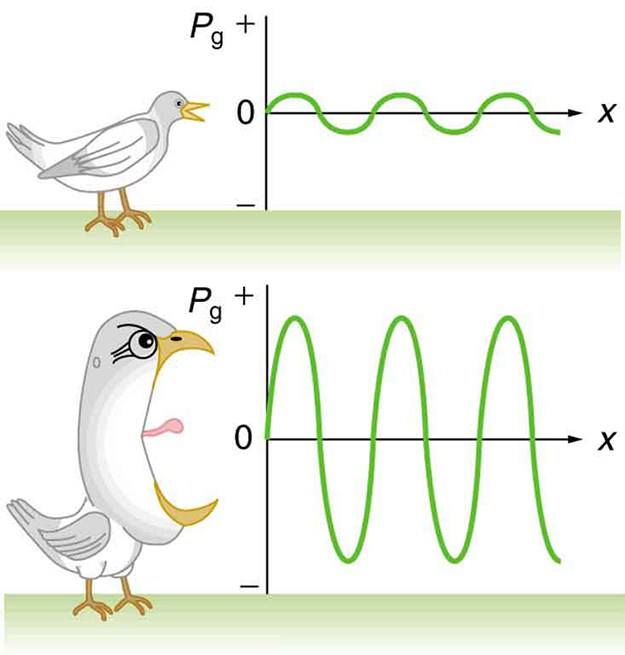
When a sound is louder what measurement gets bigger?
a)
Frequency
b)
Amplitude
c)
Wavelength
d)
Crest
8.
A wave that requires a medium through which to travel
a)
mechanical wave
b)
chemical wave
c)
electromagnetic wave
d)
pitch
9.
Highest point of a wave
a)
crest
b)
trough
c)
wavelength
d)
frequency
10.
The number of wavelengths that pass a point each second
a)
crest
b)
amplitude
c)
frequency
d)
pitch
11.
The shorter the wavelength the
a)
shorter the frequency
b)
higher the freuqnecy
c)
frequency stays the same
d)
less energy
12.
Sound is produced by
a)
music
b)
vibrations of molecules
c)
Electromagnetic Waves
d)
Transverse Waves
13.
Which feature of sound is determined by amplitude?
a)
Pitch
b)
Smoothness
c)
Loudness
d)
A Wave
14.
A disturbance that transfers energy from one place to another without transferring matter.
a)
wave
b)
trough
c)
pitch
d)
sound
15.
Material (matter) through which a wave travels
a)
medium
b)
Doppler Effect
c)
sound
d)
pitch
16.
What medium does sound travel through slowest?
a)
gas
b)
solid
c)
liquid
d)
trees
17.
What medium (solid, liquid, gas) does sound travel fastest through?
a)
solid
b)
liquid
c)
gas
18.
Why is sound able to travel faster through a solid than a gas?
a)
Gas molecules are packed tightly.
b)
Sound does not travel faster through a solid than a gas.
c)
Solid molecules are packed tightly.
d)
Gas molecules move slowly.
19.
The part of a longitudinal wave where the particles of the medium are close together.
a)
rarefaction
b)
compression
c)
crest
d)
trough
20.
A wave in which the vibration is in the same direction as that in which the wave is traveling; sound waves
a)
longitudinal wave
b)
ocean wave
c)
transverse wave
d)
mechanical wave
21.
A part in a longitudinal wave where the particles are spread apart
a)
compression
b)
rarefaction
c)
crest
d)
trough
22.
If a wave is traveling at 260 m/s and has a wavelength of 0.8 m/s, what is its frequency?
a)
208 Hz
b)
325 Hz
c)
430 Hz
d)
160 Hz
23.

Examine the wave.
Which region on this wave would correspond to rarefaction?
a)
W
b)
X
c)
Y
d)
Z
24.
Which temperature causes sound to travel more slowly?
a)
hot
b)
cold
25.
A change in frequency results in a change of wave length; a change in amplitude does not.
a)
true
b)
false
100 %

