wayground logo

Free Printable Worksheets

Font size

S
M
L
XL
Worksheets

USG First Nine Weeks Makeup Test

Total questions: 149

Worksheet time: 5hrs 50mins
Name
Class
Date
1.

Which branch can veto legislation.

a)

Legislative

b)

Executive

c)

Judicial

d)

Congress

2.

Which clause states that the Constitution, laws and treaties of the national government are the “supreme law of the land.”

a)

Extradition Clause

b)

Supremacy Clause

c)

Full Faith & Credit Clause

d)

Privileges & Immunities Clause

3.

What does the Judicial Branch do?

a)

Create laws

b)

Enforce laws

c)

Interpret laws

d)

Write laws

4.

Which clause is the Constitution's requirement that each State accept the public acts, records, and judicial proceedings of every other State.

a)

Privileges and Immunities Clause

b)

Extradition Clause

c)

Full Faith & Credit Clause

d)

Supremacy Clause

5.
What is Common Law?
a)
Idea of a utopian society
b)
Idea that courts should base cases on judges personal preferences
c)
Idea that only laws written down are considered in court
d)
Idea that Judges must look at previous court decisions before deciding new cases
6.
Thomas Hobbes is known for which of the following?
a)
Natural Rights
b)
Divine Right of Kings
c)
Social Contract
d)
Common Law
7.
Which system holds all power in one central level of government?
a)
Unitary System
b)
Federal System
c)
Democratic System
d)
The Galactic Republic System
8.
The idea of Natural Rights can be attributed to who?
a)
George Washington
b)
Adam Smith
c)
John Locke
d)
Thomas Jefferson
9.
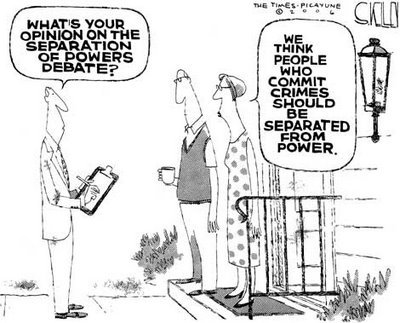
What does it mean to say we have "separation of powers?"
a)
We divide power between the three Branches
b)
The President doesn't work with the Courts
c)
Congress doesn't work with the President
d)
We divide the two Houses of Congress
10.
The leader in a Parliamentary system is?
a)
President
b)
King
c)
Dictator
d)
Prime Minister
11.

America's government is most similar to:

a)

the Vatican's Theocracy

b)

Middle Ages Monarchy

c)

Athenian Democracy

d)

Roman Republic

12.

What was a major change from the Articles of Confederation to the Constitution?

a)

The government gained the power to tax, created the executive branch, and did not need unanimous consent to do anything.

b)

The government lost the power to raise an army, collect taxes, and make amendments.

c)

The government gained the power to declare laws and actions of other branches unconstitutional.

d)

The government lost the power to protect freedom of speech, religion, and the right to bear arms.
13.

The Great Compromise was a compromise between--

a)

Mass. Plan and New Jersey Plan

b)

Virginia Plan and New Jersey Plan

c)

Virginia Plan and New York Plan

d)

Virginia Plan and Delaware Plan

14.

What is the difference between a democracy and a republic?

a)

In a Democracy, people are represented by someone else. In a Republic, people get a direct say in government.

b)

In a Republic, people are represented by someone else. In a Democracy, people get a direct say in government.

c)

In a Democracy, people get a direct say in government. In a Republic, people are ruled by a King.

d)

In a Republic, people are represented by someone else. In a Democracy, the government is based around religious law.
15.

Which political theory held that God created the state, and God had given those of "royal birth" the right to rule?

a)

Common Law

b)

Natural Rights

c)

Divine Right Theory

d)

Social Contract Theory

16.

The rule of law gives ___________ to a government.

a)

natural rights

b)

a social contract

c)

sovereignty

d)

legitimacy

17.

Which of the following is an example of an Autocracy?

a)

The United States

b)

Medieval England

c)

The Vatican

d)

North Korea

18.

An accused person who flees to another state after committing crime must be returned to the state in which they allegedly committed the crime.

a)

Full Faith & Credit Clause

b)

Extradition Clause

c)

Supremacy Clause

d)

Privileges & Immunities Clause

19.
According to John Locke, which agreement did individuals enter into to form their own society?
a)
constitution
b)
social contract
c)
Mayflower Compact
d)
English Bill of Rights
20.
According to John Locke, which rights were guaranteed by natural law?
a)
trial by jury and no cruel punishments
b)
freedom of speech and the press
c)
life, liberty, and property
d)
freedom of worship and the right to petition
21.
"No freeman shall be taken or imprisoned or disseised or exiled or any way destroyed, nor will we go upon him nor send upon him, except by the lawful judgement of his peers or by the law of the land."
Which right was guaranteed in this excerpt from Magna Carta?
a)
trial by jury
b)
no taxation without representation
c)
freedom of the press
d)
freedom of religion
22.
Which thinker introduced the idea of separation of powers for effective government?
a)
John Locke
b)
Baron de Montesquieu
c)
Thomas Paine
d)
Thomas Jefferson
23.
How was Locke's social contract theory related to his belief in natural law?
a)
He argued subjects had the right to rebel against a  ruler who acted against natural law.
b)
He argued that whatever the king did was good according to natural law.
c)
He argued that natural law required colonists to be given their independence.
d)
He argued that God had especially chosen kings to rule over their subjects as part of nature.
24.
Which describes an impact of Magna Carta on the American colonists in the 1770's?
a)
They believed they could not be taxed without their consent.
b)
They believed they could not be governed by a far-away island.
c)
They thought they had the right to overthrow a king who did not protect their rights.
d)
They favored a separation of the powers of government into different branches.
25.
What most attracted the Founding Fathers to Montesquieu's views on the separation of powers?
a)
It could help prevent the central government from becoming tyrannical and oppressive.
b)
It could protect the rights of the nobility from the actions of the king.
c)
It could preserve the privileges of the monarch and nobles from popular attack.
d)
It raised judicial power to a level of equality with legislative and executive power.
26.
Which right was established by Magna Carta in 1215?
a)
The right to vote in elections.
b)
The right to choose the monarch
c)
The right to freedom of speech
d)
the right to trial by jury
27.
Which document confirmed the rights of English subjects after the overthrow of James II in the Glorious Revelution?
a)
Magna Carta
b)
Mayflower Compact
c)
English Bill of Rights
d)
Montesquieu's "Spirit of the laws"
28.
Which of the following were most similar?
a)
The Mayflower Compact and John Locke's social contract theory.
b)
The English Bill of Rights and Thomas Paine's "Common Sense"
c)
Magna Carta and Montesquieu's separation of powers
d)
The Mayflower Compact and Montesquie's separation of powers
29.
The Mayflower Compact--> Self-government.
English Bill of Rights --> ?
Which phrase completes the diagram?
a)
Natural law
b)
Separation of power
c)
Divine Right of Kings
d)
Guarantee of certain individual rights
30.
1.That in all capital or criminal prosecutions a man hath a right to demand...evidence in his favor, and to a speedy trial by an impartial jury...
2. That the legislative, executive, and judiciary department shall be separate and distinct.
Which statement guarantees a right first granted by Magna Carta?
a)
1
b)
2
31.
Which document guarantees freedom of speech, the right to bear arms, and protection from unreasonable search and seizure?
a)
Bill of Rights
b)
Declaration of Sentiments
c)
Albany Plan of Union
d)
Federalist Papers
32.
By which process can the United States Constitution be changed?
a)
veto
b)
amendment
c)
resolution
d)
legislative hearing
33.
Which statement best illustrates the principle of federalism?
a)
The president has the power to veto bills.
b)
Congress is divided into two houses.
c)
The Supreme Court has the power to review laws.
d)
Power is divided between the states and the national government.
34.
Which branch of government is responsible for enforcing (executing) laws?
a)
Judicial
b)
Legislative
c)
Executive 
35.
The authors of the United States Constitution included a system of checks and balances to
a)
prevent any one branch of government from controlling the other branches
b)
protect states against the power of the national government
c)
guarantee respect for the freedoms listed in the Bill of Rights
d)
safeguard the United States against foreign attacks
36.
Which part of the federal government is most directly affected by the results of the United States Census, or population count?
a)
President's Cabinet
b)
House of Representatives
c)
Supreme Court
d)
Senate
37.
Which branch is the law making branch?
a)
Executive
b)
Judicial 
c)
Legislative
38.
Which branch interprets laws?
a)
Exectuive 
b)
Judicial 
c)
Legislative
39.
Which branch is made up of the House of Representatives and the Senate (Congress)?
a)
Exectuive
b)
Judicial 
c)
Legislative
40.
Which branch decides what a law means?
a)
Exectuive
b)
Legislative
c)
Judicial
41.
Which branch can declare laws unconsitutional?
a)
Executive
b)
Judicial
c)
Legislative
42.
Which house of Congress has the number of representatives based on population?
a)
The Senate
b)
The House of Representatives
43.

Which protection is included in your first amendment right?

a)

Freedom of Reading

b)

Freedom of Speech

c)

Freedom of Travel

d)

Freedom of Equality

44.

Why is it difficult for Congress to override a veto?

a)

They would need to go against an executive order.

b)

They would have to get a judge to approve the bill.

c)

They would need to have a two-thirds majority vote.

d)

They would have to stick to a very strict time-frame.

45.

The president can “check” the power of the legislative branch by

a)

vetoing a law.

b)

issuing an executive order.

c)

granting a pardon.

d)

petitioning Congress.

46.

True or False: There are limitations to freedom of speech.

a)

True

b)

False

47.

True of False: The Executive Branch is the most powerful branch of government because it includes the office of the president.

a)

True

b)

False

48.
In the Constitution, the implied powers of Congress come from the 
a)
Necessary and Proper Clause
b)
Supremacy Clause
c)
Relative Clause
d)
Santa Clause
49.
Powers that are not given to the Federal government are 
a)
implied powers
b)
expressed powers
c)
reserved powers
d)
super powers
50.
The power to tax is a(n)
a)
implied power
b)
concurrent power
c)
reserved power
d)
abused power
51.
The power to print money is a(n)
a)
reserved power
b)
concurrent power
c)
implied
d)
expressed power
52.
The power to run public schools is a(n)
a)
concurrent power
b)
expressed power
c)
reserved power
d)
implied power
53.
The central government of the United States is called the 
a)
federal government
b)
executive branch
c)
constitution
d)
congress
54.
The division of power between a central government and state governments is called
a)
The United States
b)
the Supremacy Clause
c)
the Necessary and Proper Clause
d)
federalism
55.
The Supremacy Clause states that 
a)
state laws are superior to federal laws
b)
federal laws are superior to state laws
c)
expressed powers are superior to implied powers
d)
Alabama is superior to Auburn
56.
Powers that the federal government shares with state governments are called 
a)
reserved
b)
implied
c)
concurrent
d)
expressed
57.
Powers of Congress that are stated in the Constitution
a)
expressed
b)
reserved
c)
implied
d)
concurrent
58.
Powers of Congress that are not stated in the Constitution are 
a)
reserved
b)
expressed
c)
concurrent
d)
implied
59.
A group of individuals united together for a purpose
a)
confederation
b)
Supremacy
c)
reserved
d)
expressed
60.
The second and final attempt to write a document that would govern the United States
a)
Articles of Confederation
b)
Declaration of Independence
c)
Constitution
d)
Preamble
61.
The first document that explained how the original 13 states would be governed
a)
Constitution
b)
Preamble
c)
Declaration of Independence
d)
Articles of Confederation
62.
Under the Articles of Confederation the United States did not have one of these
a)
president
b)
congress
c)
military
d)
government
63.
The document that replaced the Articles of Confederation
a)
Declaration of Independence
b)
Preamble
c)
Supremacy Clause
d)
Constitution
64.
The branch of government that carries out laws
a)
Legislative
b)
Judicial
c)
Executive
d)
Congress
65.
The branch of government that makes laws
a)
Legislative
b)
Executive
c)
Judicial
d)
Supreme Court
66.
The branch of government that interprets laws
a)
Congress
b)
Executive
c)
Legislative
d)
Judicial
67.
The Articles let congress create this but they could not pay for it
a)
military
b)
schools
c)
constitution
d)
taxes
68.

The Legislative Branch is organized by what part of the Constitution?

a)

Article 1

b)

Article 2

c)

Article 3

d)

The Bill of Rights

69.

Another name for the Legislative Branch is

a)

The Executive Branch

b)

The Supreme Court

c)

Congress

d)

The Constitution

70.

What is the main job of the Legislative Branch?

a)

Evaluate laws

b)

Make laws

c)

Enforce laws

d)

Ignore laws

71.

How many parts are there to Congress

a)

One

b)

Two

c)

Three

d)

Four

72.

One part of Congress is the...

a)

President's Cabinet

b)

Library of Congress

c)

The Supreme Court

d)

The House of Representatives

73.

The other part of Congress is the...

a)

House of Blues

b)

President

c)

Senate

d)

Department of Defense

74.

How many Senators are there in the Senate?

a)

25

b)

50

c)

100

d)

435

75.

For how many years is a Senator in office?

a)

Two years

b)

Four years

c)

Six years

d)

Ten years

76.

Who is the leader of the Senate?

a)

The President

b)

The Vice President

c)

The Speaker of the House

d)

The Chief Justice of the Supreme Court

77.

How many Representatives are in the House of Representatives?

a)

25

b)

50

c)

100

d)

435

78.

For how many years is a Representative in office?

a)

Two years

b)

Four years

c)

Six years

d)

Ten years

79.

Who is the leader of the Hosue of Representatives?

a)

The President

b)

The Vice President

c)

The Speaker of the House

d)

The Chief Justice of the Supreme Court

80.

Where does Congress meet?

a)

The Supreme Court

b)

The White House

c)

The Library of Congress

d)

The Capitol

81.

How many times can a Senator be elected to the Senate?

a)

One time

b)

Two times

c)

Five times

d)

There is no limit

82.

How many times can a Representative be elected to the House of Representatives?

a)

One time

b)

Two times

c)

Five times

d)

There is no limit

83.

What are three things that Congress can decide on?

a)

Taxes

b)

Foreign trade

c)

If a law is unconstitutional

d)

Declare war

84.

How does Congress limit the power of the President?

a)

Veto a bill

b)

Declare a law unconstitutional

c)

Impeachment power

d)

Declare war

85.

How many senators are elected every two years?

a)

All of them

b)

1/3 of them

c)

None of them

d)

One half of them

86.

How many representatives are elected every two years?

a)

All of them

b)

1/3 of them

c)

None of them

d)

One half of them

87.

What is a bill?

a)

A veto

b)

An idea for a law

c)

A new member of Congress

d)

Another name for the Capitol

88.

A president is elected to a term of

a)

2 years

b)

4 years

c)

6 years

d)

8 years

89.

Which of the following is not a requirement to become President?

a)

Must be at least 35 years old

b)

Must live in the United States for at least 14 years

c)

Must be at least 45 years old

d)

Must be a natural born United States citizen

90.

The role of the President that makes them the top official of the military is the

a)

Chief of State

b)

Commander in Chief

c)

Master and Commander

d)

Chief Executive

91.

The role of the President as a negotiator of foreign policy is

a)

Chief of State

b)

Chief Executive

c)

Commander in Chief

d)

Chief Diplomat

92.

If the presidency and vice presidency were both to become vacant, the next person in line to the presidency is the

a)

Chief Janitor of the White House

b)

Speaker of the House

c)

President Pro Tempore of the Senate

d)

Secretary of State

93.

If the President doesn't like a new law he can:

a)

veto it

b)

make changes to it

c)

just not follow it

94.

True or False, an Executive Order is harder to change or get rid of than a law that has passed through the house and been approved by a former president.

a)

True

b)

False

95.

The President belongs to which of the 3 branches of government?

a)

Judicial

b)

Executive

c)

Legislative

96.

True or False, the President chooses his own cabinet members (after they pass Congress' approval).

a)

True

b)

False

97.

The President must ensure that all laws are being enforced. This powers comes from what?

a)

this isn't a duty of the President

b)

Chief Janitor of the White House

c)

the "take care" clause in the constitution

d)

his or her spouse

98.

T or F, the President has the power to pardon anyone convicted of crimes in the United States including himself.

a)

True

b)

False

99.

Name one thing the president has the power to do.

a)

Appoint federal judges

b)

Declare war

c)

Make laws

d)

Live outside of the US

100.

Who has the power to declare war?

a)

Congress

b)

the President (Commander in Chief)

101.

If the president dies this person takes over

a)

Speaker of the House

b)

First Lady

c)

President pro Tempore

d)

Vice President

102.

Who is next in line after the President and Vice President

a)

First Lady

b)

President Pro Tempore

c)

Speaker of the House

d)

Chief of Staff

103.

The order of who replaces the president in the event of death or incapacitation?

a)

Veto power

b)

Separation of Powers

c)

Order of Sucession

d)

Commander in Chief

104.

How many terms can the president serve?

a)

one

b)

two

c)

three

d)

unlimited

105.

How long is each presidential term?

a)

1 year

b)

2 years

c)

4 years

d)

6 years

106.

What determines the number of electoral from each state

a)

Congress votes on it

b)

the president decides this

c)

the number of congressional representatives the state has

d)

the number of voters in each state divided by the number of districts

107.
.  Which amendment addresses the order of succession to the Presidency if the President dies or resigns?
a)
20
b)
25
c)
22
d)
23
108.
Which amendment addresses the number of years a President can serve?  
a)
20
b)
22
c)
23
d)
25
109.

What role gives the President the ability to rule as head of all the branches of the military?

a)

Chief of State

b)

Chief Diplomat

c)

Chief Citizen

d)

Commander in Chief

110.

What role gives the President the ability to host the first pitch in a baseball game in the World Seriess?

a)

Commander in Chief

b)

Chief of Foreign Policy

c)

Chief of State

d)

Chief Executive

111.

To be President you must be at least ____ years old

a)

25

b)

30

c)

35

d)

40

112.

To be president you must be

a)

a citizen for 7 years

b)

a citizen for 9 years

c)

a natural born citizen

d)

a citizen for 14 years

113.

This cabinet department helps people with their housing needs including affordable homes.

a)

Health and Human Services

b)

The Labor Department

c)

Housing and Urban Development

d)

State Department

114.

This cabinet department could also be called the Department of Foreign Affairs.

a)

Health and Human Services

b)

The Labor Department

c)

Housing and Urban Development

d)

State Department

115.

This cabinet department provides the military forces needed to deter war and to protect the security of our country.

a)

Health and Human Services

b)

Defense Department

c)

Housing and Urban Development

d)

State Department

116.

1. Which person would be eligible to run for president in the Election of 2016?


.

a)

A. Susan , born in 1984 in Texas, has lived in Georgia for 15 years.

b)

B. George, a naturalized citizen, has lived in New York for 20 years.

c)

C. Tiffany, born in 1969 in Nebraska, has lived in the U.S. for 45 years

d)

D. John, a legal immigrant, has lived in the U.S. for 14 consecutive years.

117.

1. Which of these is an example of a “check and balance” of power of Congress?

a)

A. The power to tax

b)

B. The power to veto

c)

C. The power to borrow money

d)

D. The power to impeach public officials

118.

1. President Franklin D. Roosevelt brought the United States out of the Great Depression by creating a series of programs called the New Deal. What does the picture imply about the presidency?

a)

A. Congress pushes the President to make changes.

b)

B. The Legislative and Executive Branch work together.

c)

C. The President pressures Congress to support his goals.

d)

D. Congress doesn’t have to take the Presidents’ ideas into consideration.

119.

All of these are departments that belong in what Executive Agency?


Office of Water

Office of Air and Radiation

Office of Solid Waste and Emergency Response

a)

A. State Department

b)

B. Department of Energy

c)

C. Housing and Urban Development

d)

D. Environmental Protection Agency

120.

Supreme Court justices are nominated by the _______.

a)

President

b)

Senate

c)

Vice President

d)

Congress

121.

How many justices make up the Supreme Court?

a)

8

b)

5

c)

9

d)

7

122.
Fill in the blank on how a case gets to the Supreme Court:
1. Case is filed in a federal district court.
2. ???
3. Case is appealed to the US Supreme Court, which does one of the following:
a. Allows the lower court ruling to stand.
b. Sends the case back to the lower court for reconsideration.
c. Decides to try the case.
a)
Someone sues another person or group.
b)
The Supreme Court declares the law unconstitutional.
c)
The case is filed in a state court.
d)
The case is appealed to a federal court of appeals.
123.

Choose the answer(s) that are true of Judicial Review.

a)

Allows the US Supreme Court the authority to choose which cases they will hear.

b)

Is the result of Marbury v Madison

c)

The actions of the executive and legislative branches of government are subject to review.

d)

Gives the US Supreme Court authority to rule actions unconstitutional.
124.

The Supreme Court ruling a State law unconstitutional is an example of what?

a)

Judicial Review

b)

Judicial Restraint

c)

Judicial Activism

d)

Jurisdiction

125.

Original Jurisdiction is when:

a)

a court is the first to hear a case

b)

a court has the authority to hear a case

c)

a court reviews the decision of a lower court

d)

power is shared between the Federal and State courts to hear a certain case
126.

If a Supreme Court justice agrees with the decision of the court, but did not agree with the reasoning of how they came to that conclusion, the justice may write a:

a)

Writ of Certiorari

b)

Concurring Opinion

c)

Majority Opinion

d)

Dissenting Opinion

127.

What is the opinion of the Supreme Court justices who make up the minority?

a)

Majority Opinion

b)

Concurring Opinion

c)

Unanimous Decision

d)

Dissenting Opinion

128.
When a person asks a higher court to review the result of a trial it's called ___
a)
writ of certiorari
b)
appeal
c)
nullify
d)
opinion
129.
What is a ruling that is used as the basis for a judicial decision in a later, similar case?
a)
subpoena
b)
docket
c)
precedent
d)
opinion
130.

Presidents typically appoint Supreme Court Justices that have similar ideas to theirs.

a)

True

b)

Fals

131.

a person who brings a case against another in a court of law.

a)

Plantiff

b)

Defendant

c)

Prosecutor

132.

an individual, company, or institution sued or accused in a court of law.

a)

Plantiff

b)

Defendant

133.
What are all the reasons that a Justice would stop serving on the Supreme Court:
a)
they retire
b)
they retire or pass away
c)
they retire, pass away, or Congress has them step down
d)
none, they are Justices for life
134.
What are the two different court systems?
a)
Federal & State
b)
Constitutional & Federal
c)
State & Constitutional
d)
Supreme Court & District Court
135.
All of the following is a function of a political party except...
a)
Write Editorials
b)
Nominate Candidates
c)
Win elections
d)
Educate the electorate
136.
When a political party hands out literature, which function are they performing?
a)
Educating the Electorate
b)
Nominate Candidates
c)
Watch office holders
d)
Help win elections
137.
There are two major political parties in the USA. Why do 3rd parties struggle to win elections?
a)
Winner Take All electoral system
b)
They focus on a single issue
c)
They revolve around a strong personality
d)
They rarely win elections
138.
Which political ideology is described below: favor large government, favor social programs, favor equality for all, favor education and science
a)
Liberal
b)
Conservative
c)
Authoritatian
d)
Libertarian
139.
Which political ideology is described below: favor freedoms of the individual, favor small government, favor states' rights, and favor religious freedoms
a)
Conservative
b)
Liberal 
c)
Authoritarian 
d)
Libertarian
140.
Which political party is considered to be more liberal?
a)
Democrats
b)
Republicans
141.
Which political party is considered the more conservative?
a)
Republican
b)
Democrat
142.
Where should you look in order to find the major differences between the political parties?
a)
Party Platform
b)
Party Constitution
c)
US Constitution
d)
Congress
143.
Which House of Congress has the power of Impeachment?
a)
Congress
b)
Senate
c)
House of Representatives
d)
Hufflepuff
144.
What role is the President fulfilling when he tours the country with other members of his party?
a)
Chief of Party
b)
Chief of State
c)
Commander in Chief
d)
Chief Executive
145.
Which step of the campaign process would have members of the same party competing against each other for votes?
a)
Primaries
b)
General Election
c)
Conventions
d)
Election Day
146.
In Presidential elections, what is the role of the People?
a)
Their votes choose the electors
b)
They vote directly for President
c)
They have no role
d)
Consent of the Governed
147.
What created the electoral college?
a)
US Constitution
b)
George Washington
c)
John F Kennedy
d)
Barack Obama
148.
All of the following are reasons why Hillary Clinton lost the election, except?
a)
She ignored the little states
b)
She won California
c)
She lost the Electoral College 
d)
She lost most of the swing states
149.
A forum for opposing arguments, often televised, where two candidates square off against each other is called a...
a)
Debate
b)
Platform
c)
Convention
d)
Rally