wayground logo

Free Printable Worksheets

Font size

S
M
L
XL
Worksheets

Getting Ready for Milestones

Total questions: 99

Worksheet time: 3hrs 27mins

Name
Class
Date
1.

Dignity: Even when the police officers put the handcuffs on my mother, she maintained her dignity, holding her head up high as she was marched off the protest site. (a)  

Choose from the below words
fear
pride
2.

How do you find the theme? (select all that apply)

a)

Look at the characters' feelings

b)

Look at the characters' thoughts and dialogue

c)

Look at the characters' actions

d)

Look at the lesson the character learned

3.

The theme is always explicitly stated in the text.

a)

True, I can always underline the theme

b)

False, sometimes I need to make an inference about the theme

4.

Which one sounds like a THEME? (hint: a lesson learned you can apply at any age, time, or place)

a)

The Cat and the Hat

b)

Always listen to your parents

c)

Two siblings are bored in the house on a rainy day. A cat comes over to play with the kids. He brings his friends Thing 1 and Thing 2, and they destroyed the house.

5.

Choose the main idea from the choices below.

a)

Teamwork makes the dream work.

b)

Working together makes you stronger.

c)

The team won the game when they worked together.

d)

Hard work pays off.

6.

Smartphones are phones that are used for more than making calls and sending messages. People count on them for getting directions and finding information on the internet. People also have fun listening to music, taking pictures, and playing games on their phones. On the other hand, smartphones have some downsides. They can make it hard to keep your mind on important things, like studying. Some people even text during meals, or when spending time with their family. Driving while using a phone puts people in danger. Smartphones are useful, but they can cause problems if not used safely and politely.

a)

Smart phones can be used in both good and bad ways.

b)

There are many good things about smart phones.

7.

What is a character trait?

a)

a word that describes a character's physical appearance

b)

a word that describes a character's personality

c)

a word that describes how a character is feeling at one time

8.

Character traits can be inferred based on four things --

a)

feelings

b)

actions

c)

appearance

d)

dialogue

e)

thoughts

9.

Amber had been studying the possible Spelling Bee words every night since Mrs. Van Wagner had handed them out. The night before the Spelling Bee, Amber was still studying.

Amber's mom walked into her room. "Amber, I think it's time you turn off your light and go to bed. You've studied enough," she said.

"Just five more minutes, mom?" pleaded Amber. "I don't want to get second place again like I did last year. I want to be the champion!"


A character trait for Amber is --

a)

creative

b)

stubborn

c)

neat

d)

determined

10.

Which type of point of view is when a narrator who is not a part of the story tells the story?

a)

1st Person

b)

3rd Person

11.

What point of view is this written?: "Suddenly a mouse timidly poked its head out of the bathroom door. I jumped up on the couch and squealed in surprise. My sister screamed in fear at my response to the mouse."

a)

1st Person

b)

3rd Person

12.

What is the subject of both of these fables?

a)

Choosing to do the right thing.

b)

The conflict between the hunter and its prey.

c)

The battle between good and evil.

d)

What animals need to survive.

13.
When reading fiction we must think about the PLOT. What is the plot of a story? 
a)
Characters in a story
b)
The problem 
c)
The solution
d)
All the events that make up a story
14.
Synonyms are words that -
a)
have the same meaning 
b)
have opposite meaning 
c)
sound the same with different meaning 
d)
sound the same with different spelling 
15.
The prefix un- (as in unlikely) 
a)
able to do
b)
full of something 
c)
not 
d)
before 
16.
The prefix dis- (as in dislike) 
a)
do it again 
b)
not 
c)
before 
d)
full of 
17.
The prefix re (as in reread) -
a)
before 
b)
again 
c)
not 
d)
able to do 
18.
The suffix -ful (as in colorful) 
a)
full of something 
b)
able to do 
c)
without having 
d)
having little of 
19.
The suffix -less (as in homeless) 
a)
able to do
b)
full of something 
c)
with less of 
d)
without having 
20.
The suffix -ist (as in artist) 
a)
the most of 
b)
a person who does 
c)
without having 
d)
full of something 
21.
A diagram
a)
labels the parts of something.
b)
identifies the main idea. 
c)
is used like a title. 
d)
is used to tell directions. 
22.
Headings are used to- 
a)
identify the main idea of a selection
b)
tell about the photograph 
c)
explain how to do something 
d)
describe what it looks like 
23.
Captions are used to- 
a)
explain the main idea 
b)
describe the selection 
c)
describe the author's purpose 
d)
explain the photograph
24.
Lines in poetry are like- 
a)
sentences 
b)
paragraphs 
c)
the whole poem 
d)
the poet 
25.
Which phrase appeals to the sense of taste-
a)
The sour milk gagged me when I took a gulp.
b)
The breeze tickled my neck. 
c)
The scorching sun burned my skin. 
d)
The aroma of fresh flowers filled the air. 
26.
I was so parched, I drank an entire glass of water in one gulp.
a)
hungry
b)
thirsty
c)
sleepy
27.
The parking lot was so congested, it took half an hour to get out.
a)
empty
b)
hot
c)
crowded
28.
The lost campers sweltered in the heat of the desert sun.
a)
ate
b)
burned 
c)
slept 
d)
sunbathed
29.
The long hike up to the mountains was grueling.
a)
loud
b)
tiring
c)
easy
30.
During a baseball game, Tanner tried to tag a player leaving first base. When the umpire called the player out, Tanner immediately informed the umpire that he in fact did not tag the runner. Two weeks later, the very same umpire was at another one of Tanner’s baseball games. Tanner was playing short stop and tagged a runner as they approached third base. When the umpire called the player safe, Tanner didn’t say a word, but the umpire noticed the surprised look on Tanner’s face. “Did you tag the runner?” she asked Tanner. When Tanner told her that he did tag the runner, the umpire changed her decision and called the player out. The coaches and parents were furious, but the umpire stood by her decision.
What is the theme?
a)
You should cheat to win.
b)
Always work hard.
c)
It pays to be honest.
d)
Teamwork is best.
31.
Mark wanted to be a great skater. But he didn't want to spend the hours practicing. He wished he could just do the tricks easily. Mark's dream was to have everyone stop and stare when he entered the skate park. He  wanted them to say, "Mark is the best skater in the whole world."
What is the main idea?
a)
Mark wants everyone to think he's a great skater without doing the hard work.
b)
Mark practices very hard to become a great skater.
c)
Mark is the best skater at the park.
d)
Mark wants to learn how to skate so he can compete.
32.
If you are feeling sad, you can make yourself feel better by doing a few simple things. You can take a walk (or get another form of exercise), you can talk to a friend, or you can write down your feelings. Writing down the good things in your life will help too. Doing something good for someone else will also help you feel better. If you still feel a little sad, act happy. It works like magic to make you feel better!
What is the main idea?
a)
Sometimes people feel sad.
b)
You should do good things for others.
c)
We're not always happy.
d)
There are many ways to make yourself feel better. 
33.
What type of figurative language is shown?
She was so sad that all the tears she cried filled up a lake.
a)
hyperbole
b)
oxymoron
c)
alliteration
d)
onomatopoeia
34.
Jeff's father was IRATE because Jeff talked to him and had a bad attitude all day long.
a)
happy
b)
angry
c)
not bothered
d)
tired
35.

What the text is mostly about is the...

a)

irony

b)

setting

c)

theme

d)

central idea

36.

A comparison between two unlike things using "like" or "as" is called a...

a)

simile

b)

metaphor

c)

hyperbole

d)

idiom

37.

When you figure out what a word means by using the words around it, you are using...

a)

theme

b)

context clues

c)

tone

d)

dialogue

38.

Interruptions to the story that writers use to insert past events are called...

a)

flashbacks

b)

foreshadowing

c)

summaries

d)

dialogue

39.

Three crucial elements of plot are...

a)

simile, metaphor, and personification

b)

objective, subjective, active

c)

positive, negative, neutral

d)

exposition, conflict, climax

40.

Evidence in front of you and prior knowledge combined to make an intelligent guess is...

a)

a summary

b)

a stanza

c)

the mood

d)

an inference

41.
Making an educated guess based on prior knowledge and "reading between the lines" for clues when limited information is available is known as an...
a)
imagery
b)
inference
c)
opinion
d)
allusion
42.
Onomatopoeia, personification, imagery, simile and metaphor are all examples of...
a)
plot elements
b)
story elements
c)
figurative language
d)
character development
43.
Plot, character, conflict, theme, setting are all... 
a)
figurative language
b)
story elements
c)
text structures
d)
plot elements
44.
An author uses text structures in order to...
a)
be considered a fancy writer
b)
make the text more complicated than it needs to be
c)
keep the reader confused about what is going on in the text
d)
organize information in a certain way in a nonfiction text
45.
The information in an article about mistreatment of referees might be structured as...
a)
chronological
b)
sequence
c)
problem and solution
d)
compare/contrast
46.

When the teacher/proctor is going over the directions, you should begin your test.

a)

True

b)

False

47.
Your desk will be clear of ALL materials!
a)
True
b)
False
48.

Will you be taking a Science EOG?

a)

Yes

b)

No

c)

I am not sure

49.
Explicit means...
a)
very vague
b)
stated clearly
c)
to explain something
d)
to break information into parts
50.
Read between the lines. Think beyond the text. What is the hidden meaning?
a)
Infer
b)
Analyze
c)
Explain
d)
Compare
51.
The definition of support is?
a)
Back up an answer with details. Prove. Provide evidence.
b)
Give the short version: main idea + the beginning, middle, end.
c)
Take your best guess on what will happen next.
d)
Tell how something happened. Tell the steps.
52.
Karina woke up with the sun blasting through her shades. She groggily rolled over and looked at her clock, which read 6:30 a.m. She yawned and crawled out of bed, sticky and sweaty from the humid night. After lazily getting into her bathing suit and grabbing a ripe banana, she swung her backpack on her back and left the quiet house.  Based on the passage what can we infer about the type of job this person has?
a)
Waitress
b)
Lifeguard
c)
Nurse
53.
What does the word connection mean?
a)
to link with something else
b)
to be close in meaning
54.
What does analyze mean?
a)
 break down to reveal
b)
to correct
55.

What operation is used when you see the word difference?

a)

+

b)

-

c)

x

d)

÷

56.

What operation is used when you see the word product?

a)

+

b)

-

c)

x

d)

÷

57.

What operation is used when you see the word sum?

a)

+

b)

-

c)

x

d)

÷

58.

What operation is used when you see the word less than?

a)

+

b)

-

c)

x

d)

÷

59.

the sum of fifteen and six

a)

15 - 6

b)

6 + 15

c)

15 x 6

60.

the quotient of 144 and 12

a)

144 x 12

b)

144 / 12

c)

12 + 144

61.

Triple the sum of 33 and 27

a)

(2x33)+27

b)

3x(33+27)

c)

13x(33-27)

d)

3x(33-27)

62.
Find 8 less than 14 and then take the difference from 23
a)
(8 - 14) - 23 
b)
23 - (8 - 14)
c)
23 - (14 - 8) 
d)
(14 - 8) - 23 
63.
Evaluate the Expression:
11 × 8 − 6 ÷ 2
a)
85
b)
41
c)
55
d)
11
64.
Evaluate the expression:
5 + 2³ ÷ 4 − 2
a)
9
b)
1
c)
6
d)
5
65.
Write the Prime Factorization of the number:
42
a)
2 × 21
b)
2 × 10 ²
c)
2 × 7 × 3
d)
2 × 7 × 6
66.
Find the LCM of the numbers
26 , 39
a)
78
b)
84
c)
117
d)
104
67.
Find the LCM of the numbers
6, 12, 14
a)
108
b)
72
c)
56
d)
84
68.
Find the GCF of the numbers using lists of factors
24, 54
a)
8
b)
6
c)
3
d)
1
69.
4^3
a)
12
b)
8
c)
124
d)
64
70.
What is the exponent?
a)
9
b)
5
c)
95
d)
45
71.
Evaluate.
10 * 10 * 10 * 10
a)
40
b)
400
c)
1000
d)
10000
72.
Compare. Use <, > or =.
23 _____ 42
a)
<
b)
>
c)
=
73.
When Mark is 4, how old is Amber? 
a)
6
b)
7
c)
8
d)
9
74.
567 x43 
a)
2,432
b)
24,381
c)
24,281
d)
14,381
75.
45 x 10
a)
45
b)
450
c)
4500
d)
401
76.
56 x 92
a)
1012
b)
493
c)
5,152
d)
5,106
77.
In the Forestwood Middle School cafeteria all of 6th grade eats lunch at the same time. There are 25 rectangular lunch tables and about 35 students at each table. How many students eat lunch at the same time?
a)
175 students
b)
875 students
c)
625 students
d)
1,525 students
78.
Christian is an Uber driver. He gave 15 rides on Friday night, and 12 rides on Saturday night. If the average cost for a ride in Christian's car is $23, how much money did Christian make?
a)
$621.00
b)
$161.00
c)
$207.00
d)
$180.00
79.
There are 28 students in a math class. ⁴⁄₇ of the students were boys. How many boys were in the math class?
a)
16 boys
b)
12 girls
c)
14 girls
d)
12 boys
80.
7 x 1⅖ will be __________________ 7.
a)
greater than
b)
less than 
c)
equal to
81.
2/4 is the same as ____
a)
3/4
b)
1
c)
1/4
d)
1/2
82.
a)
5/14
b)
3/7
c)
5/7
d)
5/14
83.
Solve this equation using the least common denominator.
¼ + ½
a)
3/4
b)
2/8
c)
6/4
d)
6/8
84.
Write an addition equation with an addend for each color represented in the model:
a)
3/9 + 1/9 + 2/9 + 3/9 = 9/9
b)
6/9 + 3/9 = 9/9
c)
2/9 + 4/9 + 3/9 = 9/9
85.
1/2 + 3/7
a)
4/9
b)
13/14
c)
11/14
86.
1/2 + 2/3 + 1/6
a)
4/11
b)
1  2/3
c)
1  1/3
87.
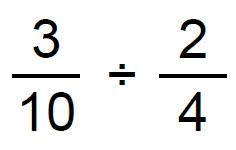
What is the quotient of these fractions in lowest terms?
a)
6/40
b)
6/10
c)
3/5
d)
12/20
88.
Simplify: 16/30
a)
4/7
b)
8/15
c)
1/8
d)
2/7
89.
1 ÷ 1/5 =
a)
10
b)
1/10
c)
5
d)
1/5
90.
a)
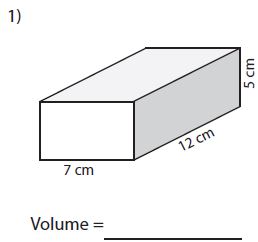
410 cm3
b)
420 cm3
c)
402 cm3
d)
401 cm3
91.
53.23 x 10
a)
5.232
b)
5,323
c)
5.323
d)
532.3
92.
19.32 ÷ 2.3
a)
8.4
b)
7.2
c)
8.9
d)
8.6
93.

Use the >,<, or=0.07____ 0.7

a)

<

b)

>

c)

=

94.
What is equivalent to
a)
3,150
b)
31,500
c)
.00315
d)
3.15
95.
20,000 ÷ 5 =
a)
100,000
b)
40,000
c)
10,000
d)
4,000
96.
4,500,000 ÷ 9 =
a)
500,000
b)
50,000
c)
5,000,000
d)
5,000
97.
Harry kept a record of how far he ran each day last week:
Monday: 4.5 miles
Tuesday: 3.9 miles
Wednesday: 4.25 miles
Thursday 3.75 miles
Friday 4.2 miles
On which day did Harry run the greatest number of miles?

a)
Monday
b)
Tuesday
c)
Thursday
d)
Friday
98.
Hoy uploaded 56 photos to his computer. He put an equal number of photos in each of 8 folders. Which multiplication sentence could Hoy use to find the number of photos in each folder?
a)
8 x 9= 72
b)
8 x 8= 64
c)
7 x 8= 56 
d)
6 x 8 = 48 
99.
3/100
a)
.03
b)
.003
c)
3
d)
300