
 Worksheets
Resultant Forces
Total questions: 50
Worksheet time: 26mins


The unit of force is...
m/s
m
N
kg
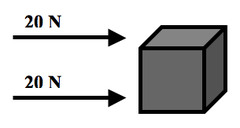
What is the resultant force?
40 N, Left
0 N, Balanced
400 N, Right
40 N, Right

What is the resultant force?
400 N, Up
400 N, Down
800 N, Up
800 N, Down

What is the resultant force?
17 N, Left
6N, Right
11N , Left
12N, Left

What is the resultant force?
40N, Left
40N, Right
0N, Balanced
75N, Right

What is the resultant force?
40 N left
0 N Balalnced
400 N right
40 N right


What is the resultant/ net force?
30 N left
25 N right
5 N left
55 N right
Which could be an example of an unbalanced force?
A plate sitting on a dining table
A ball at the top of a hill that is not moving
Earth orbiting the Sun
A football that has been thrown to the goal post.

What is the resultant/ net force?
400 N Up
400 N Down
- 400 N Down
800 N Down
A balanced force is only an object that is not moving.
True
False


All stationary (Still) objects have __________ forces on them.
unbalanced
balanced
high
If forces on an object are unbalanced, it will _______
make the object to move or change direction.
make it move at same speed.
it will remain still.
Forces acting on an object are said to be balanced, when
the forces are equal in size and are acting in opposite direction.
the forces are equal in size and are acting in same direction.
the forces are different in size and are acting in opposite direction.
The head of an arrow represent the __________ of force.
strength
length
direction
The sum of all forces acting on an object is called
unbalanced force.
balanced force.
resultant force.

What is the net force shown in the diagram?
50 N right
950 N
50 N left
500 N left

The resultant force is the . . .
force that acts in the opposite direction to motion.
overall force acting on an object.
unit for measuring force.

How do you calculate the resultant force when the forces on an object are acting in the same direction?
Add the forces together.
Subtract the smaller force from the larger force.

How do you calculate the resultant force when the forces on an object are acting in opposite directions.
Add the forces together.
Subtract the smaller force from the larger force.

Calculate the resultant force acting on the truck.
15 N to the right
15 N to the left
35 N to the right
35 N to the left

Calculate the resultant force acting on the ball.
10 N to the left
10 N to the right
0 N
5 N to the right

Calculate the resultant force acting on the paper aeroplane.
2 N to the left
2 N to the right
6 N to the right
6 N to the left

Calculate the resultant force acting on the block.
21 N to the left
21 N to the right
1 N to the left
1 N to the right

Calculate the resultant force acting on the parachute.
19 N upwards
19 N downwards
5 N upwards
5 N downwards

Calculate the resultant force acting on the boat.
200 N to the left
200 N to the right
400 N to the right
400 N to the left

Calculate the resultant force acting on the car.
105 N to the right
105 N to the left
35 N to the left
35 N to the right

Calculate the resultant force acting on the kite.
40 N upwards
40 N downwards
64 N downwards
64 N upwards

Calculate the resultant force acting
on the parachute.
85 N upwards
85 N downwards
215 N upwards
215 N downwards

Calculate the resultant force acting on the car.
82 N to the right
82 N to the left
226 N to the left
226 N to the right

Calculate the resultant force acting on the fish.
7 N to the left
7 N to the right
47 N to the left
47 N to the right

The resultant force acting on the aeroplane is ...
484 N towards the left
484 N towards the right
664 N towards the right
664 N towards the left

The resultant force acting on the ball is ...
6 N upwards.
6 N downwards.
30 N downwards.
30 N upwards.

The resultant force acting on the balloon is ...
8 N towards the right.
18 N towards the right.
18 N towards the left.
8 N towards the left.

Calculate the resultant force
90N to the right
30N to the left
60N to the left
90N to the left

Calculate the resultant force
20N to the right
40N
30N to the left
20N to the left
What is the unit of force?
Newton (N)
Watt (W)
Joule (J)

