wayground logo

Free Printable Worksheets

NEW

Font size

S
M
L
XL
Worksheets

Carbon, Nitrogen and Water cycles

Total questions: 42

Worksheet time: 44mins

Name
Class
Date
1.

What process occurs when tiny water droplets cling together in the atmosphere?

a)

clouds

b)

evaporation

c)

condensation

d)

accumulation

2.

What is the role of the sun in the water cycle?

a)

provide heat energy for evaporation

b)

provide heat energy for condensation

c)

dry out the soil for runoff to occur

d)

provide thermal energy for accumulation

3.

What do we call water in its gas state?

a)

rain

b)

snow

c)

ice

d)

water vapor

4.

If groundwater reaches earth's surface, how does it reenter the water cycle?

a)

by transpiration

b)

by evaporation

c)

by accumulation

d)

it can't

5.

The water cycle starts at....

a)

evaporation

b)

condensation

c)

precipitation

d)

it has not beginning or ending

6.

What process is show by letter A in the diagram?

a)

condensation

b)

evaporation

c)

accumulation

d)

precipitation

7.
Water in lakes and rivers that does not contain salt-
a)
recycled water
b)
new water
c)
salt water
d)
fresh water
8.
After condensation, the droplets of water in the clouds fall to the earth in different forms
a)
precipitation 
b)
condensation
c)
evaporation 
d)
ground water
9.
What part of the water cycle does this picture show?
a)
condensation
b)
precipitation
c)
evaporation
10.
What is the water cycle?
a)
the 3 forms of water
b)
the movement of water on, above, or below the surface of the Earth
c)
when water melts
d)
when clouds form
11.
What is it called when plants give off water vapor as a waste product?
a)
condensation
b)
evaporation
c)
sublimation
d)
transpiration
12.
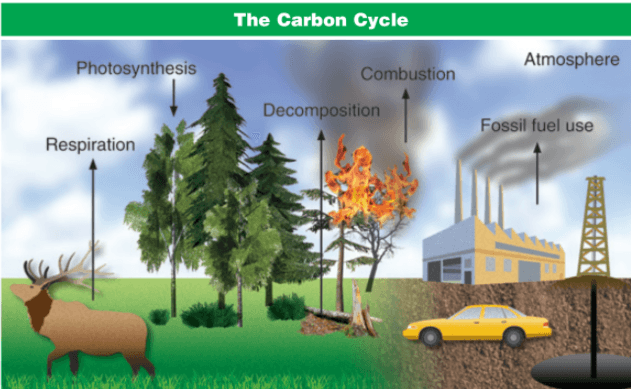
What does NOT produce carbon dioxide?
a)
Photosynthesis
b)
Burning Fossil Fuels
c)
Animal respiration
d)
Plants decaying
13.
Combustion is another word for __________.
a)
Transportation
b)
Respiration
c)
Fossil Fuels
d)
Burning
14.
Carbon can be found in...
a)
The atmosphere
b)
Soil
c)
Fossil fuels
d)
All of the above
15.
Which of the following removes carbon from the atmosphere?
a)
Combustion
b)
Respiration
c)
Photosynthesis
d)
Death
16.
oxygen is a gas produced by _ and used by  _ 
a)
plants and animals 
b)
photosynthesis and carbon dioxide 
c)
animals and plants 
d)
carbon dioxide and photosynthesis
17.

When humans EXHALE, we release ____________________.

a)

Oxygen

b)

Nitrogen

c)

Water

d)

Carbon Dioxide

18.

If the plant population decreased, the amount of carbon in the atmosphere would ____________________.

a)

Increase

b)

Decrease

c)

Stay the same

19.
Burning fossil fuel has which effect in the carbon cycle?
a)
It removes carbon dioxide from the atmosphere.
b)
It puts carbon dioxide under the ground.
c)
It adds carbon dioxide to the atmosphere.
d)
It has no effect in the carbon cycle.
20.

Since the mid- 1800's, _____________ activity has significantly altered the carbon cycle.

a)

animal

b)

plant

c)

unknown

d)

human

21.

Burning fossil fuels has raised the concentration of ___________ in the atmosphere.

a)

oxygen

b)

rain

c)

carbon

d)

nitrogen

22.
Which one of these does not add CO2 to the atmosphere?
a)
cooking with gas
b)
planting trees
c)
burning wood
d)
riding in a bus
23.

An example of a fossil fuel is:

a)

Coal

b)

Oil

c)

Natural Gas

d)

All of the above

e)

None of the above

24.

What converts nitrogen gas into a usable form for plants and animals?

a)

bacteria

b)

rain

c)

fungi

d)

car exhaust

25.

The process in which nitrogen circulates and is recycled is called

a)

The nitrogen cycle

b)

The carbon cycle

c)

The water cycle

d)

The phosphorus cycle

26.

Organisms that need nitrogen to survive.

a)

only plants

b)

only animals

c)

only bacteria

d)

all living things

27.

How is nitrogen "fixed" into a usable form for plants?

a)

Through action of bacteria only

b)

Through lightning only

c)

Through action of bacteria and lightning

d)

Through photosynthesis

28.

How do animals get the nitrogen they need?

a)

From the air they breathe

b)

From the water they drink

c)

From the food they eat

d)

From the sun

29.

Gas that makes up 78% of our atmosphere.

a)

Oxygen

b)

Nitrogen

c)

Hydrogen

d)

Carbon Dioxide

30.

What is the formula for atmospheric nitrogen?

a)

N

b)

N2

c)

NH3

d)

NO3

31.
Plants and animals need nitrogen to make __________.
a)
Protein
b)
Carbohydrates
c)
Lipids
d)
Minerals
32.

True or False. The nitrogen in the atmosphere is in the right form for living things to use.

a)

True

b)

False

33.

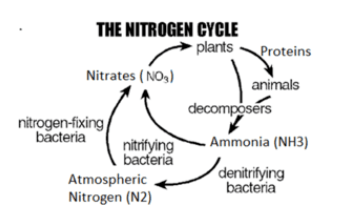
According to this diagram, plants use nitrogen to make _________________________

a)

bacteria

b)

animals

c)

proteins

d)

decomposers

34.
Organisms that break down dead plants & animals and release nitrogen back into atmosphere...
a)
bacteria
b)
plants
c)
animals
d)
producers
35.
What happens when organisms die and decay? 
a)
Their bodies are lifted up
b)
Their nitrogen returns to the soil
c)
they keep their nitrogen
d)
They stay on earth forever
36.

Which nitrogen cycle process is occurring when plant roots absorb ammonium ions and nitrate ions for use in making molecules such as DNA, amino acids, and proteins?

a)

nitrogen fixation

b)

nitrification

c)

denitrification

d)

ammonification

e)

assimilation

37.

Which nitrogen cycle process is occurring when bacteria convert ammonium to nitrite and then into nitrate?

a)

nitrogen fixation

b)

nitrification

c)

denitrification

d)

ammonification

e)

assimilation

38.

Which of these nitrogen cycle processes takes nitrogen from its largest reservoir?

a)

nitrogen fixation

b)

nitrification

c)

denitrification

d)

ammonification

e)

assimilation

39.
Plants and animals cannot use nitrogen directly from the air.
a)
True
b)
False
40.
After plants and animals contain nitrogen, what puts it back into atmosphere and soil?
a)
decomposition
b)
precipitation
c)
condensation
d)
bacteria
41.
Which type of organism is responsible for recycling the remains of a dead plant or animal to the soil?
a)
Producer
b)
Consumer
c)
Decomposer
42.
A mushroom is a 
a)
producer
b)
consumer
c)
decomposer