
 Worksheets
FEE SICKS
Total questions: 124
Worksheet time: 3hrs 58mins


Pressure depends on depth
1 Pa = 1N/m2
Torque = ________
Force / distance
Force × distance
Distance / Force
Force / Area
The Kinetic Theory of Matter states that...
matter is made of small particles that are in constant motion
matter is made of small particles that never move
matter is made of large particles that sometimes move
When a solid is heated it's particles begin to vibrate with energy
true
false
What is the melting point?
Temperature solid changes to gas
Temperature liquid changes to gas
Temperature solid changes to liquid
Evaporation is when liquid particles get enough energy they begin to escape
True
False
What is the boiling point?
The temperature a gas changes to a liquid
The temperature a liquid changes to a gas
The temperature a solid changes to a liquid
What is sublimation?
When a solid changes to a liquid
When a solid changes to a gas
When a gas changes to a solid
Solids are effected a lot by pressure
True
False
What happens when pressure is applied to a container of gas?
The particles expand
The particles vibrate
The particles get closer together
A gas can change to a liquid if a lot of pressure is applied
True
False
Choose the correct statement(s) about how pressure can effect changes of states of matter
If pressure if lower, you need a higher temperature to change the state of matter
If the pressure is higher, you need a higher temperature to change the state of matter
If pressure if lower, you need a lower temperature to change to state of matter
In some substances, the melting point increases with the increase in pressure
True
False
Pressure does not affect the boiling point or melting point of substances
True
False
Liquid pressure is because of the forces between the liquid particles and the _________ of the container.
Volume
Mass
Surface
Density
When divers return to the surface of water quickly, the pressure is ________.
Increased
Decreased
Not changing
The pressure in a liquid or gas is measures by a _________.
Viscosity
Pressure Plate
Pressure Gauge
Pressure Counter
The pressure exerted by a liquid
increases with depth.
decreases with depth.
is constant
first increases and then decreases.
The pressure of the water at the bottom of a pond is ___ at the surface of the pond.
either lower or higher
higher than
same
lower than
Which of the following does not affect the pressure beneath the surface of a liquid?
Strength of the gravitational field
Area of the liquid surface
Density of the liquid
Depth of the liquid

The diagrams show, to the same scale, the vertical sections of a set of circular vessels, each containing the same depth of water.
The water exerts the same pressure on the base of each vessel.
The water exerts the greatest pressure on the base of vessel S.
The water exerts the greatest pressure on the base of vessel P.
The water exerts the same force on the base of each vessel.
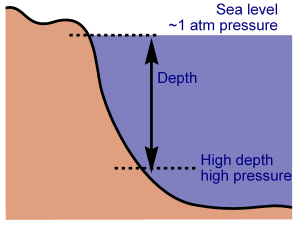
When you increase your depth under water, the water pressure on your body
increases
decreases
stays the same

Diagram shows the design of a dam. Why does the thickness of the dam increase with its depth?
The design of this structure is stronger.
Water pressure increases with depth.
The cost of construction is lower.
Water pressure acts uniformly in all directions.
Which of the following does not affect the pressure beneath the surface of a liquid?
Strength of the gravitational field
Area of the liquid surface
Density of the liquid
Depth of the liquid
pressure acts on all direction
true
false
the deeper the object is, the______________
low pressure on the object
more pressure on the object

which hole has the longest distance?
highest one
the middle one
the deepest one
all of them have the same distance

which shape has the greatest pressure?
Shape A
Shape B
Shape C
Shape D
All of them have the same pressure

which liquid has the greatest density?
oil
water
another name for liquids and gases is
gases
liquids
fluids
water
pressure
The pressure exerted by a liquid
increases with depth.
decreases with depth.
is constant
first increases and then decreases.
The pressure of the water at the bottom of a pond is ___ at the surface of the pond.
either lower or higher
higher than
same
lower than
The diagrams show, to the same scale, the vertical sections of a set of circular vessels, each containing the same depth of water.
The water exerts the same pressure on the base of each vessel.
The water exerts the greatest pressure on the base of vessel S.
The water exerts the greatest pressure on the base of vessel P.
The water exerts the same force on the base of each vessel.
Liquid pressure is because of the forces between the liquid particles and the _________ of the container.
Volume
Mass
Surface
Density
When divers return to the surface of water quickly, the pressure is ________.
Increased
Decreased
Not changing
The pressure in a liquid or gas is measures by a _________.
Viscosity
Pressure Plate
Pressure Gauge
Pressure Counter
The pressure exerted by a liquid
increases with depth.
decreases with depth.
is constant
first increases and then decreases.
The pressure of the water at the bottom of a pond is ___ at the surface of the pond.
either lower or higher
higher than
same
lower than
Which of the following does not affect the pressure beneath the surface of a liquid?
Strength of the gravitational field
Area of the liquid surface
Density of the liquid
Depth of the liquid
The diagrams show, to the same scale, the vertical sections of a set of circular vessels, each containing the same depth of water.
The water exerts the same pressure on the base of each vessel.
The water exerts the greatest pressure on the base of vessel S.
The water exerts the greatest pressure on the base of vessel P.
The water exerts the same force on the base of each vessel.
When you increase your depth under water, the water pressure on your body
increases
decreases
stays the same
Diagram shows the design of a dam. Why does the thickness of the dam increase with its depth?
The design of this structure is stronger.
Water pressure increases with depth.
The cost of construction is lower.
Water pressure acts uniformly in all directions.
Which of the following does not affect the pressure beneath the surface of a liquid?
Strength of the gravitational field
Area of the liquid surface
Density of the liquid
Depth of the liquid


Which statement BEST describes the relationship between the weight and mass of an object?
If mass increases, weight will decrease.
Doubling mass reduces weight by half.
An increase in mass will not affect weight.
If mass increases, weight will increase.
A spring scale is used to measure weight. Which of the following does it measure?
The force of gravity on an object.
The amount of matter in an object.
The composition of an object.
The average density of an object.
What happens to the mass and weight of an object that is launched into space, where the pull of gravity is less?
The mass decreases while the weight stays constant.
The mass stays constant while the weight decreases.
The mass stays constant while the weight increases.
The mass increases while the weight decreases.
Nick is preparing a solution and needs to measure the mass of some copper sulfate. Which one of the objects should he use to measure MASS?
Electric Scale
Ruler
Triple Beam Balance
Graduated Cylinder
Jen is explaining the difference between weight and mass to her sister. In comparing the two, which of the following could Jen use to CORRECTLY describe the weight of an object?
Weight is the same everywhere in space.
Weight is how much matter is in an object.
Weight is the amount of gravitational pull on an object.
Weight is not impacted by the force of gravity.

15 cm3
50 cm3
150 cm3
180 cm3
Density is a physical property of matter and can be used to classify substances. Density is calculated by which of the following?
d=v/m
d=m/v
d=w/v
d=m/w

303.4 g
370.4 g
373.0 g
373.4 g

2.5 g/cm3
25 g/cm3
250 g/cm3
2,500 g/cm3
Based on the data for the four samples, determine which of the following substances has the greatest density.
Sample 1: volume = 15 cm3, mass =30 g
Sample 2: volume = 20 cm3, mass = 66 g
Sample 3: volume = 3 cm3, mass = 12 g
Sample 4: volume = 48 cm3, mass = 100 g


What type of lever
First Class Lever
Second Class Lever
Third Class Lever

What class lever does this picture show?
1st
2nd
3rd

What class lever does this picture show?
1st
2nd
3rd

What class lever does this picture show?
1st
2nd
3rd

What is the IMA of the lever?
3
2
4
1

What is the AMA of the lever?
1
2
3
4

What is the efficiency of the lever?
66%
82%
90%
150%

Which lever gives you the largest IMA?
A
B
C

Which lever would be the easiest to lift the load?
A
B
C

Which of the levers would have the largest IMA?
A
B
C

Which of the levers would be the easiest to lift the load?
A
B
C

Which lever has the largest IMA?
A
B
C

Which lever would be the easiest to lift the load?
C
A
B

Which lever has an IMA of more than one?
C
A
B

Which lever has an IMA of less than one?
A
B
C

First class levers can have an IMA of _________________.
less than 1
more than 1
exactly 1
all of the above

Second class levers can have an IMA of ______________.
more than one
exactly one
less than one
all of the above

Third class levers can have an IMA of _____________.
less than 1
exactly 1
more than 1
all of the above


What is the unit of moment f force?
N
m
Nm
N/m
The moment of force defined as the product of....
the force and the acceleration
the force and the perpendicular distance
the force and the velocity
the force and the perpendicular distance from pivot
State the principle of moments.
When a system is in equilibrium, the sum of the total clockwise moment is equal to the sum of the total anti-clockwise moment about the same pivot.
When a system is in equilibrium, the sum of the total clockwise moment is greater the sum of the total anti-clockwise moment about the same pivot.
When a system is in equilibrium, the sum of the total clockwise moment is less than the sum of the total anti-clockwise moment about the same pivot.
When a system is in equilibrium, the sum of the total clockwise moment is equal to the sum of the total anti-clockwise moment about the different pivot.

What is the formula for moments?
Force = Distance x time
Moment = Force ÷ distance
Moment = Force x distance
Force = distance x Moment
When an object is in equilibrium, which equation is true?
Clockwise moment = anticlockwise moment
Clockwise moment + anticlockwise moment = 0
Clockwise moment / anticlockwise moment = 0
Clockwise moment + anticlockwise moment = resultant force
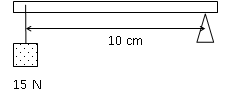

Which statement is correct?
All the forces are equal in size.
The resultant force on the beam is in the opposite direction to the resultant turning effect.
The resultant force on the beam is zero and the resultant turning effect on the beam is zero.
The total upward force is twice the total downward force.
The point through which the whole weight of the body acts is called
Inertial Point
Center of gravity
Centriod
Central point
Where will be the centre of gravity of a uniform rod lies ?
At its end
At its middle point
At its centre of its cross sectional area
Depends upon its material
What is one way you might increase the stability of an object?
Lower the center of gravity
Raise the center of gravity
Increase the height of the object
Shorten the base of the object
Which one describe the point through which the whole weight of the body acts?
Inertial Point
Center of gravity
Centriod
Central point

