wayground logo

Free Printable Worksheets

NEW

Font size

S
M
L
XL
Worksheets

2023 Stars and Planetary Motion

Total questions: 36

Worksheet time: 30mins
Name
Class
Date
1.
Planets orbit the Sun in a shape called a(n)
a)
circle
b)
ellipse
c)
focus
d)
perihelion
2.
An ellipse is drawn around two points called
a)
aphelion
b)
perihelion
c)
foci
d)
axis
3.
When a planet orbits the Sun, one of the foci of the elliptical orbit is 
a)
the axis
b)
the perihelion
c)
the center
d)
the Sun
4.
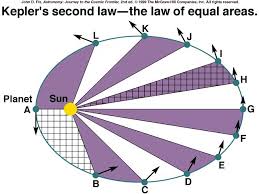
Where is the planet moving faster
a)
Position A to B
b)
Position B to C
c)
Position H to I
d)
Position I to J
5.
What is true about the area between points A, B and the Sun, and the area between points H, I and the Sun?
a)
The area between A, B and the Sun is the largest.
b)
The area between H, I and the Sun is the largest
c)
Both areas are equal in size
d)
There is not enough information to determine the areas
6.
A planet moves __________ when it is farthest from the sun.
a)
faster
b)
slower
7.
Two factors effecting the magnitude of the force of gravity between 2 objects are...
a)
mass and distance 
b)
mass and matter
c)
distance and weight 
d)
weight and mass
8.
What are the reasons for the season?
a)
Earth's tilt & rotation
b)
Earth's tilt & revolution
c)
Earth's rotation & rovolution
d)
Earth's tilt & resolution
9.

In winter, the axis of the earth in the Northern Hemisphere is pointed away or toward the sun?

a)

towards

b)

up

c)

down

d)

away

10.

What seasons are the hemispheres in at location A?

a)

Northern Hemisphere (Summer)/ Southern Hemisphere (Winter)

b)

Northern Hemisphere (Fall)/ Southern Hemisphere (Winter)

c)

Northern Hemisphere (Spring)/ Southern Hemisphere (Fall)

d)

Northern Hemisphere (Winter)/ Southern Hemisphere (Summer)

11.

What seasons are the hemispheres in at B?

a)

Northern Hemisphere (Summer)/ Southern Hemisphere (Winter)

b)

Northern Hemisphere (Fall)/ Southern Hemisphere (Spring)

c)

Northern Hemisphere (Spring)/ Southern Hemisphere (Fall)

d)

Northern Hemisphere (Winter)/ Southern Hemisphere (Summer)

12.

What seasons are the hemispheres in at C?

a)

Northern Hemisphere (Summer)/ Southern Hemisphere (Winter)

b)

Northern Hemisphere (Fall)/ Southern Hemisphere (Spring)

c)

Northern Hemisphere (Spring)/ Southern Hemisphere (Fall)

d)

Northern Hemisphere (Winter)/ Southern Hemisphere (Summer)

13.

Which part of the Earth is receiving the most direct Sunlight?

a)

Northern Hemisphere

b)

Southern Hemisphere

c)

Polar Hemisphere

d)

MidAtlantic Hemisphere

14.

Which part of the Earth is receiving the the least direct Sunlight?

a)

Northern Hemisphere

b)

Southern Hemisphere

c)

Polar Hemisphere

d)

MidAtlantic Hemisphere

15.

Kepler's Second Law states

a)

objects attract other objects with a force that is directly proportional to the product of their masses

b)

the square of the ratio of the periods of any two planets revolving around the Sun is equal to the cube of the ratio of their average distance from the Sun

c)

An imaginary line joining a planet and the sun sweeps out an equal area of space in equal amounts of time.

d)

Planets move about the Sun in an elliptical orbit with the Sun at one of the foci.

16.
The moon and other satellites rotate around the earth. Identify the force that keeps these satellites in orbit.
a)
gravity
b)
friction
c)
a strong force
d)
electromagnetic force
17.

What is the name of the cloud that a star is formed in?

a)

Nebula / Stellar Nursery

b)

Supernova

c)

Main Sequence

d)

Dwarf

18.

When a Red Giant runs out of fuel, it become a:

a)

Supernova

b)

Solar Nebula/stellar nursery

c)

White Dwarf

d)

Main Sequence Star

19.
After the main sequence, a low mass star becomes a
a)
black dwarf
b)
protostar
c)
red giant
d)
supergiant
20.

Low-mass stars like our Sun will never explode.

a)

True

b)

False

21.

Luminosity is

a)

The measure of brightness of a star.

b)

The temperature of a star.

c)

The mashing of atoms to create heat and light.

22.

Energy is generated in the core of the star as hydrogen atoms fuse to become helium atoms.

a)

Nebula

b)

Novas

c)

Main Sequence Stars

d)

Giant

23.

Third stage of a star; Almost all of the hydrogen atoms within its core have fused into helium atoms.

a)

Giant and Supergiant

b)

Main Sequence Stars

c)

White Dwarf Star

d)

Supernova

24.

Final stages of a star; Star loses its outer gases, revealing a core.

a)

Black Hole

b)

White Dwarf Star

c)

Supernova

d)

Nebula

25.

When an iron core is reached gravity takes over and a(n) _________ occurs.

a)

black hole

b)

neutron star

c)

explosion

d)

supernova

26.
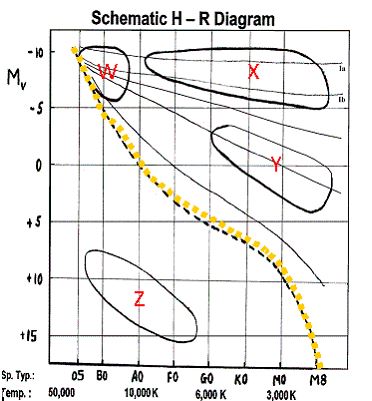
What else does the H-R Diagram tell us besides the luminosity and temperature?
a)
Color and size
b)
Location and distance from Earth
c)
Constellation structures
27.
Which category is our Sun located in?
a)
White Dwarfs
b)
Supergiants
c)
Main Sequence
d)
Giants
28.
The category that contains the most stars is...
a)
Main Sequence
b)
Supergiants
c)
Giants
29.
Analyze this HR Diagram. Which group of stars is considered to have lower than average luminosity as well as a higher than average temperature?
a)
Giants
b)
Main Sequence
c)
White Dwarfs
d)
Super Giants
30.
Analyze this HR Diagram. Which group of stars is considered to have higher than average luminosity as well as a lower than average temperature?
a)
Giants
b)
Main Sequence
c)
White Dwarfs
d)
Super Giants
31.
Which of these observations of Proxima Centuri's Star is most likely accurate?
a)
Proxima Centuri's Star is less bright than the sun and has a surface temperature below 3,400 K
b)
Proxima Centuri's Star is less bright than the sun and has a surface temperature above 3,400 K
c)
Proxima Centuri's Star is brighter than the sun and has a surface temperature below 4,000 K
d)
Proxima Centuri's Star is brighter than the sun and has a surface temperature above 4,000 K
32.
In which region of the H-R Diagram would you be likely to find Blue Giants?
a)
W
b)
X
c)
Y
d)
Z
33.
In which region of the H-R Diagram would you be likely to find the oldest stars?
a)
W
b)
X
c)
Y
d)
Z
34.
In which region of the H-R Diagram would you be likely to find stars fusing hydrogen to make helium in their cores?
a)

W

b)

X

c)

Y

d)

The yellow dashed line

35.

In which region of the H-R Diagram would you be likely to find stars that are in equilibrium between fusion and gravity?

a)

W

b)

X

c)

Y

d)

The yellow dashed line

36.
In which region of the H-R Diagram would you be likely to find the brightest, reddest stars?
a)

W

b)

X

c)

Y

d)

The yellow dashed line